CSotD: 2 a.m. in the Sophomore Dorm
Skip to comments
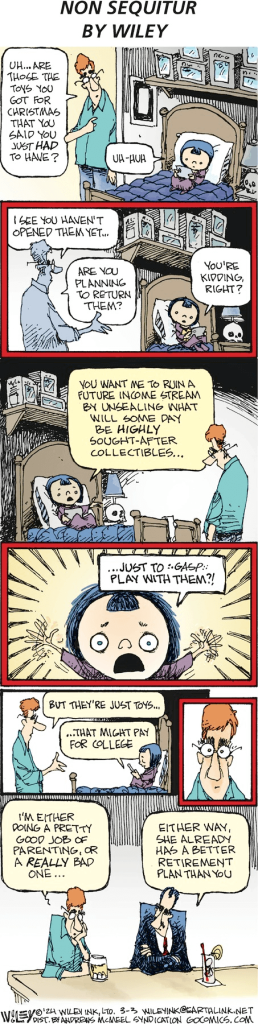
We’ll start with today’s Non Sequitur (AMS), a relatively gentle example of the sorts of ideas that emerge from the sophomore dorm at two in the morning.
But first, a definition of terms: As you may know, “sophomore” is a portmanteau of the Greek words for “wise” and “foolish.” Except that it isn’t. Here’s the Straight Dope on that. Still, it’s an excellent word to sport a bogus etymology!
I realized very early after arriving at college that sophomores were a source of puffed-up nonsense, proud to no longer be freshmen but without either the knowledge base or modesty of juniors, or, certainly, seniors.
Back in the days when many colleges housed students by class year, the sophomore dorms were where you would find these overly idealistic, overly self-assured geniuses debating high-sounding but astonishingly impractical concepts, often at 2 a.m. when the wisest of that wet-behind-the-ears lot had turned in for the night.
Relevant to Non Sequitur, the reason that first Superman comic is so valuable is that nobody set it aside.
“Collectibility” wasn’t a thing back then, and the notion of collectibility became self-canceling, because as soon as people began hoarding various items, they were no longer rare and thus no longer valuable.
Not Beanie Babies, not Trump NFTs and, no, not golden high-tops, either.
Granted, a $20 bill is only worth $20 because we all agree that it is. But the system behind that belief is a whole lot larger and stronger than the system which holds that an Emperor Star Wars action figure is worth anything at all.
You’d have to have a lot of Emperors in original, unopened boxes to pay for a single semester of college, much less get you to the profound wisdom of your sophomore year.
Juxtaposition of the Day
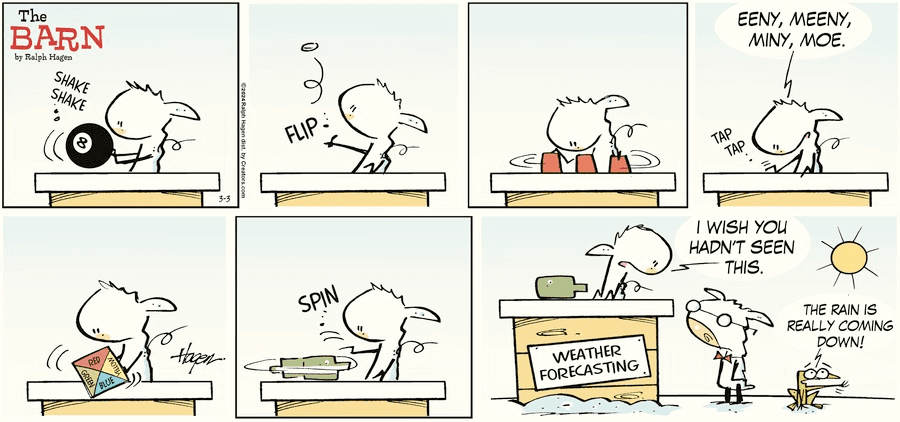
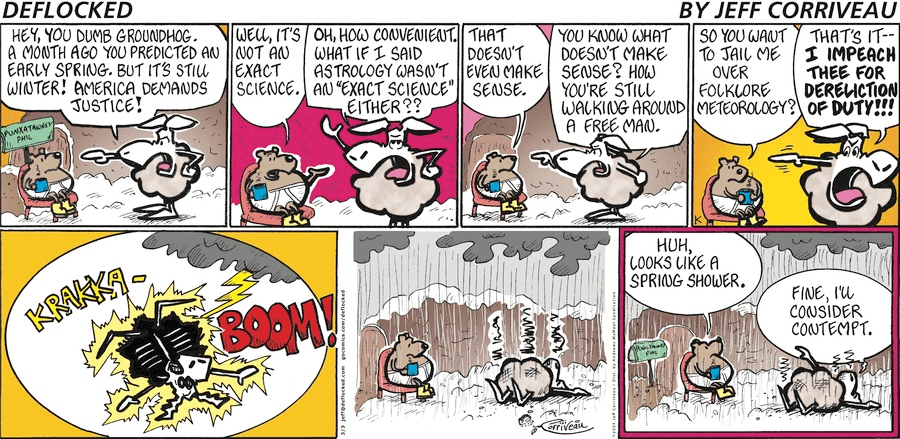
It’s ironic or appropriate or something that these examples of those who don’t understand meteorology are both sheep.
Charles Warner Dudley’s observation, “Everybody talks about the weather, but nobody does anything about it” dates back to 1884, a time when there wasn’t much you could do about it. The Galveston hurricane of 1900 sparked the birth of modern meteorology, because the development of faster communication had finally made prediction possible, if not perfect.
Only sophomores believe in perfection.
In 1963, my Earth Science classes did weather predictions, based on next-day delivery of national weather maps and on our classroom barometer. We did pretty well, without nearly the data that for-real meteorologists have at their disposal today.
The relevance to sophomoric logic being that current TV weatherfolks will lay out the facts and explain the variables and detail the potential outcomes and make their best predictions, but people still forget the six days they were “right” and dwell, instead, on the seventh day that one of those variables inserted itself and altered the likely outcome.
If you listen to how they explain their predictions, meteorologists are accurate, but people still harp on the idea that nobody knows what’s gonna happen tomorrow, a comfy old bit of faux wisdom passed down over the years.
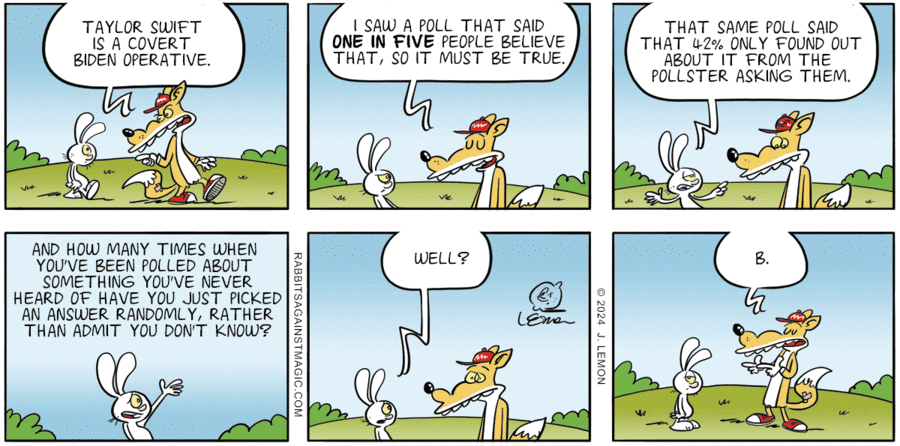
If it were only a matter of hoarding action figures and getting wet in rainstorms, it wouldn’t matter much. But as Rabbits Against Magic notes, we love polls and people who respond to polls love to give answers, and neither pollsters nor poll-takers seem as well-armed as the TV weatherperson.
Polls show this and polls show that, but I haven’t seen a poll yet that shows which people answer polls and which let it ring through to voicemail.
But I’ve seen the same information that Jonathan Lemon used in creating this cartoon, which indicates that people will volunteer answers about things they didn’t know existed until the pollster asked about it.
I’ve also been on the receiving end of push-polls, in which two or three innocent questions lead to one so loaded with target language that you know exactly who commissioned it and what they plan to discover people think.
The challenge for political cartoonists comes when analysis becomes prediction, because while people may be influenced by the language of polls, and claim to agree with things they’d never heard before they were asked, they may be similarly influenced by cartoons that raise propositions they hadn’t considered.
And, after all, that’s the point of political cartooning: To raise questions and attempt to influence opinions.
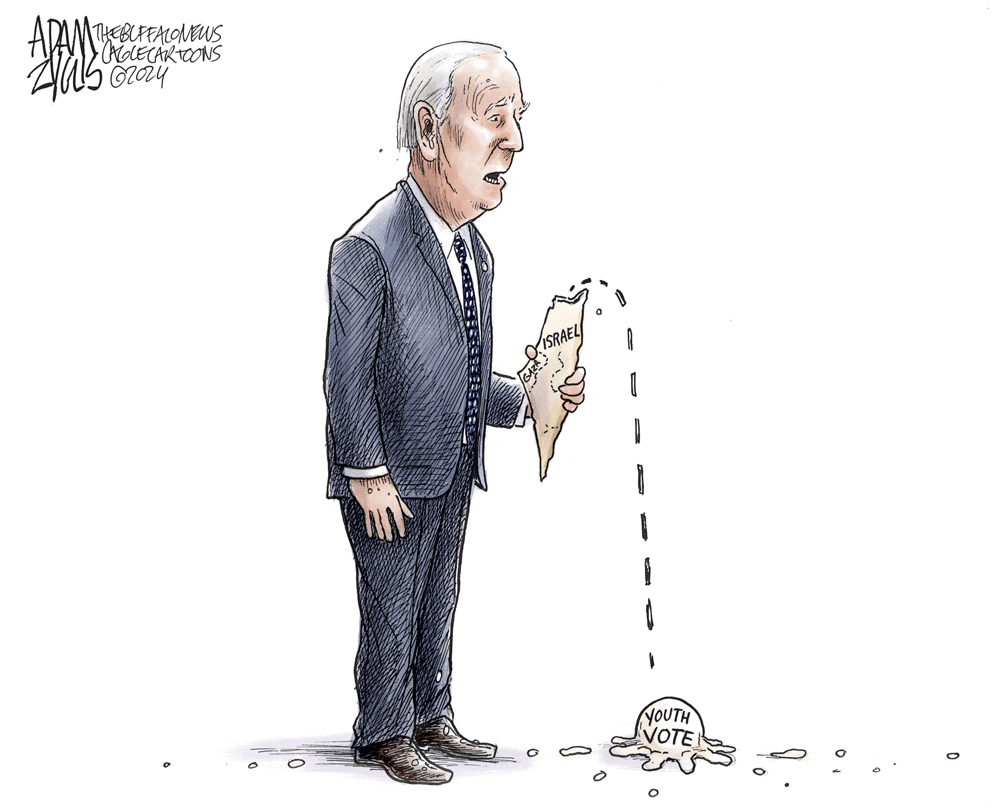
The problem arises when a point is unclear and persuades people in an unintended direction. For instance, Adam Zyglis is correct that Biden’s response to the Gaza Crisis is shaking the faith of young voters.
I think most who lean towards the Democrats are troubled by the seeming contradictions, and I think, too, that it’s natural for young people to expect transparent, consistent policies, while more experienced voters wait — uncomfortably — for concrete developments.
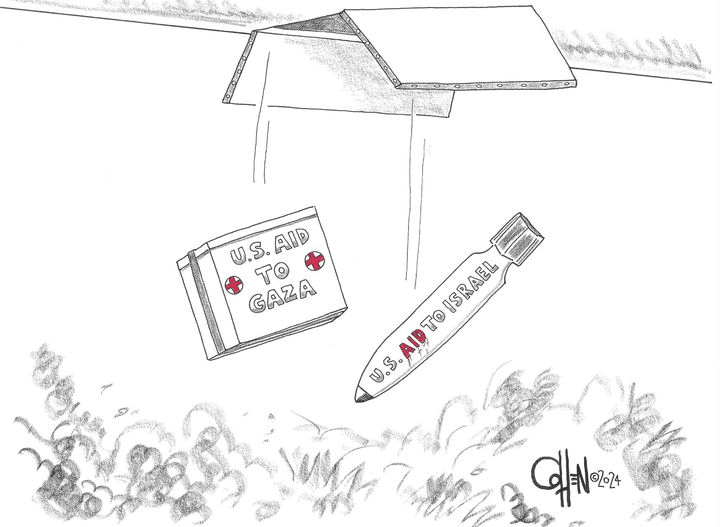
Yeah, I know, David Cohen: We’re still waiting, very uncomfortably.
However, there’s no proof that Biden has lost the entire youth vote, as the cartoon suggests, which raises the question of whether Zyglis’s cartoon — which makes use of the anti-Biden ice cream trope — is analyzing or attempting to persuade?
Both comprise the duty of cartoonists, but consider the Rabbits Against Magic peer-pressure factor of people agreeing to agree with something they hadn’t previously pondered.
By contrast, predicting rain won’t make it rain.

Matt Wuerker (Politico) attacks Biden’s candidacy, agreeing with the Hur Report that Biden is failing.
But Biden has always been a fumblemouth while thinking clearly, and there’s no indication his age has changed that. He’s only slightly older than his opponent, he exercises regularly and his health is good (as his recent physical indicates).
Plus he doesn’t intend, if elected, to unleash the military on protesters, deport hundreds of thousands of immigrants, increase costs of imported items, make transgender treatment illegal, increase use of fossil fuels, promote prayer in public schools and empower local police to shoot shoplifters.
His opponent in the 2024 Election does.
Meanwhile, the notion of replacing him at this stage is pure 2 a.m. in the Sophomore Dorm thinking. It’s totally impractical. It can’t happen.
And if it did happen, it would all but guarantee defeat of the substituted ticket, while an accompanying voter boycott would hand control of Congress to the MAGAts.
What sort of country would these sophomores find themselves living in by junior year?
(This song came out my sophomore year.)
Mike Peterson has posted his "Comic Strip of the Day" column every day since 2010. His opinions are his own, but we welcome comments either agreeing or in opposition.

Comments 16
Comments are closed.