Glen Baxter – RIP
Skip to comments
British cartoonist Glen Baxter has passed away.

Glen Baxter
March 4, 1944 – March 29, 2026
From WePresent in 2020 comes a wonderful account of the life and times of Glen Baxter by Liv Sidall:
Confusing us, forcing us to question our relationship with words, pictures, or even the format of books, makes him happy. Since Glen was a kid, he’s been fascinated by things that he couldn’t understand. “When I was a kid when I saw things I couldn’t understand, I was fascinated by that and I still am,” he says. “I want people to look at my work and go ‘what’s funny about this?’ You either get it or you don’t.” He likes the moment in which our brains have to suddenly work slightly harder to process something in front of us. His images offer us an image of something recognisable, then pulls the rug from underneath us with an entirely unrelated caption below it.
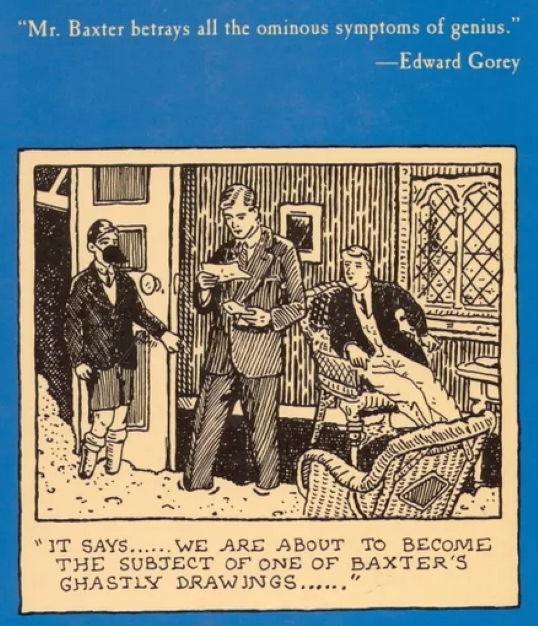
Glen Baxter, the Leeds-born artist whose deadpan ink drawings made absurdism look easy and pretension look ridiculous, has died. He was one of those rare figures who managed to make serious art out of the refusal to be serious, and in doing so built a body of work that influenced everyone from Edward Gorey to Salman Rushdie, while remaining cheerfully impossible to categorise…
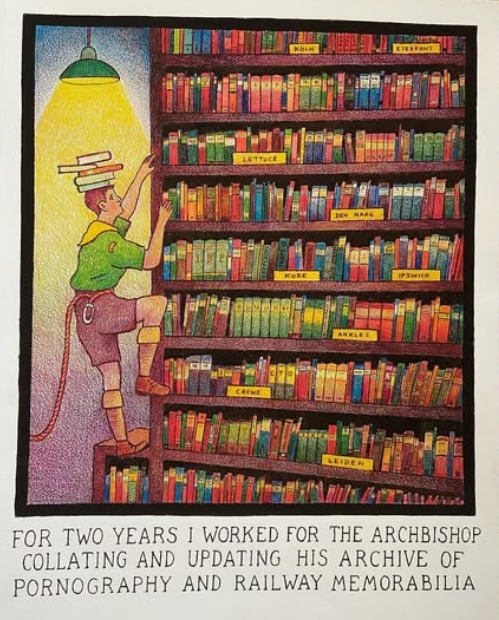
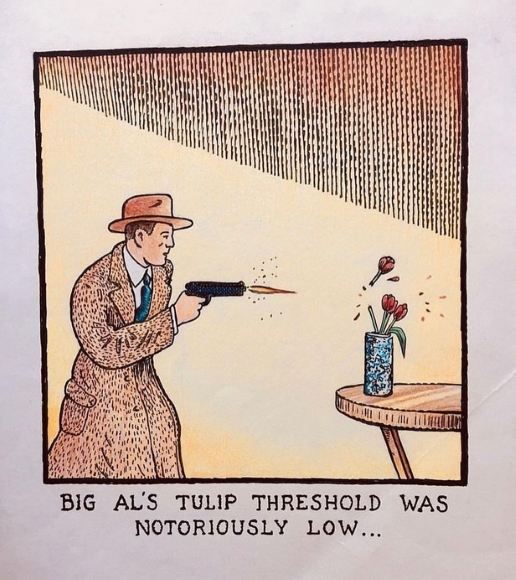
A minor surrealist and major seller of greetings cards, the artist Glen Baxter believed that “drawing is a form of electricity connecting one thing to another, sometimes, and hopefully, in surprising ways”. As such, he long had a strange preoccupation with tweed, one of the many artefacts redolent of Empire that he was to turn to account.
With his work appearing in The New Yorker, Vanity Fair and the Independent on Sunday, he found a worldwide market from the Eighties onwards for such captioned drawings as two tweedy men tied to posts in front of another: “There, as usual, was Edelson, delivering his post-structuralist analysis of the modern novel to the privileged few…”
As mentioned above among the magazines Baxter sold cartoons to was The New Yorker. His first cartoon (below left) for that magazine appeared in the May 8, 1989 issue, his latest in the April 6, 2026 issue on the newsstands now (below right).
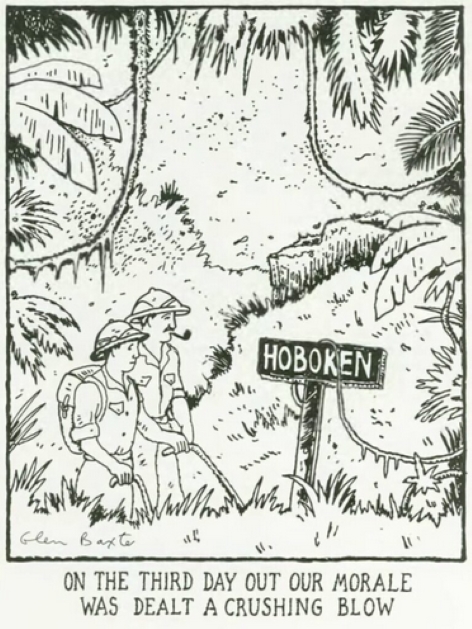
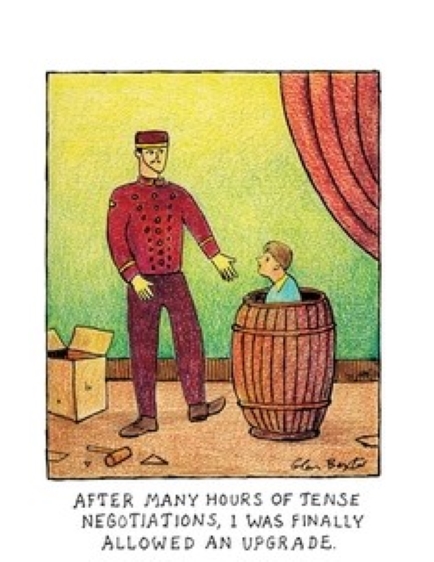
The Condé Nast Store displays dozens of Glen Baxter’s cartoons for The New Yorker.
Glen Baxter, alias Colonel Baxter, is a British contemporary artist, illustrator, and draughtsman. A representative of the surrealist movement, he creates comics-like figurative ink and crayon drawings that allude to social issues in a humorous way.
Glen Baxter started his career at the Victoria and Albert Museum where he taught from 1967 to 1974. It was during this time when he published his first poems and short stories in Adventures in Poetry magazine of New York City. Later that same year, the magazine featured his illustrations. One of his most popular artworks, ‘The Impending Gleam’, saw the publication in 1981…
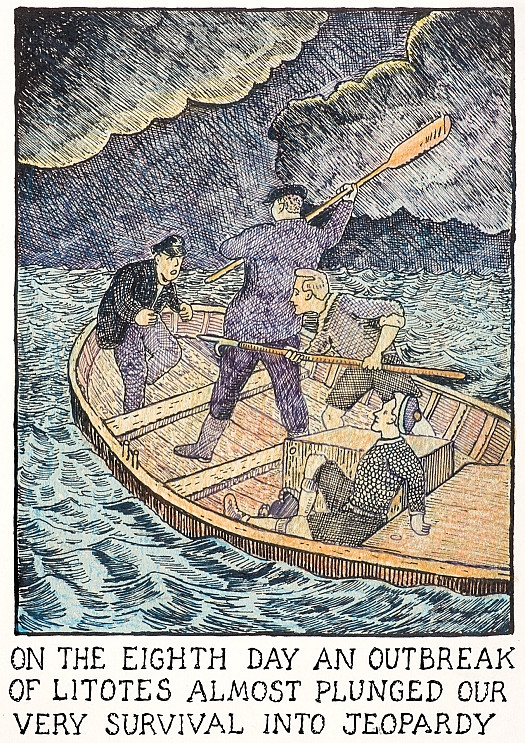
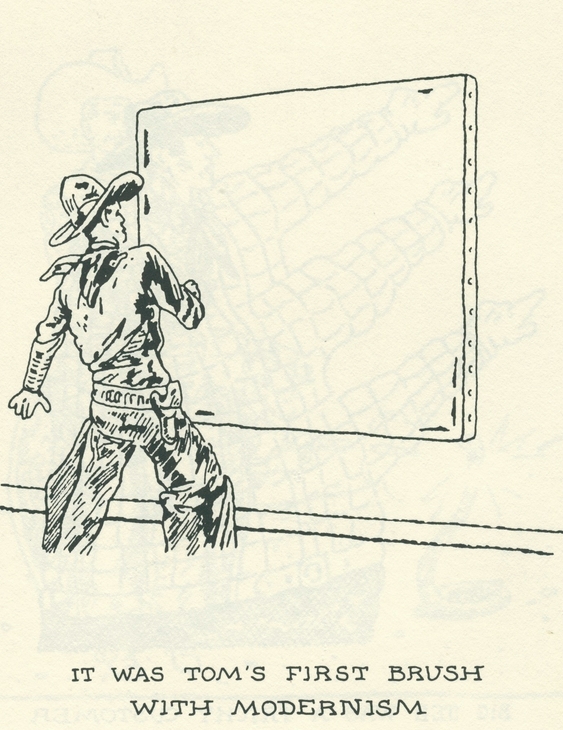
Upon returning to London from a trip to America in 1978, Glen began to combine words and images in the cartoon format that he has become renowned for today. Amongst Surrealist artists, Glen admires the combination of the absurd alongside Magritte’s ‘bland, academic, painterly style’. This influence is easily seen in his own work, as his mismatched visual art and captions leave the viewer wrong-footed, and often laughing. His work is also based on the style of much English children’s illustration of the thirties and forties, especially stories of school and adventure. He creates worlds in which dysfunctional families battle with Heath Robinson style contraptions, and where cowboys duel over Rothko paintings.
His illustrative work first appeared in 1979 with his collection of drawings titled Atlas, published by De Harmonie in Amsterdam. In 1980 London’s Institute of Contemporary Arts exhibited a small selection of his works and it was quickly picked up on in reviews by the Times and Guardian, leading to great attention in literary circles. Ever since he worked as a full-time artist, continuing to publish books across a variety of international publishing houses and exhibiting his artwork worldwide.
His notable editorial contributions include work for the New Yorker, Vogue, Vanity Fair and Le Monde. Many of his drawings are also widely available as greetings cards, and on merchandise such as ceramic plates and wristwatches.
From 2016 Emily Flake interviews Glen Baxter for The Comics Journal:
I loved the authority of the black line and realized that with a little tweaking I could create fragments of an absurdist narrative. I was reading Kafka and Raymond Roussel, so it just fell into place. So I had managed to avoid the trap of collage and felt liberated to draw in a way that seems to evoke this reassuring quality that NOTHING COULD POSSIBLY GO WRONG. Much like the work of Magritte… I’ve never looked back.
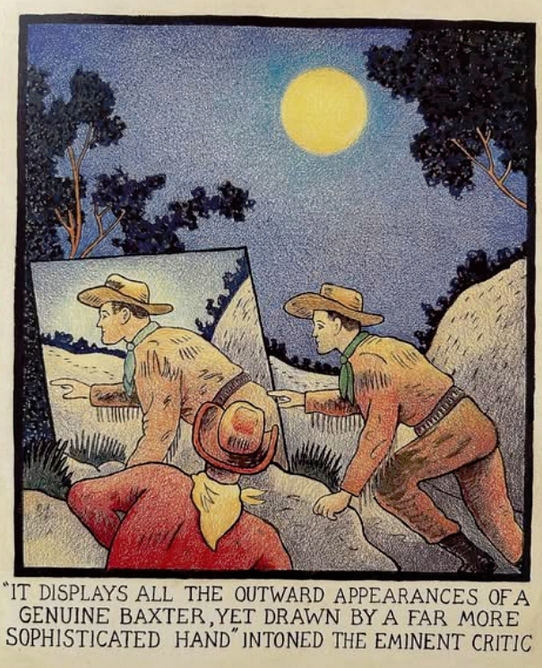
The Glen Baxter Artist Instagram page has thousands of examples of his weird cartoons and other ephemera.


Comments 1
Comments are closed.