CSotD: Keeping It Simple and/or Stupid
Skip to comments

As noted yesterday, drawing for Politico gives Wuerker more latitude in creating cartoons that make intellectual demands on people. This, however, is a good example of a cartoon that would do well in a general-circulation magazine in the category of “comforting the afflicted.”
I’m not sure it would be as effective in converting anyone to Wuerker’s POV, however, because it violates that rule lawyers live by, which is to never ask a question unless you already know the answer. More specifically, never ask an answer unless you know what the witness will answer.
It is an excellent set of “How can you be so dumb?” questions, and very much worth wide distribution, but it could produce some unwelcome surprise answers.
No one in this world, so far as I know—and I have searched the records for years, and employed agents to help me—has ever lost money by underestimating the intelligence of the great masses of the plain people. Nor has anyone ever lost public office thereby. The mistake that is made always runs the other way.
Mencken wasn’t a very pleasant person, and there’s nothing wrong with trying to make people think, except that, for all his faults, Mencken was right about this. The more complex your point, the more you risk being, as the comedians say, too smart for the room.
If your goal is to comfort and to rally the troops, go for it. If your goal is to convert, however, K.I.S.S.
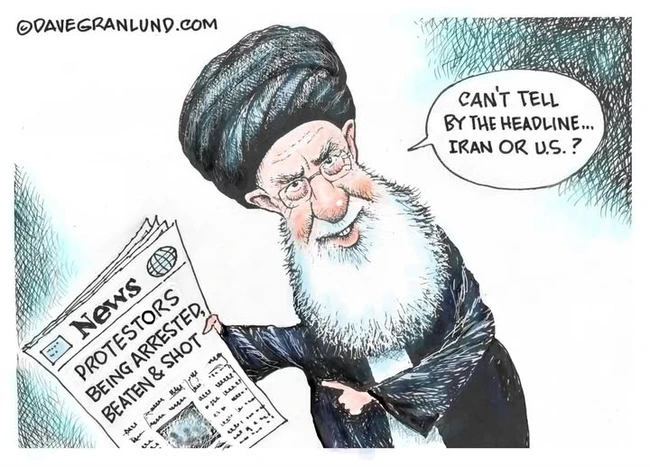
A good example from Dave Granlund. There are several cartoons floating around that compare Trump’s outrage over Iran’s crackdown on their protesters with his own unleashing of ICE on his own protesters. If you’ve heard about it at all, it’s pretty simple case of hypocrisy, or, at least, of a double-standard.
But Granlund boils it way, way down by having the mullah hold up a newspaper explaining the situation and then providing the point of the cartoon as plainly as is possible. You can’t always get away with being so elementary, but it works here and it’s certainly a case of K.I.S.S. in action.

“Simple” needn’t always come in small packages. Sorensen provides an extensive conversation here, with several examples of her argument against what turns out to be the “simple” part, which is that there is a lot of bafflegab surrounding white supremacist racism.
She boils down their high-falutin’ cover story by picking at it with very plain questions, and, of course, she knows where she’s going with it, but it’s hard to argue with the points she brings up.
However, as also noted here recently, Socrates kept things simple, but he always knew the conclusion he was soliciting.
And we know how things turned out for Socrates, which brings us to this:

I really like Horsey’s depiction. I’ve dealt with good cops and bad cops, and my respect for the good ones makes me dislike the bullies even more. My experience, too, suggests that Horsey is tapping into a rich vein here, because good women don’t like bad men.
Still, it’s an example of insult humor, which makes it more effective in comforting people who already agree with your values than it does in getting people to change theirs.

More effective is Brodner’s approach, which is the straightforward depiction of a particular piece of horror enacted in the streets of Minneapolis.

The photograph of this terrified woman being dragged from her car has had some circulation, but Brodner’s technique is to make sure more people see these things, and he adds her autism in his caption to emphasize the brutality of the moment.

Not to say we can’t get a little dark humor out of a bad situation, but Bagley isn’t going for conversions with this. He’s also not bothering to exaggerate: The brutality is very much a part of Trump’s war on immigrants, and it’s no secret.
The question here is whether anyone will be shocked into changing their mind, or if those who support the effort will agree with Dear Leader rather than be horrified by what Bagley has him say.
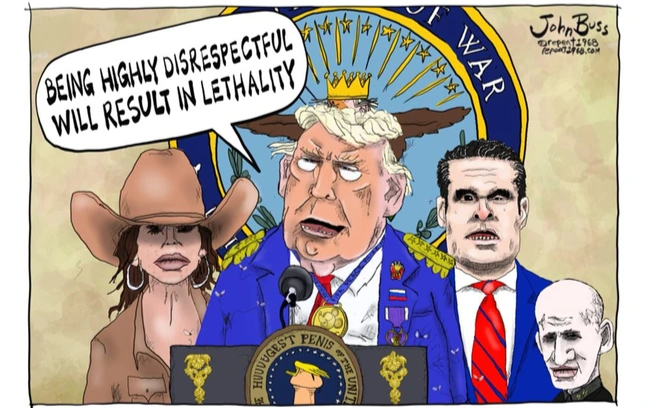
Buss also faces the issue of what readers know. Donald Trump genuinely did blame Renee Good for her own death, saying that she was disrespectful and thereby was asking for it, and warning that other people who were rude to ICE or other police would be to blame if they were shot and killed for disrespect.
Talk about keeping things simple!
But if you only watch Fox and Newsmax and OAN, you may not hear everything Dear Leader says, or it may be covered in enough fawning approval that the horror doesn’t come through. And chances are if you stick to those broadcast sources, you aren’t seeing any print sources that would carry a cartoon like this, and your on-line adventures may be sanitized by the algorithms you’ve established for yourself.
Our silos are strong and it takes craft rather than force to break through them.

The farce of María Corina Machado giving Dear Leader the medal from her Nobel Peace Prize has inspired cartoonists. She’d have probably given him a kidney if she thought it would help Venezuela, but only Trump thinks he received anything meaningful.
It reminded me of when Patriots owner Robert Kraft handed Putin his Super Bowl ring to inspect and Putin, thinking it was a gift, kept it. It didn’t change the outcome of the game, nor did it make Putin a member of the team nor did Machado’s gift turn Dear Leader into a winner.
Anderson’s cartoon — and a couple I’ve seen with the medal as a baby’s binkie — show the infantile fascination of a childish man-baby. It’s a use of simple ridicule that is hard to misinterpret.

Having written about business for several years, I understand the importance of an independent Fed, and I understand much of the commentary around Trump’s war on Jerome Powell. But it is somewhat complicated, and trying to explain it just leads a lot of people into deep weeds.
Mike Smith, however, reduces it to everything you need to know, assuming you want to know anything at all.
And not everybody does.
Mike Peterson has posted his "Comic Strip of the Day" column every day since 2010. His opinions are his own, but we welcome comments either agreeing or in opposition.

Comments 14
Comments are closed.