Angoulême Launches New Independent Comic Festival
Skip to comments
With the cancellation of the Angoulême International Comics Festival, the city of Angoulême has organized a new local, independent festival called Le Grand Off to be held January 29 through February 1, 2026, the same days as the cancelled international festival.
The four day festival will include 150 events be held throughout the city at 60 or so venues. There is an extensive program on their website. The festival will cap off with two awards presentations: the Prix Charlie Schlingo and the “Couilles au cul” which depending on your translation: “balls up your ass” or “balls of steel”. Charlie Schlingo was a French comics artist and illustrator. The “Couilles au cul” award for courage to a cartoonist who faces threats in their country. The award is a ceramic pair of testicles.
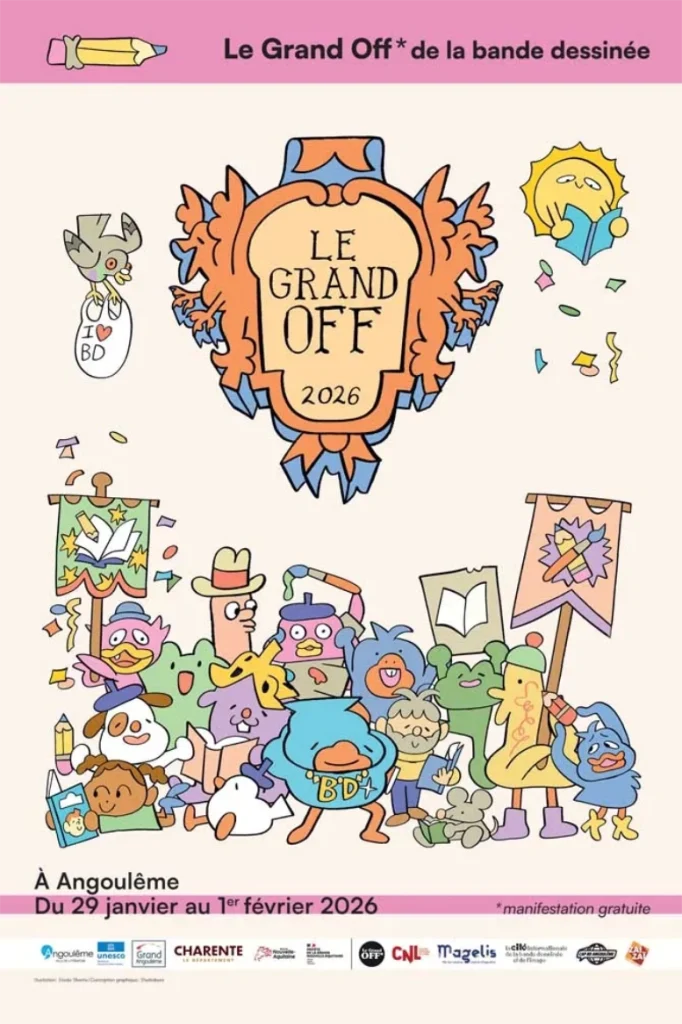
The Le Grand Off organization
The new organization is made up of local authors, publishers, collectives, associations, booksellers, businesses, cultural institutions, and students. The city has put up 1 million euros. Other financing came from the Grand Angoulême metropolitan area community, the Charente Department, the Nouvelle-Aquitaine Region, and the DRAC Nouvelle-Aquitaine (Regional Directorate of Cultural Affairs) to make the four day event possible.
The organization has defined three main goals of the new festival:
Since 1987, the Angoulême Comic Strip Off Festival has been an essential component of the “official” festival, which is currently suspended. The 2026 edition of the Off Festival has become the Grand OFF* of Angoulême Comic Strips with at least three objectives:
- To return to the source of the art. Celebrating comic strips means celebrating the authors who create and produce them, often under difficult conditions. The Grand OFF* aims to put artists back in the spotlight through events tailored to their needs, which showcase their work and allow them to truly connect with their audiences in a spirit of celebration, sharing, and free access.
- To maintain Angoulême’s status as the capital (center) of comic strips by respecting a spatiotemporal framework known worldwide and to ensure that local stakeholders reclaim this artistic and human heritage.
- The Grand OFF* also aims to be a laboratory for the future. How to organize an event that involves local stakeholders, an event that is transparent, respectful of gender equality, and that does not tolerate any sexist, racist, homophobic, transphobic, ableist, or other forms of discriminatory behavior or remarks. In short, an event with an ethical dimension. The Charter written by the co-organizers of the Grand OFF*, which is provided to you, opens the debate.

Comments 1
Comments are closed.