Reaction to Scott Adams’ Life and Death
Skip to comments
The reactions to Scott Adams‘ death, like the comments in our obituary, varied greatly depending on the point of view of those responding as whether they were or were not a fan of the cartoonist.
President Trump and MAGA were fans, but…
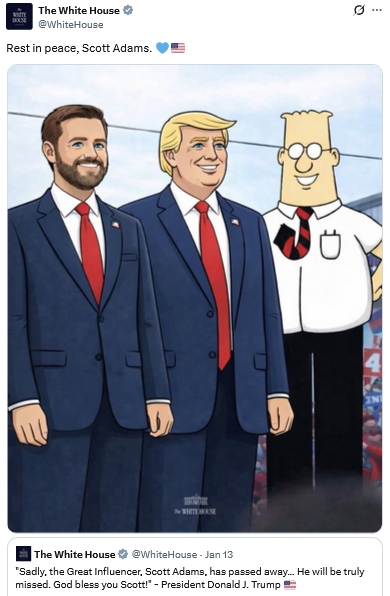
there had to be a better way to pay tribute to a cartoonist than with an A.I. generated image that shows Adams’ mouthless Dilbert character with a wide open-mouthed grin.
Headlines ranged from “beloved” to “disgraced.”
The first from Los Angeles Magazine mentions but gives short shrift to why the comic strip was dropped, while the second from People magazine has that event in their lead paragraph. People magazine and the author received flak from conservative (Just The News) media (Matt Walsh on X) about the headline and the article.
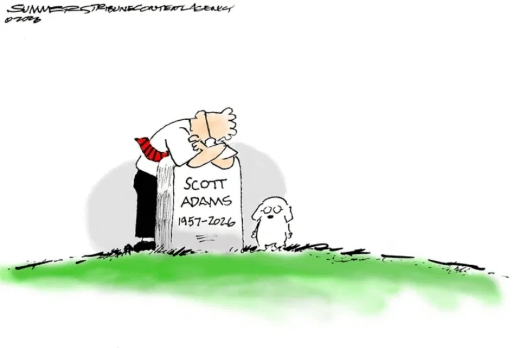

At AMAC, the conservative alternate to AARP, Adams’ fall from grace was attributed to “the left-wing cancel culture machine – then at the height of its power – had tried its best to destroy Adams and bully him into silence.” At Cartoon Brew, where the animated Dilbert was portrayed with a small mouth, they note that same circumstance as his “career ended in public disgrace after a series of racist remarks led to the collapse of his syndication and his effective exile from the mainstream comics and animation industries.”


Of course cubicle workers must be included in any Scott Adams remembrance.
At Fast Company Sarah Bregel writes:
Dilbert was created in 1989, and it broke new ground, offering a refreshing and pointed critique of white-collar work life. It became known for its ever-relatable digs about the drudgery of office culture and insufferable bosses, long preceding relatable movies and TV shows…
Lohmeyer says that the idea [about the annoyance of ‘middle management’] truly resonated with office workers, who posted the comics in their cubicles in the ’90s, or emailed them to coworkers.
A different take on those cubicles filled with clipped Dilbert strips comes from ‘Ride Theory’ via Sean Kleefeld:
In the 1990s, I worked as an office temp. I logged a lot of hours in a lot of different offices, and I had an instant and accurate way to sense how dysfunctional and toxic a workplace was as soon as I walked in.
I took note of how many Dilbert comics were pinned up, and where.
If I saw one or two Dilbert comics scattered around, I knew people had their gripes and complaints about their co-workers, but it was nothing too serious.
If virtually every cubicle had more than one Dilbert comic pinned up, I knew everyone working there disliked each other. The atmosphere probably wasn’t going to be too terrible for me as a temp, but I wouldn’t want to work there permanently…
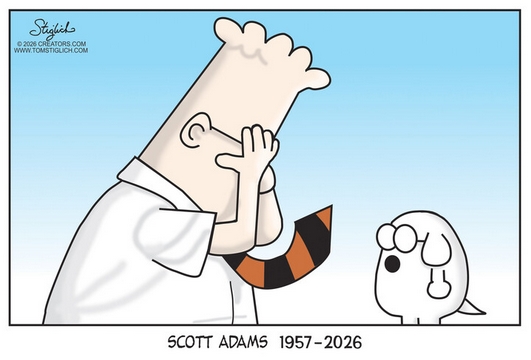
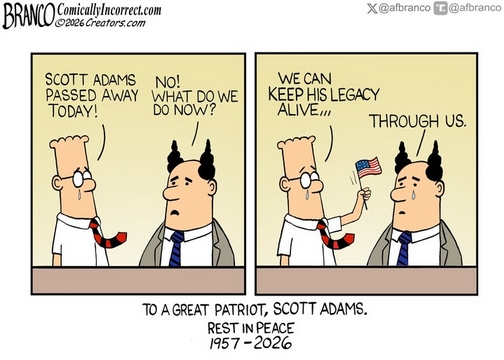
Opposing views.
Nitish Pahwa at Slate writes of Scott Adams with the headline and subhead (or here):
Scott Adams’ Life and Death Is a Cautionary Tale for the MAGA Age
While generations of fans may have loved Dilbert, its creator devolved into something unrecognizable as he embraced the MAGA era.
David Suissa at The Jewish Journal remembers Adams differently:
On Giving Happiness: How I Remember Scott Adams
Year after year, 365 days a year, his legions of fans would tune in every morning for “Coffee with Scott Adams,” which included the famous “simultaneous sip.”
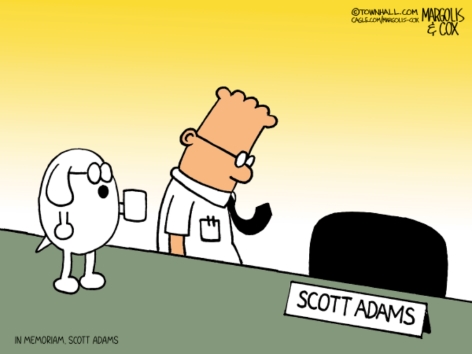
The Daily Mail obituary by Harriet Alexander gives a good accounting of Scott Adams and Dilbert.
Post Script:
As the ending of Calvin and Hobbes boosted Dilbert’s newspaper circulation, so Dilbert’s end did for another.
Whatever you may feel about Scott Adams, the fact is that one day Crabgrass was in 70 newspapers and the next day (thanks to him) it was in 800. I don’t know what you call that but I’m going to call it reparations.
I have a feeling he would absolutely HATE that.
feature image is a detail from a 2026 Dilbert Daily Desk Calendar promo


Comments 16
Comments are closed.