Adaptation or Original Work? – Updated with Rebuttal
Skip to comments
A controversy has occurred over two biographical books both of which are titled Charity & Sylvia.
The author of the 2014 non-fiction Charity & Sylvia, Rachel Hope Cleves, is accusing the author of the 2026 graphic novel Charity & Sylvia, Tillie Walden, of adapting the 2014 work for the 2026 graphic novel without proper credit and is asking that the graphic novel acknowledge the adaptation and give credit where credit is due and pay licensing rights.
Author Rachel Hope Cleves has written an open letter about the issue:
Charity and Sylvia’s story has been so deeply meaningful to so many people—their story has, without exaggeration, saved lives-that I’ve tried to be happy that Walden’s book is making their story more widely known, even if she chose to take my title and my cover design as well as my narrative and my research with only a single sentence of acknowledgement at the end of her book in her notes section. Walden’s illustrations and storytelling are wonderful, as I told her when she reached out to me during the writing process. It would take nothing away from her hard work to be honest about how it is built on my hard work. But in Walden’s publicity tour, she has repeatedly made the claim to have based her book on her extensive research in the archive without acknowledging that her book is, in fact, based on my book. This false representation demands response not only for my sake, but for the sake of all the hard-working historians out there whose work has similarly been taken without credit.
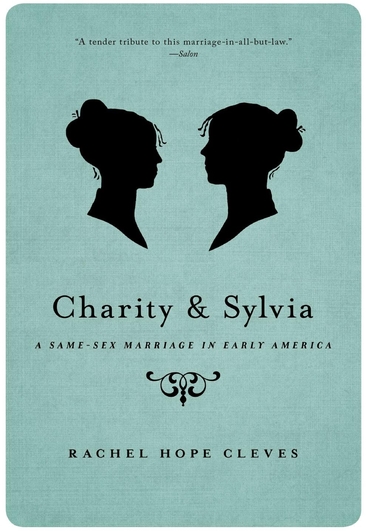
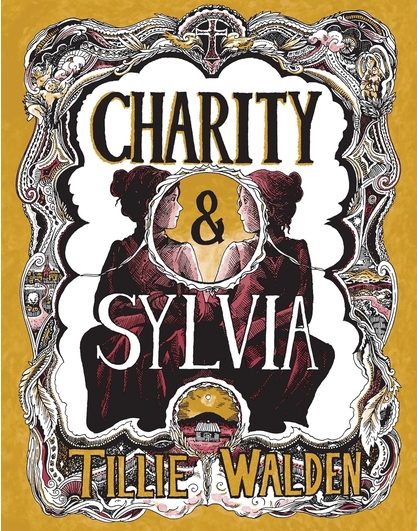
Samatha Puc of The Beat contacted Cleves to discuss the matter.
In the graphic novel’s afterword, Walden writes,
I was able to weave these short remembrances together into a story with the added context of over 900 letters (nearly all sent to them) and the formidable, endlessly informative history on their lives written by Rachel Hope Cleves titled Charity and Sylvia and published in 2014. Without these different angles from which to see them, my job would have been much harder. Their own papers rarely mentioned their childhoods, but because of the work of historian Hope Cleves and her research into that, I was able to describe their youth with a satisfying amount of detail.
This is the only time Cleves is mentioned in the graphic novel, but her name appears a total of 50 times on Walden’s website; in the notes for “Part Four,” [link added] Walden refers to Cleves as “our Holy Mother of knowledge.” Cleves was sent a link to the website after she posted her open letter, and says that it indicates to her that Walden’s book is a clear adaptation of hers.
Cleves tells The Beat:
“Drawn & Quarterly should have optioned my book and titled Tillie’s in a way that indicated it is an adaptation,” she continues. “They should have put me front and center. Not knocking her incredible work, but they should have openly acknowledged that it’s a graphic novel adapted from my book. … When you go to Tillie’s website where she lays out the process, it’s clear that it’s an adaptation, and that is at odds with Drawn & Quarterly’s marketing and packaging of the book. There’s no acknowledgment of me, my title, my cover, my story, or my research except for one sentence buried in the notes. Everything else is online.”
Neither Drawn & Quarterly nor Walden had responded to emails from The Beat at press time.
Drawn & Quarterly has now responded to Cleves’ accusations.
Shortly after sending our official comments to inquiring press, citing the many times Rachel Hope Cleves had been credited in Tillie Walden’s Charity and Sylvia—as well as online, on air, and in print—the accusations changed from no credit to charges of the Drawn and Quarterly book being an unauthorized adaptation. We would like to put forth a couple of points in defence of Tillie Walden, cartoonists, and comics scholarship in regard to the online mob that has formed this week on Bluesky who are currently sending us threatening emails, demanding that people destroy Tillie’s career, negative review bombing at various sites, telling stores and librarians not to carry the graphic novel, and more.
Firstly, Tillie did not “illustrate” Cleves’s 2014 book, Charity and Sylvia: A Same-Sex Marriage in Early America. Secondly, Comics are not a “derivative” form. Thirdly, Nonfiction graphic novels are not “illustrated adaptations” of source materials. Number four, Cartoonists do research of a scholarly nature. Number five, Nonfiction cartoonists are protected by the same copyright provisions as academics and nonfiction writers, provisions that account for facts and the expression of facts. Number six, Tillie was in touch with Cleves in April 2025 as she sent her a manuscript a year before publication stating the Museum had already made edits, to which Cleves replied with a single edit/comment as well as words of praise: quote “I’m already blown away by the historicity of it, and by the fullness of the characterization, and by the art, of course.” end quote. And finally, Please see the Henry Sheldon Museum of Vermont History statement on Tillie’s book and research on their website…
Comments 2
Comments are closed.