CSotD: The Ould Orange Recorder
Skip to comments
(Brevity)
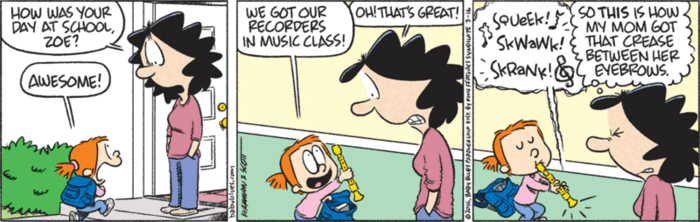
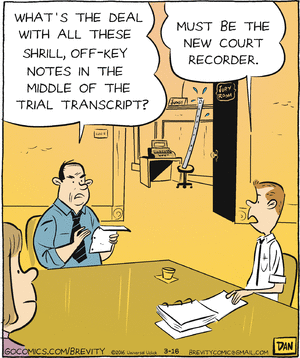
We'll start with an off-key Juxtaposition of the Day about which I have very little to say. Kids should learn to play a musical instrument and I suppose a recorder is as good a place to start as any.
While it is an easy instrument to play, it is a hard instrument to play well, and so it prepares them for all sorts of things they will learn, like writing poetry, which is also easy unless you want to do it well, but in which that's okay because nobody's going to demand you do.
The biggest problem is not that they start with recorders but that the vast majority end there. Cuts in arts education have made music increasingly the territory of kids who may or may not be middle class and above, but who have fully-engaged parents.
The days when a teacher might inspire a lifelong love of, or even a career in, music for a kid without other sources of guidance are pretty much over.
We're raising mobs of Deltas who are glad they're not Betas because Betas have to work so awfully hard. And practice their music lessons.
Pretty sure neither cartoonist was trying to touch off that response.
It's the most horrible time of the year
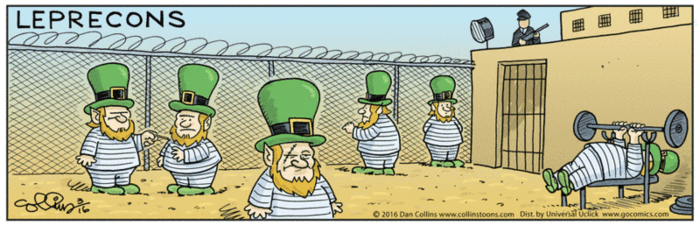
Tomorrow is the low point on the calendar. I've already seen "Happy St. Patty's Day" and a four-leaf clover, and so Dan Collins wins today by, inadvertantly or not, capturing the true personality of the leprechaun, some of the nastiest, most anti-social fairy folk in Irish tradition.
St. Patty's Day, for anyone who wants to celebrate it, is August 25. The diminutive of Padraig is Paddy. The diminutive of Patrick is Pat.
As for the shamrock, being a metaphor for the Holy Trinity, it has three leaves.
And, BTW, drunk jokes are like the N-word: Perfectly acceptable in-house, not so much from outsiders.
Saint Patrick's Day in Ireland was, until recent years, a religious observance. Its descent into drunken idiocy in this country has a couple of causes:
One is that it began as an ethnic pride demonstration here at a time when there was plenty of discrimination, but also a time when minorities were expected to fit in and so, along with "Here's who we are!" there was also a note of "Please like us!"
Another is that St. Patrick's Day was a good occasion to get everyone together and raise money for The Cause. If that happened today, half the Irish in America would end up in Guantanamo, the red jumpsuits only adding insult to injury.
Third is that the Irish became, alongside blackfaced minstrels, stock characters in vaudeville. The cautionary note on use of the N-word above is modern; back in those days, showing you could take a joke was part of blending in and becoming a real American.
So if you put Martin Luther King Day on one end of the spectrum and St. Patrick's Day on the other, Cinco de Mayo falls somewhere in the middle, with, as far as I can tell, most Chicanos trying to edge it towards Martin and not let it slide too much farther up the scale towards Stepin McFetchit.
Meanwhile, "Bringing Up Father" remains the comic-strip touchstone for the Irish in America: Ambitious, social-climbing lace-curtain Maggie trying to cozy up to the WASP elite, while poor hen-pecked shanty-Irish Jiggs just wants to go have some corned beef and play cards at Dinty Moore's.
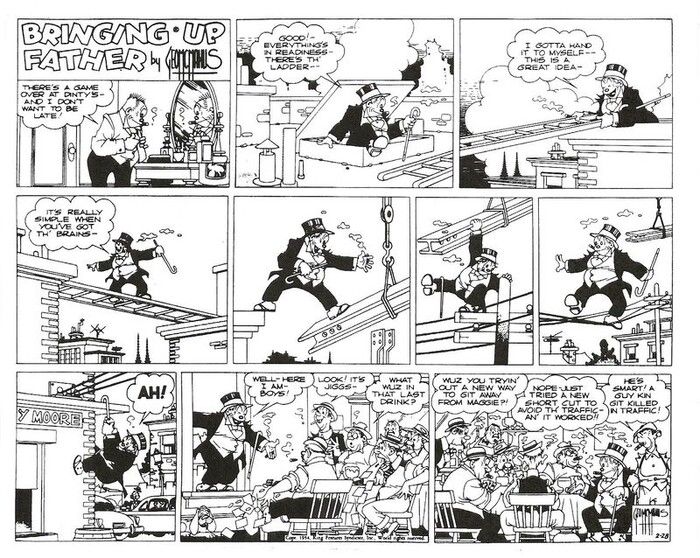
 If you go to the page where I swiped this, you'll probably learn more than you wanted to know about the strip, but, if you're curious, it's a good read. And, yes, the canned stew is related to the comic strip, but there was a restaurant inserted in the middle.
Scroll down to the second question here for the details on that.
And speaking of my roots
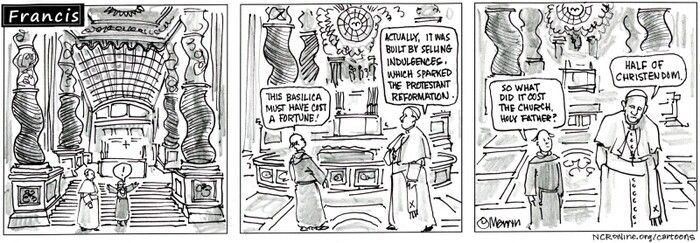
I love the strip Francis, which is on GoComics but actually lives over at National Catholic Reporter. I'm not sure if Patrick Marrin really has this sunny a view of the Pope or if he is simply using the personna to project the Pope Who Ought To Be, but today's strip is about as right-on as it gets.
I recently went to a Catholic mass for the first time in a decade or so, and it went pretty well. That is, I only blurted out the wrong thing a couple of times.
My problem is that, after I left the Church, I became an Episcopalian for several years, and so, when I go to Mass, my responses are close enough for me to get myself in trouble.
If I didn't know anything at all, I'd sit there with my mouth shut, but, no, I think I know what I'm supposed to say, and I do remember to say "AY-men" instead of "AH-men" (at least after the first one), but then there are just a few words tossed in or left out between the one version and the other and I'm odd man out each time.
The weird part is that I don't believe, but I seem to believe more than a lot of people who show up every week.
Where this comes up is that, when I do go, I kneel, sit and stand along with everyone else. That's like a woman covering her head in a mosque (and, until Vatican II, in a Catholic Church): You don't have to believe in order to exhibit good manners and respect for others.
But, while pretty much everyone is welcome to receive in most Protestant churches, you're supposed to be a Catholic in good standing to receive at Catholic services. It's not so much snobbery as it is a theological difference in the nature of communion, and I understand that, so I don't go up to receive.
And I've had Catholics who attend regularly say, "Oh, go ahead. Nobody's going to know."
Nobody? Really?
'Cause, if you believe that, you're missing out on some good tee times.
Speaking of jokes only we're allowed to tell:
Mike Peterson has posted his "Comic Strip of the Day" column every day since 2010. His opinions are his own, but we welcome comments either agreeing or in opposition.
Comments 1
Comments are closed.