Jerry Moriarty – RIP
Skip to comments
“Paintoonist” Jerry Moriarty has passed away.
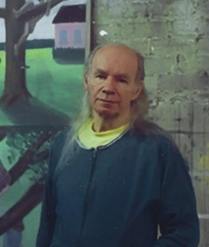
Jerome Brien (Jerry) Moriarty
January 15, 1938 – March 25, 2026
Chris Ware has called Jerry Moriarty “one of the great geniuses of the comic strip.”
Michael S. Rosenwald at The New York Times is reporting the death of Jerry Moriarty.
Jerry Moriarty, Painter Whose Brushstrokes Elevated Comics, Is Dead at 88
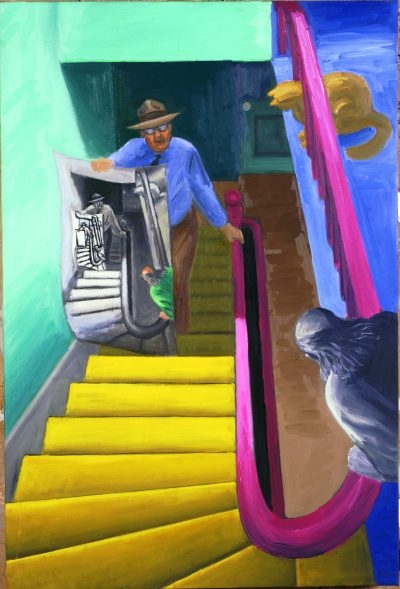
A self-described “paintoonist,” Mr. Moriarty created cartoons with spare dialogue that reminded his admirers of poetry or Samuel Beckett’s plays.
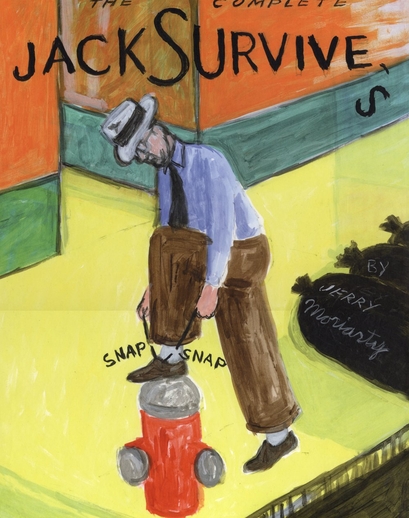
A self-described loner, Mr. Moriarty refused to sell his paintings, and supported himself by teaching at the School of Visual Arts in Manhattan. In many ways, he had the sort of average life embodied by his Everyman character, Jack, who resembled Mr. Moriarty’s father in appearance (and only in appearance).
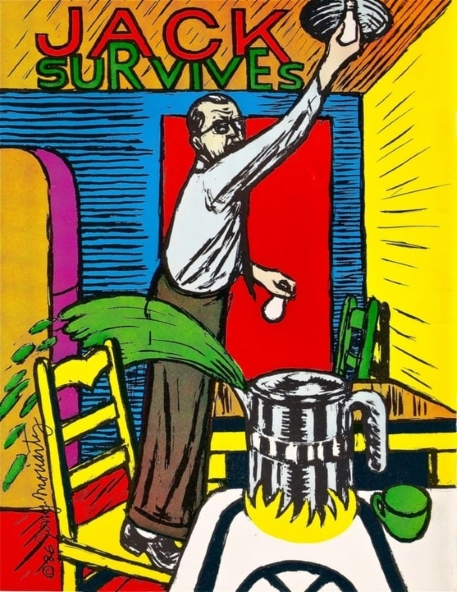
“Jack is an average man wanting to be average,” he wrote in “The Complete Jack Survives,” a 2009 collection of his Jack comics. “I am an average man who doesn’t want to be average, and art allows me to express that frustration.”
Moriarty was fairly unknown until Art Spiegelman and Francois Mouly featured him in their Raw series of comic books.
More from Chris Ware:
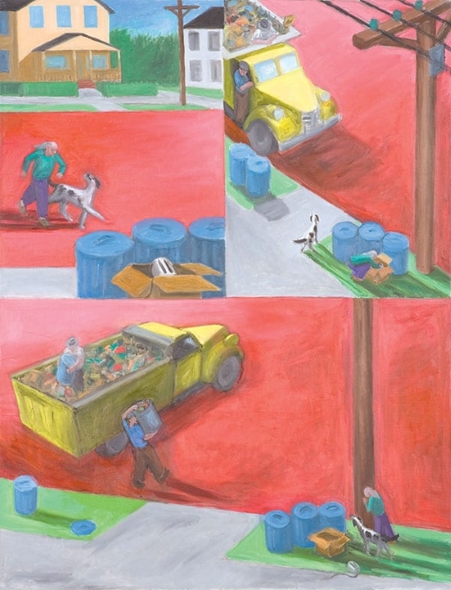
The Complete Jack Survives … beautifully reprints, reconfigures, and revives the groundbreaking work that first appeared in and was later assembled by Art Spiegelman and Françoise Mouly’s RAW Books imprint in the early 1980s. Bold, unassuming drawings blur the imagined essences of Moriarty and his father into unpretentious, searching comic strip compositions that stick in the memory like melodies; it’s as if Edward Hopper had taken up songwriting, or Ernie Bushmiller had taken up painting, or Edvard Munch had actually loved his father.
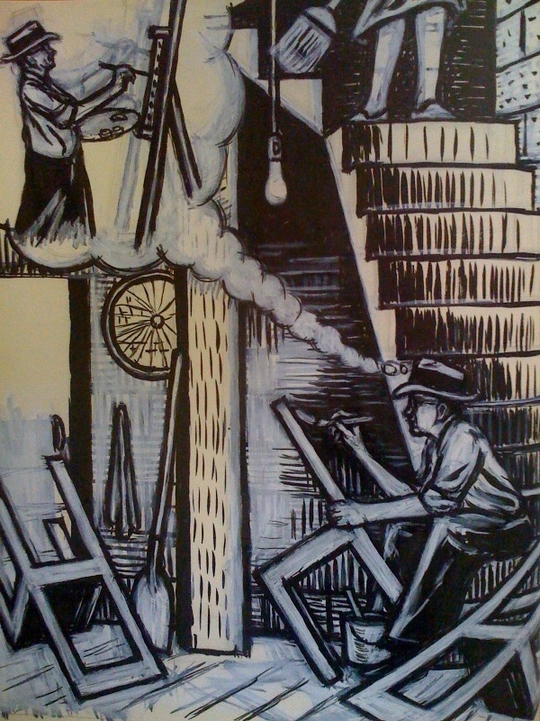
In 2009 Chris Ware interviewed Jerry Moriarty for The Believer.
JM: New ideas begin with me writing a list of them as they come to me; there could be as many as fifty. Most are forgettable gibberish, but some surprise me. First the Word, then the Image. I write because I am not a writer and do not judge my writing as I judge my art. Writing allows me to think in the extreme—and not just whether I can draw it or not. I am an “illusionist,” meaning my art can be believed as reality even though there are mistakes and details missing because I work from my head without photo references. Humans need less information than you’d think to accept something as reality. We are pattern seekers and storytellers. The next time you recognize a friend from a block away, think of how amazing that is. After writing comes the sketching of the best ideas on Xerox paper with a Flair pen. Maybe twelve ideas are sketched really rough. Next I take maybe eight of the best sketches to 18″ x 24″ Arches paper inked with a brush and altered with white acrylic. If I’m lucky, six ideas will remain from the brush and ink drawings and they will be traced and transferred to 18″ x 24″ heavy Bristol board to be painted in full color acrylics. Finally, the best acrylic paintings will go to oil paint on 46″ x 60″ stretched canvas, usually four ideas, four canvases. The process sounds tedious and redundant but it’s not. Each stage is a different medium, which in turn stimulates different thoughts so new ideas are being generated in a continual improvisation. I am especially pleased if big changes have happened in the process. It is proof that I am getting “smart with art.” Oil paint is my hero medium because I am a shameless romantic. Yet oil isn’t always the best version of the idea. Acrylic or ink could be best. It also happens that I sometimes think everything is going fine and the oil painting proves that the idea in any form sucks. Bad ideas can’t be improved with skill.
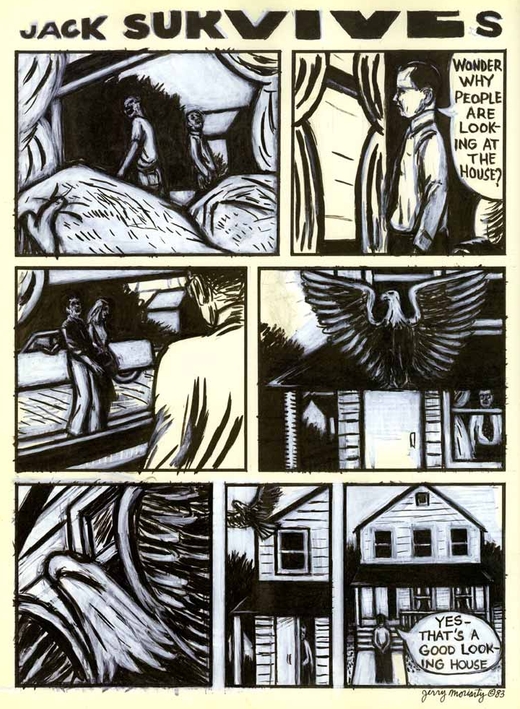
In 2008 Gary Groth interviewed Jerry Moriarty for The Comics Journal.
Moriarty is not exactly a cartoonist, per se; more of a painter who detoured into cartooning when he drew a remarkable, painterly, strip titled “Jack Survives” about he and his father for Art Spiegelman and Francoise Mouly’s Raw magazine in the mid ’80s.
MORIARTY: Yeah. It was all about being an illustrator. My admiration was for artists like Norman Rockwell, and he still had a place in my heart for many years after that.
So, I went to art school with this total acceptance of representation stuff, and then I was among all these other people who were also art kids. Plus, I had a lot of vets — because this is Korean War, GI bill people, and they really did a lot. I mean, that was really good for us, to be 18 years old, and there’s somebody who’s only like four years or five years older than you, but the seriousness is way beyond what it would have been if they were just regular four years older than you. And it was really positive, truly. It was a really interesting thing to have happen. I’m sure it’s still tried. I writevets. I don’t know if they are, I just know they’re vets, because I get the paper that says, make sure those guys make attendance, so I know he’s a vet. I’m glad, not for them being vets, but for the fact that they are going to art school…
But Pratt had all these practical, commercial things: Industrial Design up the wazoo; they had advertising, illustration. Fine art was like … I don’t think it existed there. They had a thing called Graphic Arts and Illustration, which was the department that I was in, which meant that if you wanted to be a fine artist, you took the same courses as the illustrators took, who also had to take the same courses the fine artists took; in other words, you had painting and stuff that had nothing to do with illustration, and they had illustration, which had nothing to do with painting, as far as they were concerned.
In 1988 Paul Gravett interviewed Jerry Moriarty.
Back in 1988 I had the good fortune of visiting the studio of Jerry Moriarty to interview him for the special New York issue of Escape Magazine, issue thirteen. Little did I realise then that this was one of the earliest interviews carried out with the remarkable creator of Jack Survives.
When did you start ‘Jack Survives’?
When I turned forty, the age of my father as I remember him, it turned out to be the right age to start the strips about him. The situations I chose – losing his wallet or getting tangled up in a dog’s leash – were based on my own life, as well as how I’d respond. But then, I talk and think like Jack. I am him. I feel like Jack in this time. Like Jack being caught in his old values, knowing they’re not right but he can’t abandon them because there too much a part of him.
How did you become a magazine illustrator?
In my teens I took the ‘Famous Artists’ correspondence course and then majored in Illustration at college. I had a ‘39 Chevy coupe and wore peg pants and a one-button roll-coat, with big shoulders and my DA hair. As a student I was exposed to abstract expressionism, art that was all form and no content. So I began as an illustrator in the Sixties for Girlie magazines like Swank, Caper, Nugget and Escapade, doing all this far-out looking stuff. Those of us doing the Girlie magazines used to look down at the ‘hacks’ doing the Men’s Adventure magazines. They’d have these surreal concepts like women in bras fighting Nazis, bizarre crazy stories. They were for the blue collar worker, so their content was very important. ‘Don’t give me this jive, give ‘em straight stuff.’ Those of us in the Girlie magazines Were the elite. I remember one Men’s Adventure illustrator was also a wrestler. The Wrestling Illustrator! It supported our notion that these were not aesthetic people here.

Comments
Comments are closed.