Comic Page Full Moons, Cracks, and Tight A**es
Skip to comments
Recently while reading a review of Hal Foster’s Tarzan—The Complete Sunday Comics 1931–1937, I was dismayed to see a young Tarzan’s derrière directed directly in my direction. And it wasn’t just a delineation of a duff, but a full double-wide. With a dimple. If I did a double-take, did readers in the 1930’s? When did the tush turn taboo? Today, we’re going to get to the bottom of the backside in the fanny funny pages.
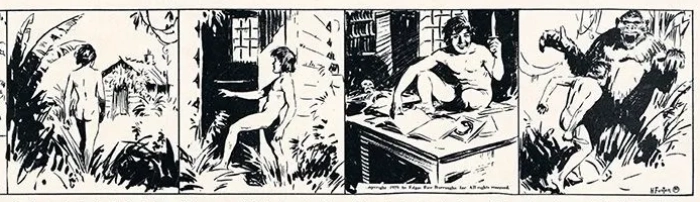
Tight Assets
Just who are the prudes of the posteriors? It’s actually not the syndicate comic editors. Of the editors I spoke with, no one indicated they had personal issues with a keister in a comic. King Features Syndicate Senior Comics Editor Ealish Waddell says, “my instinct is to let it run when we can.” The issue is not all newspaper editors are so jovial. Loose Parts creator Dave Blazek explains that because newspapers are now owned by chains, a perceived offensive cartoon carries greater risk. “It’s not just one guy having a bad day, you can lose all the papers in Wisconsin or Ohio just like that, because they are all owned by the same person,” Blazek says. “And so you’re not just losing one paper, you lose eight or ten.”
Veteran comic editor Amy Lago recalls, “I remember one of the sales reps telling me that there was a newspaper that had a person reading the comics looking for butt cracks. And they would wipe them out.” Lago, who was a comic editor with United Media, Washington Post Writers Group, and most recently Counterpoint Media, couldn’t remember which paper was wiping the comic cracks, but she remembers that the “offender” was… and you may want to sit down on your sitter for this… For Better or For Worse creator Lynn Johnston.
“You cannot tell a cartoonist not to do something and expect them not to try to do it”
Lynn Johnson
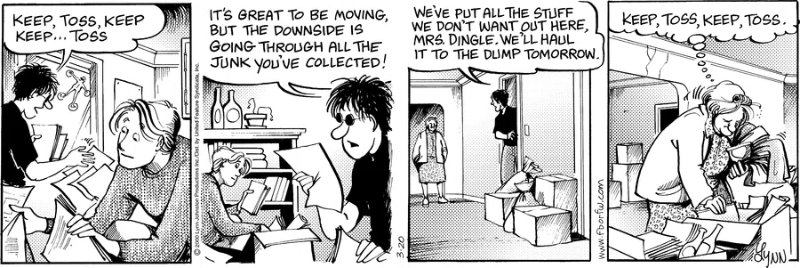
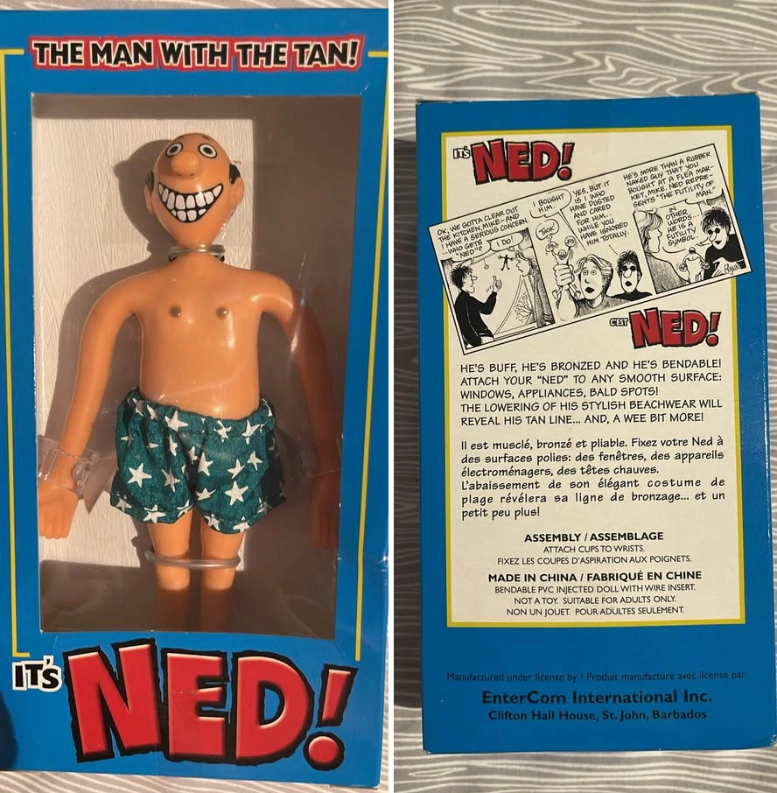
“When I was starting, they told me I could not use swear words or display any butts,” Lynn recalls. She took that as a challenge and proudly says she’s successfully violated both unwritten rules. Her full moon moment came when characters Michael and Weed went off to college and placed “Ned,” a bare bottomed human figure toy, on the window with suction cups. In several strips, you can see Ned’s heinie in the background.
A fun aside—Lynn had a bunch of those Ned dolls made and shipped from China. You can still find them online on Ebay and Facebook Market. Stripping Ned nude is strictly DIY.
Lago also says the arse allowance is much stricter on Sundays. She explains, “it’s always harder for Sundays because of the four-color separation issue. If someone wanted to get rid of a butt crack, they can’t just white it out. You would still see the outline of it from the other plates.” She adds that there’s also a perception that Sundays are harder as content is concerned.
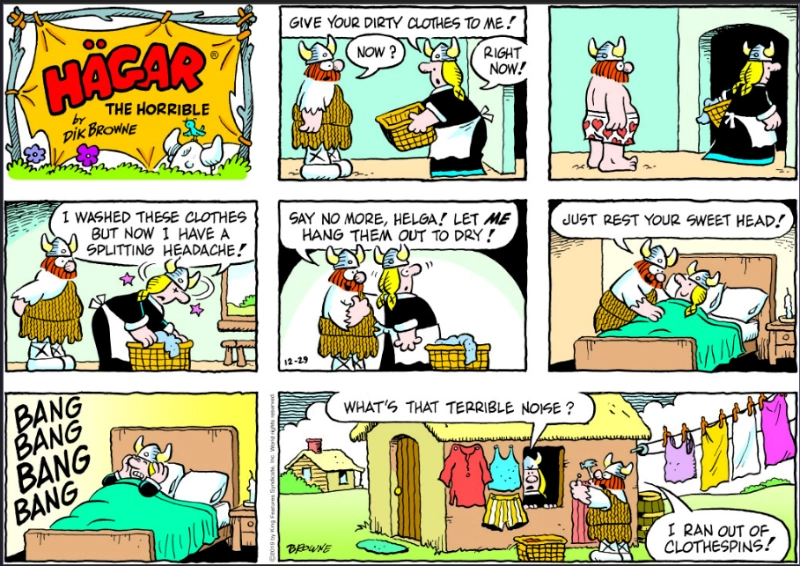
When I discussed the issue of Sundays with King Features Syndicate Editorial Director Amy Anderson she recounted a time when Chance Browne sent in a Hägar the Horrible with the title character in full side-cheeks glory. After consideration, they asked him to add underwear. Waddell says, “the underwear had same comedic effect and it was the throw-away panel so it wasn’t integral to the story.”
Cracks in the System
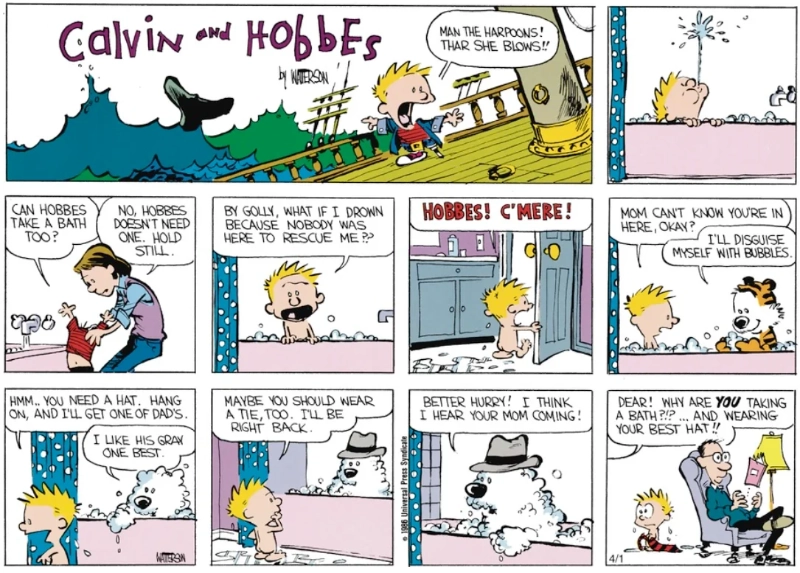
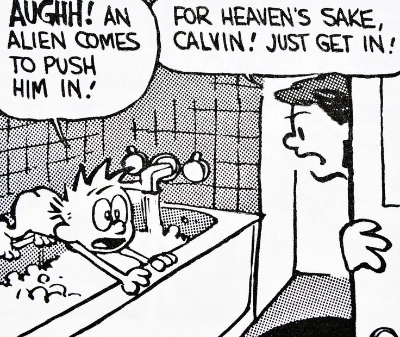
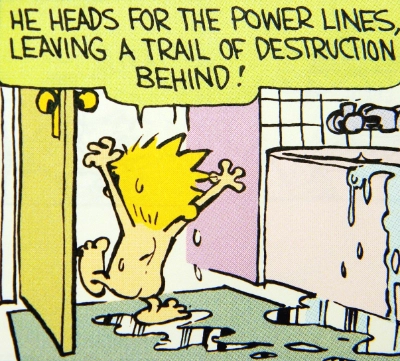
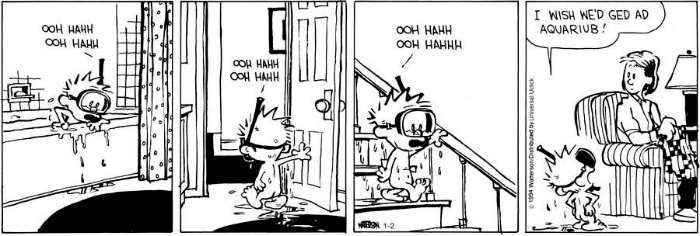
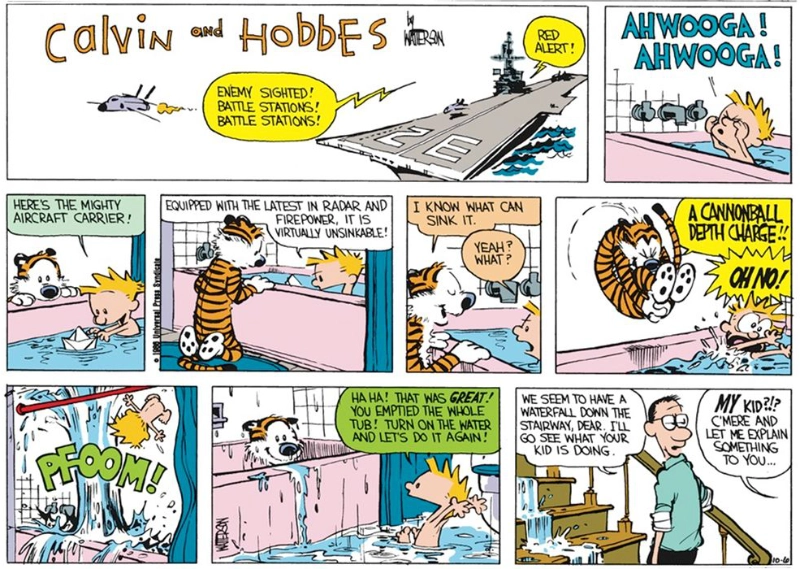
There is a backdoor to the unwritten rule about butts. Anthropomorphic characters get an easy pass. Using well placed props is also an easy way circumvent a raised eyebrow. And there’s the cute card. Lago says, “if there’s no innuendo, it’s easier to let go to the newspaper. I’m thinking Baby Blues would have gotten away with it and maybe Calvin and Hobbs. But again, you’re talking about cute kids’ butts.”
To my knowledge, Bill Watterson never got away with a full moon, but he wasn’t shy about playing the cute card—even on Sundays.
“Men’s butts are less salacious.“
Amy Anderson
Of the comics we’ve reviewed so far, there’s a common denominator: males. I asked Anderson and Waddell if gender mattered. “Of the examples we were looking at, it does tend to be the male butt not the woman who are shown,” Anderson says. “Men’s butts are less salacious.” Of the few examples of a female fanny, Blazek’s panel featuring of Adam and Eve was one of them.
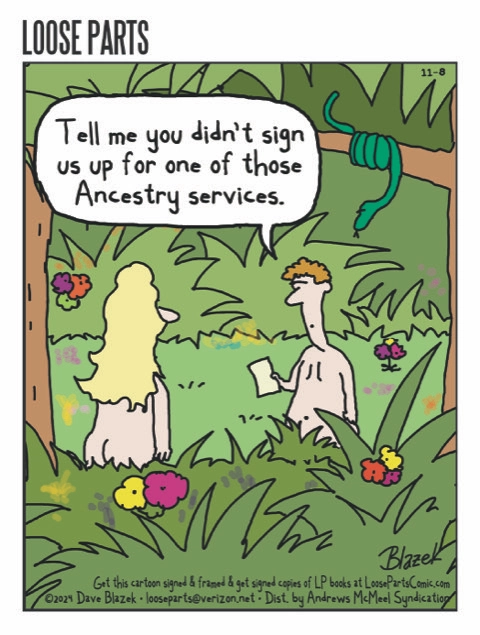
“I do remember talking it over with my editor because I’ve been in this long enough to know that this could cause some problems,” Blazek said. “She didn’t have a problem, but I certainly understand in this day and age newspaper editors are hanging on.” To his recollection, there was no negative response to his cartoon.
When it comes to content that may be seen as problematic, Blazek usually doesn’t push back. “I worked in a newspaper here at the Philadelphia Inquirer for 35 years or so. I know how tough that job can be. Generally speaking, if someone comes back to me and says, ‘we can’t do that’ or ‘we need to cover it up’ I’d be happy to do it unless I thought it blew the joke.”
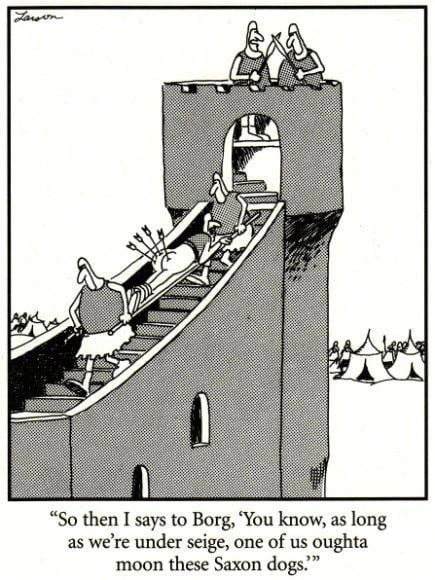
Discussing other cartoonists who may have crossed the crack line, Blazek immediately thought of Gary Larson’s Far Side comic below. “For my money, the Larson one with the mooning Saxon dogs is the standard,” Blazek says. “The fact that it popped into my head instantly. And ‘mooning the Saxon dogs’ is just such a great phrase. He could have just said ‘moon them’, but ‘moon those Saxon dogs’ is why he’s Gary Larson.”
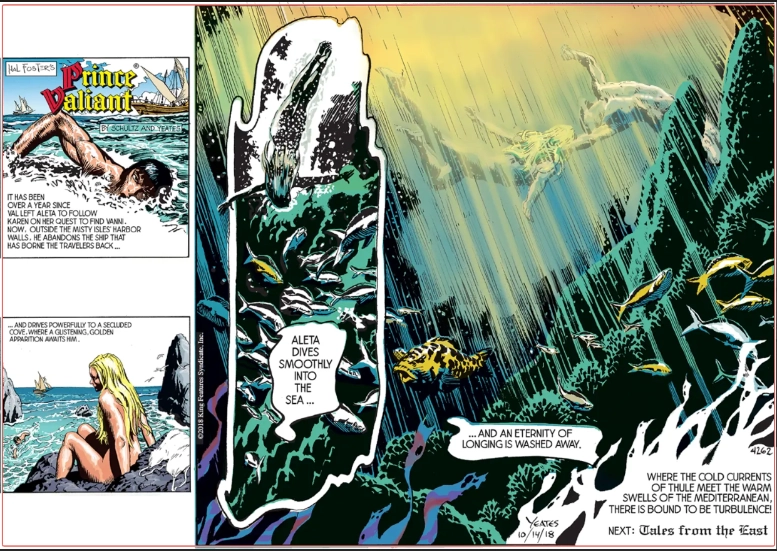
When determining whether to send out a comic depicting a derrière, there are several things to consider. “The difference is more in the comic itself rather than genre,” Anderson says. “Is it in service of a gag? Is its nature titillating? What is the context of the cartoon?” To prove the point, she provided a Prince Valiant from a 2018 story-line. The original art was more explicit—Aleta’s apple bottom was less obscure. At the behest of editors, the artist added bubble plumes and shafts of light. “In the Prince Valiant example, the nudity is both more realistic and shows male and female genders. Yet it’s clearly not meant to be provocative but rather it’s emotional and artistic,” Anderson continues. “That’s an important distinction.”
Rare Full Moons
While cracks have emerged, a full moon is still very rare. “You know, I would certainly consider a side view, but a full on moon is harder,” quipped Lago. “Most cartoonists knew [a full moon] would be an extraordinary circumstance for them to get away with it.” And in all her decades in comics, Lago cannot recall having to approve a full moon.
The only other cartoon I came across with a full moon was this March 1974 Boner’s Ark comic by Addison (pen name of Mort Walker) provided by Anderson and Waddell.
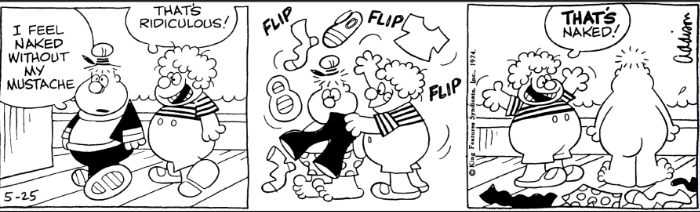
So, has newspaper audience’s tuchus tolerance changed? “Anecdotally, we think yes. As tastes and audiences change, so too does the bar for what is considered ‘all right,'” Anderson says. “However, we found a 1974 Boner’s Ark with full bottom on display, so has it really changed so much?”
Waddell adds, “It’s been a long time since we’ve had a call about a butt.”
Comments 10
Comments are closed.