Drawing Mouths, Not Saying the Right Words
Skip to comments
Each week my ADHD brain finds some comic-related things on social media that must be chased down. There were several this week. Due to scheduling conflicts with some subject matter experts, I had to push two topics to next week. This week we chase two rabbits: how do artists draw character’s mouths based on the dialogue in the script, and I try to be very nice when discussing Pedro “nice as he seems” Pascal’s habit of omitting credit to the cartoonist who was very nice to him.
Watch Your Mouth
I came across a post on Bluesky from Evan Dorkin opining on drawing a character’s mouth when speaking dialogue. He wrote…
When I say characters’ mouths should be drawn open more often when speaking dialogue I want to make two things clear. One, it’s my opinion. Two, I’m not saying it means drawing exaggerated expressions like I tend to do. Every style has a “mouth range”. IMO closed mouth in almost every panel is DOA.
That prompted Jamie McKelvie to post…
I try to draw specific syllables from the dialogue – not sure if anyone but me notices though.
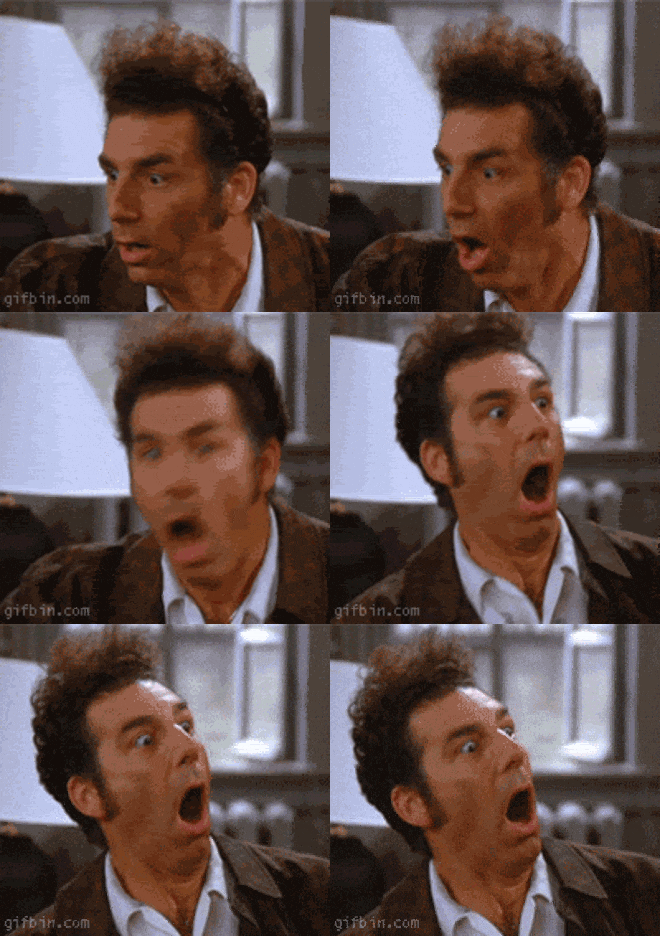
to which Chris Schweizer chimed in…
Depending on balloon placement (i.e. whether it’s gonna be read before you see the face or after) I’ll specifically correlate it with first or last syllable, IF that syllable creates a specific mouth shape (many don’t, any open mouth is fine, but EE, OO, AH, etc require specific shapes).
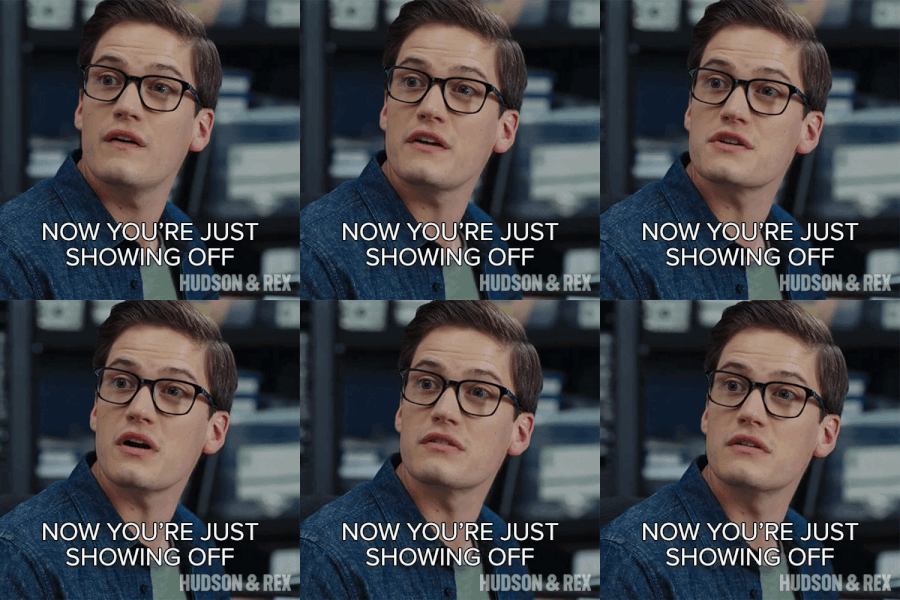
From my own experience, I’ve always drawn a speaker’s mouth open, but drawing the mouth’s shape to conform to specific syllables? That was definitely not in the comic strip or editorial cartooning manual when I cut my teeth. I tried to do a quantitative loosy-goosy scientific analysis to find what cartoonists do with their mouths—on paper. I selected five random comics from the following platforms: Comics Kingdom, GoComics, Webtoons, Marvel (free issues), and Hoopla and tried to sort out the different approaches to giving characters a voice.
Findings
Generally speaking most artists’ approach fell into four categories with a fifth outlier—a pandemic era Marvel comic saluting first responders and the medical community. All of the characters in that comic were wearing face masks or personal protective equipment. The only character with a visible mouth was an unfortunate covid victim gasping for air. It was a very well drawn pantomime of a person suffocating for whatever that’s worth. Here’s the general categories rounded to nearest whole number:
- Mixed. Open mouths, smiling, closed mouths – 13%
- Open Mouth—same shape regardless of character or dialog – 42%
- Open Mouth—different shapes per expression, but not per syllables – 42%
- Open Mouth—shapes based on words or syllables – 4%
Only one comic “Invincible Compendium Two” drawn by Ryan Otley and Cory Walker came close to a wide range of mouth shapes that may have corresponded to the first or last syllable of the character’s dialogue.
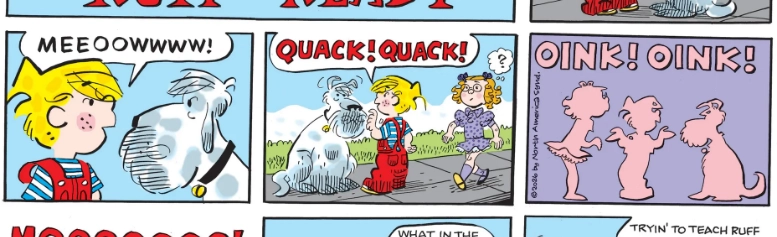
Granted, this is a very small sample and heavily influenced by the comic platforms I choose to pull samples. If I had to sum up the results based on the type of comic (comic books, strips/panels, graphic novels, or manga) nearly characters had open mouths when speaking. The three instances of characters speaking with a closed mouth were all found in comic books. Comic strips and manga had the least expressive mouths. Usually the same mouth shape was used regardless of character or dialog. One strip stood out as an example of lack of expressive mouth shape. In the recent Dennis the Menace Sunday strip (below), Dennis is making different animal noises in an attempt teach his dog “a second language.” If there was one moment when Ron Ferdinand could have had fun drawing Dennis’ mouth “making” animal sound shapes, this would have been it. But maybe that would have broke with 75 years of the “proper way” to draw Dennis.
Just Say Their Name, Please…
We’ve reported two prior recent instances where a comic or cartoon was featured on national television without mentioning or crediting the artist’s name. The first time was Jimmy Fallon talking about being on the cover of MAD magazine; the second was Seth Meyers and Pedro Pascal discussing Pascal being the subject of a New Yorker Cartoon. In neither case were the artists—Tom Richmond and David Ostow, respectively—mentioned or credited.
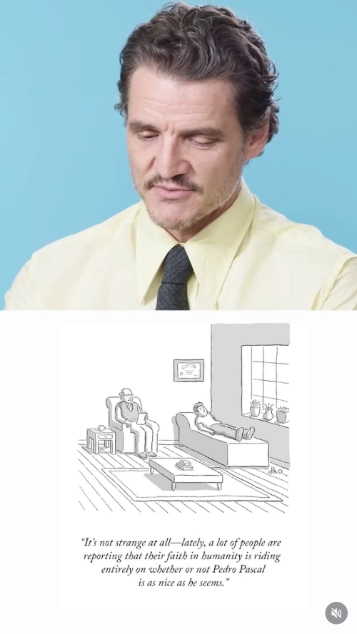
Earlier this week the New Yorker Cartoons account posted a reel on Instagram of Pascal talking about being in the Ostow New Yorker cartoon. Again Pascal offered no credit David. Understandably, being featured on a MAD magazine cover or in a New Yorker cartoon would be a honor worthy of sharing with one’s audience and fans, but I don’t think it’s too much to ask the honoree to include the artist’s name when introducing the artwork to the world. I find irony that Pascal is not being nice (IMHO) to David while glowing about a punchline pivoting on whether he is as “nice as he seems.” Because faith in humanity is at stake, we can hang hope on one of two things being true: David is the “dear friend” who framed and gave the cartoon to Pascal, or there were multiple takes for this reel and Pascal’s proper credit was left out in the edits. Let’s hope one of those cases is true.
I have reached out to David for a response. I’ll update this post should he respond.
Update 5/31: David has responded. He says he doesn’t know Pascal personally (my “dear friend” hopes dashed), but the two did exchange “brief well wishes on Instagram.”
As far as taking umbrage to not being credited, David does not share my annoyance. From his email:
Whatever benefit the magazine gets from publishing my work, I take as much if not more pleasure in being able to call myself a New Yorker cartoonist. I never expected this cartoon to blow up as much as it did and I’ve just enjoyed watching it pop up here and there.
Comments 6
Comments are closed.