Legal Technology

A.I. Generated “Art” Not Eligible For Copyright Protection

From Jo Lawson-Tancred at artnet:

Computer scientist Stephen Thaler‘s lengthy legal battle to see his A.I.-generated artwork granted copyright was dealt yet another blow on Monday when the Supreme Court declined to review a decision made by the U.S. Copyright Office in 2022.

The office ruled that without “human authorship,” the artwork was not eligible for copyright protection. This ruling was upheld in 2023 by the U.S. District Court and again last year by the U.S. Court of Appeals in Washington. As lawmakers reaffirm that copyright can only be granted to work made by humans, leaving A.I.-generated outputs without protection.
A lawyer’s take from Jacob W. S. Schneider at Holland & Knight:

As previously discussed, Thaler applied for a federal copyright registration in 2018 for “A Recent Entrance to Paradise,” a piece of visual art that Thaler acknowledged was autonomously created by his DABUS AI software. In the application, Thaler listed his AI software – not himself – as the author of the work. The U.S. Copyright Office rejected the application in 2022, finding that copyrightable creative works require human authors.

Thaler’s copyright battle parallels his patent case. Thaler filed two patent applications listing DABUS as the sole inventor. The U.S. Patent and Trademark Office (USPTO) refused both applications and concluded that the Patent Act limits inventorship to natural persons.

No it won’t stop it but it makes A.I. less attractive to those hoping to monetize off stealing artists’ styles.

Hat tip

to Jason Chatfield, who takes back to artificial intelligence arguments in the Supreme Court of 1884.

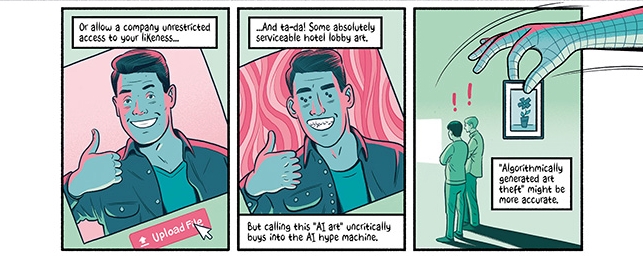
feature image by Tom Humberstone

Previous Post
Eddie Germano – RIP
Next Post
CSotD: Quick Draw Reactions

Comments 8

  1. I wonder what the definition of “work made by humans” is, or will be.

    Suppose I take a digital photograph of some subject. And then I use an upscaling/sharpening tool to increase resolution. Or I use an infill tool to replace something in the background I don’t want (for example, some photobomber who won’t give me permission to use her image).

    The original photo would, I suppose, be considered as “work made by humans”. But both of the tools I mentioned use AI — neural nets trained on collected examples. Would the final result be ineligible for copyright?

    Or suppose I train an AI image generator with all of the Puck or Judge drawings by one artist. Let’s say Victor Gillam, who died in 1920, so all his published work is in the public domain. Then I draw something myself, crudely since I’m not good at it. And I ask that AI tool to “redraw this.” The result, I presume, would legally be considered a derivative work. Some derivative works are copyrightable. And some portion of this piece must logically be considered “made by a human”. There was no theft. Would this be copyrightable?

    1. Since lawyers LOVE to split hairs, I’m assuming they’ll shred this one I into microfibers and, somehow, it will redound to the megacorps’ benefit. I’m not a pessimist, it just seems the way the wind is blowing to power their windmills of greed and corruption.

  2. So this means I can profit off others’ AI-generated work.

  3. As someone who has only known and experienced human works of art for his entire life, I don’t necessarily look at A.I.-generated images with revulsion. In fact, while others seem to be able to recognize it instantly, I often am fooled, especially by cartoons. Don’t human beings learn their art by being influenced by the works and techniques of others, tracing, copying, absorbing and regenerating it until eventually developing their own unique “style” as an amalgam of hundreds of other artists? How, exactly is this any different from how A.I. generates its works (apart from the human element)? And look at classic animation: hundreds of animators copying verbatim the style and layouts done by one person, generating the simulation of actions linking those “extremes” by “in-betweeners” whose ability to maintain the original drawings through creation of three dimensions. Is this “art” or like A.I.-generated cartoons, mathematically created simulation of reality? and what of the difference between C.G.I. and A.I.? All of this might be crucial if securing a copyright for a cartoon requires that the applicant be honest on the registration? (Itself a thing of the past–current copyright law doesn’t even require registration to secure a copyright, merely a publication with an owner, date and (optionally) the word or symbol for copyright. In other words, the court’s decision appears to be meaningless. Unless the person arguing copyright violation admits the work was generated artificially, there is no way to determine a human didn’t create it.

  4. I wonder whether photography was considered copyrightable at the time it was invented.

    Unless it’s a photo of a staged scene, a photo is not “made by humans.” All the human did was notice the scene was interesting and push a button. (I know I’m ignoring that the development and printing processes might have some human input.)

    The “made by humans” criteria, assuming that’s an accurate synopsis of the court’s ruling, seems poorly defined.

    1. The Jason Chatfield link closing out the above post tells of the 1884 Supreme Court decision on that very matter.

      1. Thanks for pointing me at.

        I’ll have to take a deeper look at Burrow-Giles Lithographic Co. v. Sarony. Jason characterizes the ruling that photographs are copyrightable as being due to the creative choices the photographer makes. But those he lists seem relevant only for posed photographs. Not, for example, for a photo like “The Terror of War” (a.k.a. “Napalm Girl”), which is like the situation I mentioned in my post.

  5. I’m glad to see this ruling, but I’m sorry to see that AI in and of itself hasn’t been designated as copyright theft.

Comments are closed.

Search

Subscribe to our newsletter

Get a daily recap of the news posted each day.