Bill Watterson Took The Road Less Traveled
Skip to comments
It is two and a half months before the Calvin and Hobbes comic strip will come to an end.
It’s 1995 and Watterson is thirty-seven. He’s sitting at the desk where he’s worked for the last ten years, drawing the adventures of Calvin and his maybe-real or maybe-stuffed-toy tiger, Hobbes. Calvin and Hobbes runs in over 2,400 newspapers across the world and, by a more meaningful metric, re-enchants life for millions of readers. It’s pop-culture that transcends the ‘pop” part of its nature; it feels like a private piece of each reader’s soul.
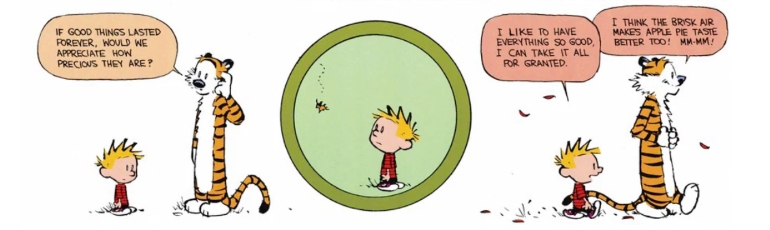
The Republic of Letters and Matthew Morgan maps out the road cartoonist Bill Watterson took to satisfaction of the soul if not the fortune that he could have had.
The letter is finished, ready to be typed up and sent out. Time now for the real work. At one edge of Watterson’s desk are a couple of pencils, an eraser, the curled zigzags of shavings. On the other side of the desk are tools for different parts of the creative process. A small sable brush (for inking), a Rapidograph fountain pen (for lettering the dialogue), and a crowquill pen (for “odds and ends”). His set-up is “as low-tech as you can get”.
This is how he likes it. The simpler things are, the more control he has over the work — which is the hill on which he’ll die and take everyone with him if he has to. For Watterson, it’s a question of maintaining artistic integrity. He derives an enormous amount of pride from the fact that he can say, “I write every word, draw every line, color every Sunday strip, and paint every book illustration myself.” The strip is a “one-man operation” because he’s convinced it’s the only way to preserve the integrity of his craft.
From college where he paints his interpretation of Michelangelo’s “Creation of Adam” on the dorm ceiling to saying goodbye to the creation that brought, and continues to bring, him worldwide fame and adoration
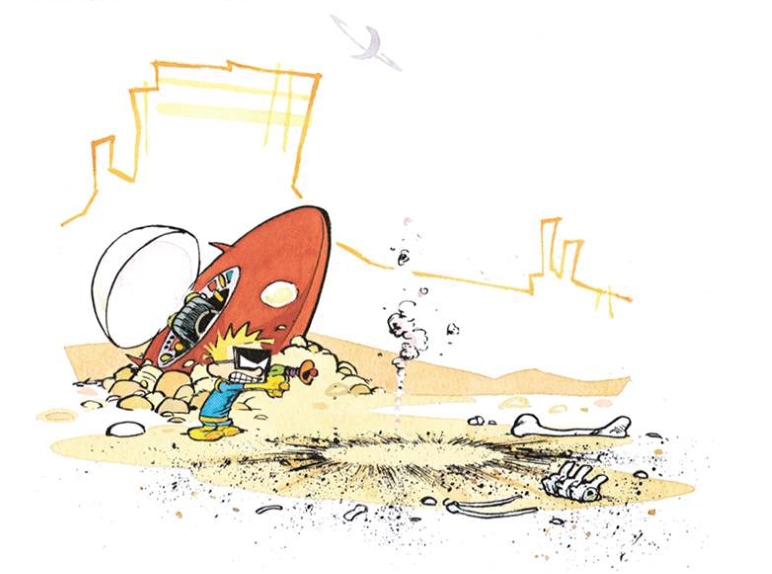
Kenneth Glad at Dagens took Morgan’s essay and ran with it, especially the parts about not signing off on merchandising his characters and becoming a billionaire.
Some popular creations become products as soon as the market allows. Others remain protected because their makers decide the work matters more than expansion. This is a story about control, limits, and the unusual power of refusing an easy fortune.
The proposed products included clothing, animated projects, bumper stickers, and a Hobbes doll.
That last idea cut especially close to the core of the strip. Hobbes worked because readers saw him through two realities at once: Calvin treated him as a living tiger, while adults saw a stuffed animal.
Watterson explained the balance this way: “Calvin sees Hobbes one way, and everyone else sees Hobbes another way. I show two versions of reality, and each makes complete sense to the participant who sees it. I think that’s how life works.”
A licensed toy would have answered a question the strip carefully left open.
I shall be telling this with a sigh
Somewhere ages and ages hence:
Two roads diverged in a wood, and I—
I took the one less traveled by,
And that has made all the difference.
– Robert Frost

Comments 5
Comments are closed.