CSotD: Paving with Lousy Intentions
Skip to comments
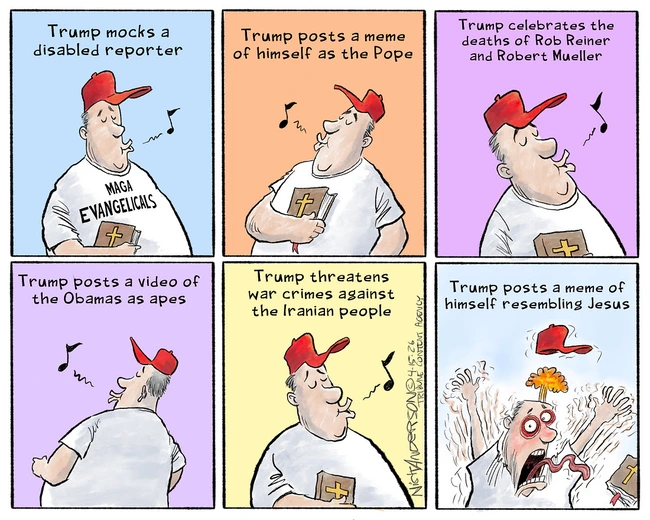
Anderson starts us off with a challenging cartoon, specifically targeting Trump’s Evangelical supporters, and accusing them of blissfully ignoring a variety of serious offenses against the commands of the Bible, but then mocking them for finally becoming incensed over what Anderson apparently sees as a somewhat trivial violation.
He often combines his cartoons with an essay, but in this case, he was rather terse, posting only:
MAGA Christians are apparently fine with a long list of cruelties and horrible statements, as long as they’re not overtly blasphemous. Christ, please save us from your followers.
I suppose it depends on how you interpret “overtly blasphemous,” since you might find all of those violations blasphemous in the sense of directly contravening Christ’s teachings, though the common definition makes only the final insult truly blasphemous. Let’s not quibble over definitions.
And while his comment has an air of “Lord, protect me from my friends; I can take care of my enemies,” the cartoon is more reminiscent of “The devil can cite Scripture for his purpose,” which is from “Merchant of Venice” and ties into the antisemitism in the play, just as the hate from bots and faux-Catholics flooding Xitter ties into a tradition of anti-Catholic bigotry.
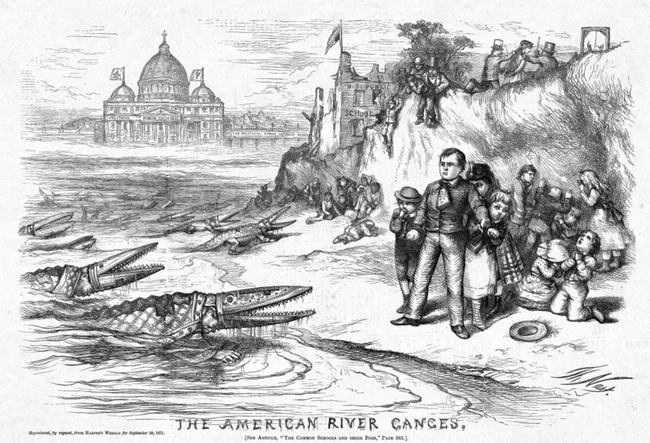
We’ve passed this way before, as seen in this well-known Thomas Nast piece from 1876, in which evil Catholic bishops creep like crocodiles determined to destroy the American educational system.
Oddly enough, the horror Nast was commenting on was a proposal to share tax funding with parochial schools, which he condemned as a terrible idea but which has resurfaced today and is being applauded.
Ain’t life peculiar?
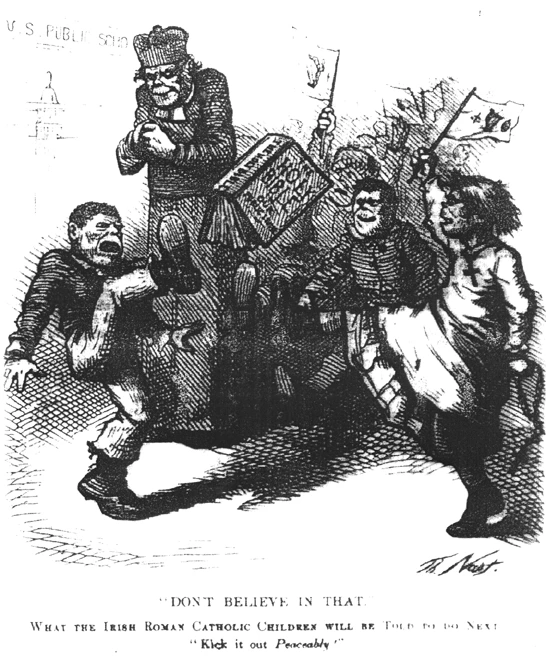
The issue of religion in schools was touchy, because public schools included prayer and religious teaching, but only from the King James Bible and only from a mainstream Protestant perspective. Catholics objected to this, and wanted the Bible out of classrooms. Accordingly, Nast shows the evil priest encouraging the Irish Roman Catholic monkey children to “Kick it out Peaceably.”
Note, BTW, that the Catholic, Protestant and Jewish translations of the 10 Commandments are different, while they are in a completely different setting in the Quran, so that today’s penchant for posting the 10 Commandments in schools is, effectively, promoting a specific religion.
Not that the people whose particular version is selected would see it that way.
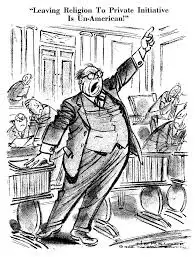
Prayer remained in public schools until Engel v Vitale; as a youngster, I thought “public” was another term for “Protestant.” People hated JFK, and I guess me, for being Catholic.
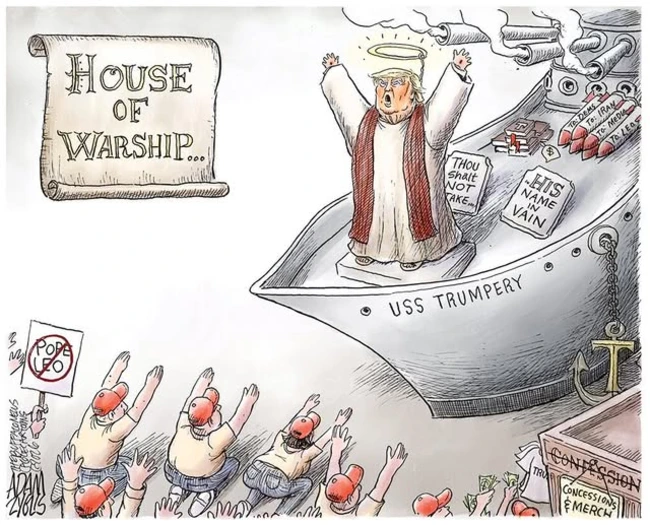
Zyglis touches on the cult of personality that has risen around Trump and was odd enough when it involved buying gold sneakers, bitcoins and suchlike. Today — Zyglis charges — it’s risen to near idolatry as Trump picks fights with the Pope.
That would be a more complicated argument if Trump hadn’t posted memes comparing himself to Christ and suggesting he has a special relationship with Jesus. He backed off when people objected, but that’s like withdrawing a racial slur: You may be sorry you said it, but obviously you were thinking it.
Zyglis also offers a worship/warship pun, which raises an interesting conversation, because it’s certainly possible to find justification for violence throughout the Old Testament. However, it requires a large dose of sophistry and spiritual contortion to find it in the words of Christ.
I’m not sure anyone cares. You needn’t be a historian to find holy violence in the Crusades, in the 30- and 100-Years Wars, in the actions of colonialists and in the lives of religious/political leaders like Cromwell. This is not new territory.
You can even be the kind of religious illiterate who steals fake scripture from popular movies, because I don’t think Hegseth’s audience is any more wise in the ways of the Lord than he is, or any more sincere in their insistence upon spiritual justification.
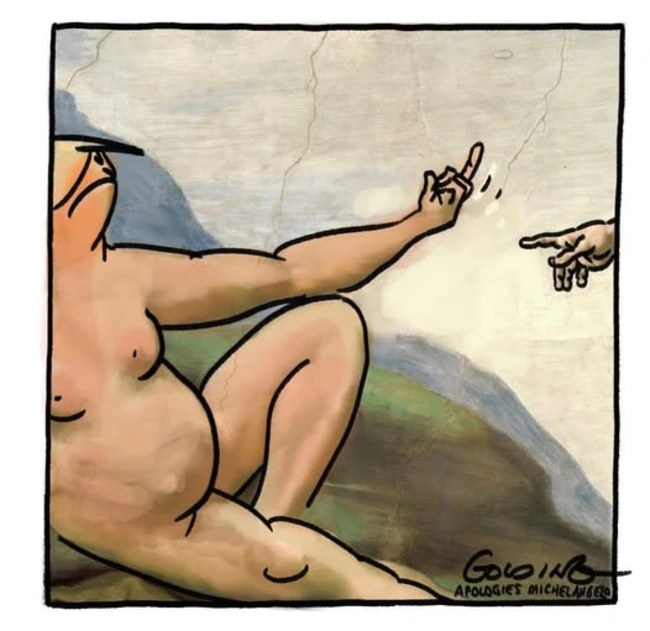
There have been a slew of Sistine Chapel cartoons, but Golding keeps it simple and reduces the quarrel to an arrogant act of prideful blasphemy that recalls the story of Lucifer’s rejection of God.
For all the fulmination this topic is generating, Golding’s small, plain illustration tells the tale.

It’s important, in a supposedly secular society, to note that Americans are not required to accept a particular scripture, a specific interpretation of that scripture or any scripture at all. Bagley suggests that there is a body of beliefs that go one way, and another body of beliefs that go the other.
The choices you make may be guided by religion, but they can also be guided purely by non-religious ethics and, moreover, you can borrow those ethics from Jesus or Mohammed or Socrates or Lao-tse or Spinoza.
You can even praise the actions of Columbus, of Cromwell, or of the Khmer Rouge, if you feel their intentions worthy enough to cancel out the ways in which they attempted to achieve them.
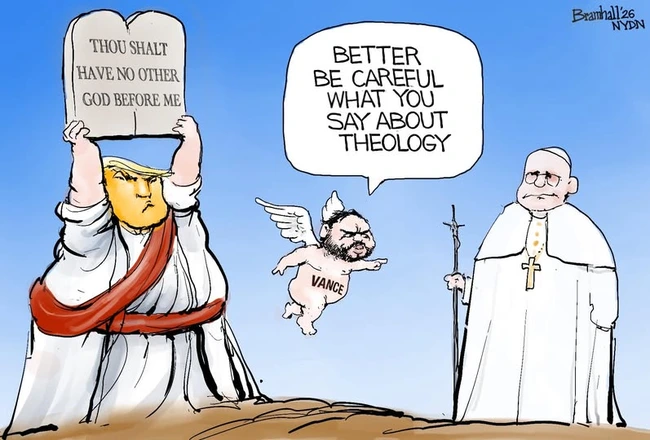
What you mustn’t do is make yourself look jaw-droppingly stupid. Bramwell lays out the most ridiculous development in this bizarre resurgence of anti-Catholic hostility.
You are free to believe that Donald Trump is equal to Jesus Christ, and you’re also free to believe he honestly thought doctors wore togas and had light streaming from their hands.
But when JD Vance, who has been a Catholic for all of seven years and is selling a book about it, declares that Pope Leo isn’t qualified to discuss theology, that catapults him to the top of the prideful idiot category.
Leo has a pair of prestigious doctorates plus extensive additional education in theology. It’s what he does for a living. To challenge his knowledge of Catholic doctrine is so astonishingly foolish as to defy examples. It is the example.
Second, he was selected to lead nearly 1.5 billion Roman Catholics in an age-old process that defines the religion. For all the caterwauling at Xitter about it, the essential difference between Episcopalians, Catholics and Lutherans is that Catholics accept the Pope.
There are other differences, but that’s the biggie. If you don’t accept papal authority, you’re a Protestant, which is fine, though hypocrisy isn’t.
Because if you’re an American, you should embrace whatever you believe, and embrace the fact that Americans are allowed to pray for whatever they want, or not at all.
Mike Peterson has posted his "Comic Strip of the Day" column every day since 2010. His opinions are his own, but we welcome comments either agreeing or in opposition.

Comments 22
Comments are closed.