CSotD: Reporting on a Few Alleged Topics
Skip to comments
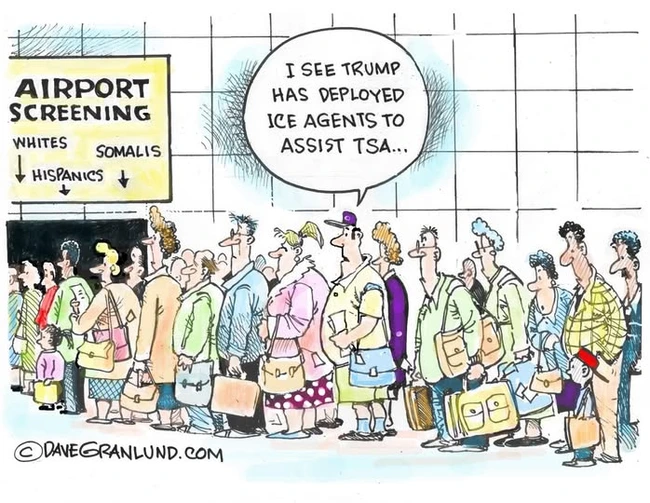
When I said yesterday that the ICE-in-the-airport cartoons were going to draw themselves, I wasn’t kidding. The past 24 hours have been a flood of cartoons of people being assaulted by ICE in airports, mostly for having liquids in their carry-ons. But we’d already chuckled over the concept and timing is everything.
I like Granlund’s take, because he’s captured ICE’s attitude as well as the lack of actual impact the move seems to have had. All they really did was replace the people who didn’t show up with people who didn’t know how to help a whole lot.
And actually the substitutes don’t seem to have even been in place yet, which brings up something else. I really like NPR and I count on their reporting.
However …
They had a piece in the morning a few days ago where they sent a reporter flying around the country to find these backed-up lines of people, and he barely found any. So they sent him out again yesterday and, again, he found a single airport with long lines but the rest were moving along fairly well.
Last night, they led their coverage of the ICE deployment by headlining the hours-long lines at airports. Don’t you even listen to your own coverage?
The morning show coverage was amusing, because they took it with a light touch. I’ve been assigned to go find something an editor was convinced was out there, and it was a relief that the reporter wasn’t forced to find it even if it’s not there. I have been.
But if the morning crew can’t find it, the afternoon crew should trust them. I’m sure that, if you’re determined, and if you’re willing to listen to what someone says their cousin’s next-door neighbor’s friend says he experienced, you can come away with the assigned story. And, of course, every airport, even when fully staffed, has periods when things back up.
But it’s insulting to make claims your own colleagues have failed to verify. You could at least toss in an “alleged” or a “reportedly.”
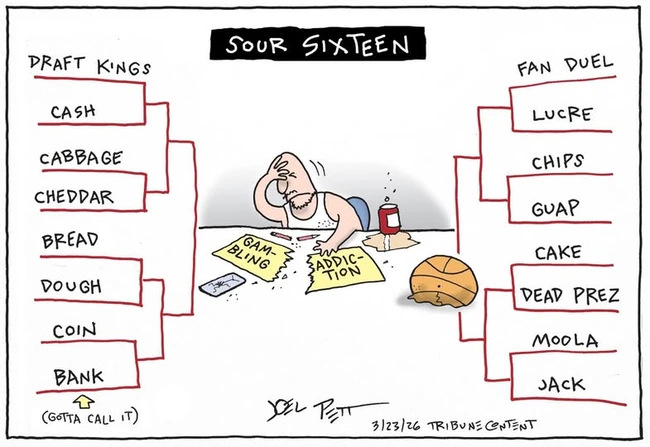
I suppose, then, I should say that the alleged scourge of gambling has reportedly done a lot of harm, but I’m reasonably confident that it has, if for no other reason than reporters have been threatened and offered bribes if their reporting doesn’t line up with what some mook bet was going to happen.
The allegedly/reportedly is whether legalized international gambling is to blame. Those of us who follow such things remember Andrés Escobar, the Colombian player who eliminated his World Cup team with an own-goal in the 1994 tournament and was shot to death in the streets of Medillin by a disappointed gambler.
But here’s some news for those of us who aren’t enamored either with the spread of legalized gambling or the constant, obnoxious ads on every televised sporting event:
One is that the NCAA is suing DraftKings for using the trademarked term “March Madness.” It’s kind of funny for those of us who have struggled to describe what set of games we’re writing ads about without using the forbidden term, and it could only be better if they’d used the word “Olympic,” because those guys are, along with Disney and Dr. Seuss, among the livewires one does not touch.
The other, and this could amount to something more, is that there is a bipartisan bill advancing through Congress that would return control of sports gambling to individual states. The trick here is that it is favored by casinos, which don’t get a taste of what Kevin Hart is selling, and states which are also cut out of the revenue stream.
The other thing the bill has going for it is that a lot of people hate those Kevin Hart commercials. Listen to them laugh!
I might place a few proposition bets myself.
Juxtaposition of the Day
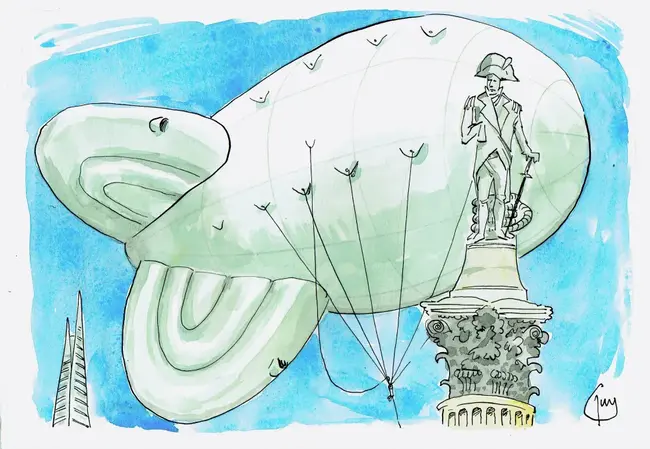
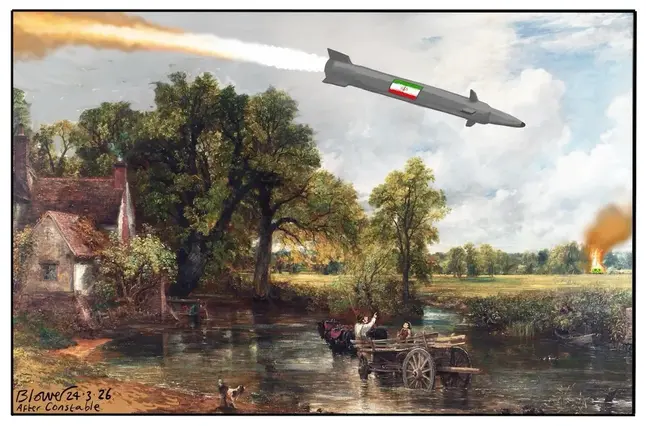
Speaking of prop bets, one of the things a reporter was confronted over had to do with a missile that struck an Israeli village. The guy who reported on it was offered a bribe, then threatened, to rewrite his story and say it was a fragment, not a whole missile, because some slobs had placed a prop bet that wouldn’t pay off if a missile landed there.
Which makes me wonder if Britain being within range of Iranian missiles has attracted any prop bets? Because it’s caused Venables to recall the days of the blitz when London was festooned with barrage balloons, and it’s got Blower redoing Constable’s idyllic landscapes.
Surely somebody’s got a few quid on Big Ben or St. Paul’s being hit. I wonder what odds you’d get if you bet on both? (And if you think that’s a sick thought, how sick is it to suspect I’m right?)
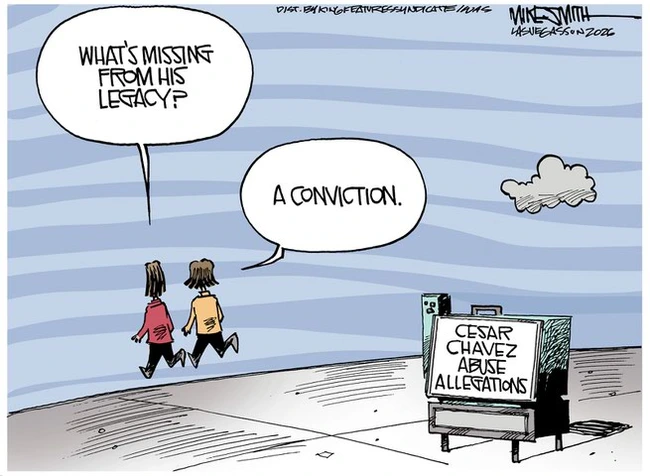
On a more serious note, I found Smith’s cartoon a head-scratcher. On the one hand, he’s right that Chavez is innocent until proven guilty with due process in a court of law with the right to face his accusers and so forth and so on.
I hate being disillusioned, and not only did I boycott table grapes and non-union lettuce for years, but I could recite every word on Bill Cosby’s first album. He just got nailed again for over $19 million, but he got due process, and Smith is correct that we don’t really know if Cesar was guilty. Or if Jeffrey Epstein was.
However, go read that NYTimes article again and then tell me renaming a street is cruel and unusual punishment.
If one woman said it happened, I’d give him the benefit of the doubt, and if two say it, I’d want to find out if they know each other.
However, while I’ve never seen Mount Kilimanjaro, enough people say they have that I’m not gonna call it the Alleged Mount Kilimanjaro, reportedly on the Serengeti Plain.
Nor am I gonna doubt all those women, or those DNA tests. Over a jail sentence, sure. But not over renaming a damn park.
How’s about we stop naming things after people and name them after movements and ideas? I’d rather see Campesino Square and a plaque explaining it, with whatever names you think belong there.
Because it sure felt like a group effort.
Mike Peterson has posted his "Comic Strip of the Day" column every day since 2010. His opinions are his own, but we welcome comments either agreeing or in opposition.


Comments 15
Comments are closed.