CSotD: A Thousand Times Before Their Death
Skip to comments
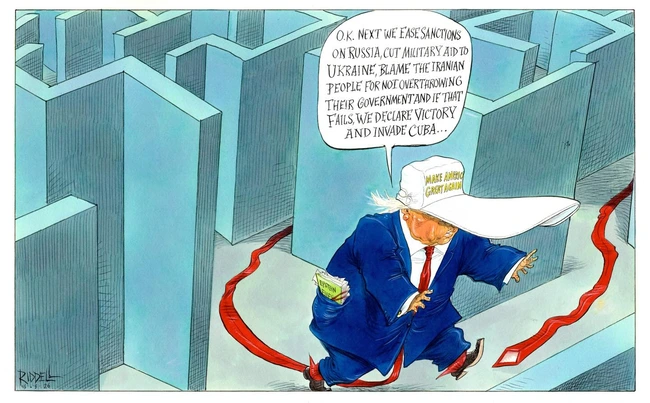
Riddell suggests that Fearless Leader doesn’t actually know where he’s headed or what he’s doing. It’s an interesting addition to other cartoons that have featured a maze, because we’ve even seen leaders with military experience and well-defined goals blunder into a labyrinth when they try their hands at asymmetric warfare.
It’s often said that generals try to fight the last war instead of the current one, but asymmetric war began in Algeria nearly 75 years ago, and it could be well-argued that it was fought by native peoples well before that. Fetterman and his 81 men had been drawn to their deaths 100 years earlier, by an astonishingly simple bluff on the part of Red Cloud and Crazy Horse.
There’s little justification in not knowing how it works.
Meanwhile, when better than on the Ides of March to quote the Bard’s version of Caesar?
A coward dies a thousand times before his death, but the valiant taste of death but once. It seems to me most strange that men should fear, seeing that death, a necessary end, will come when it will come.
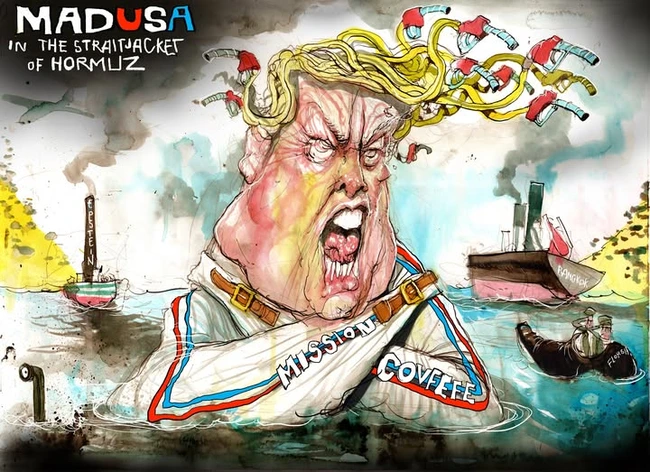
But here we are, and just as Fetterman thought he was only chasing a handful of horse thieves, Fearless Leader didn’t think that the Iranians would choke off the Strait of Hormuz.
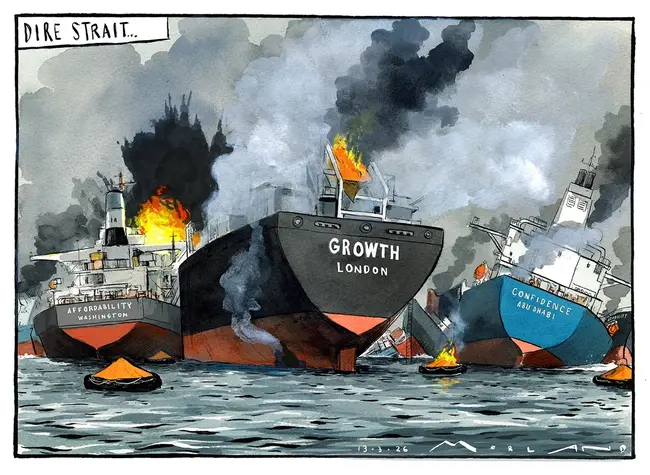
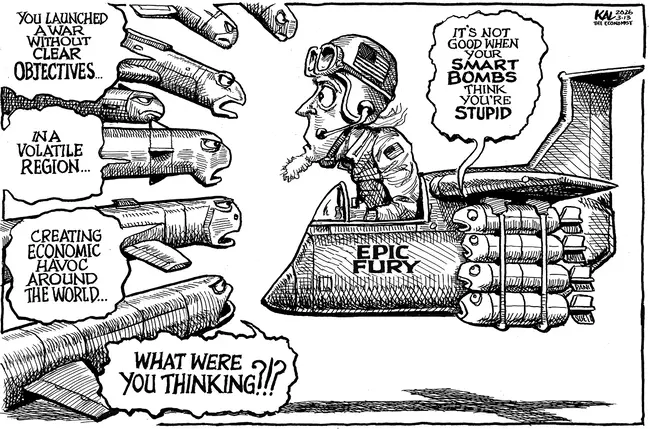
In the wake, when the damage is clear, the question seems obvious: “What were you thinking?” and the obvious answer, if anyone is left to answer, is “I wasn’t.”
Juxtaposition of the Day
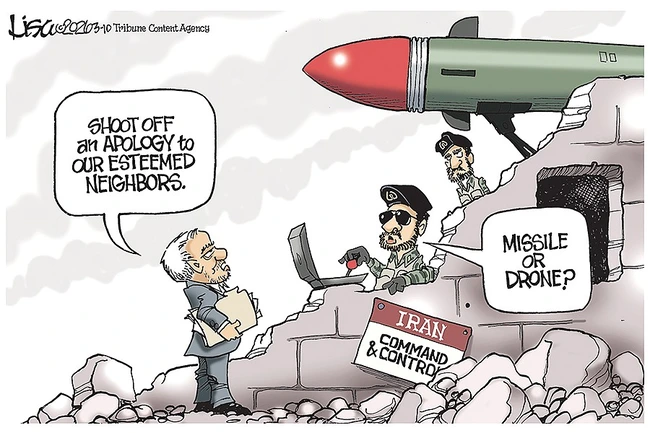
A major factor in asymmetric warfare is blaming your opponent for fighting back, and Benson is horrified that the Iranians would respond to bombs and missiles by launching some of their own. It was just as bad in Vietnam, when burning their villages only seemed to make people there more angry.
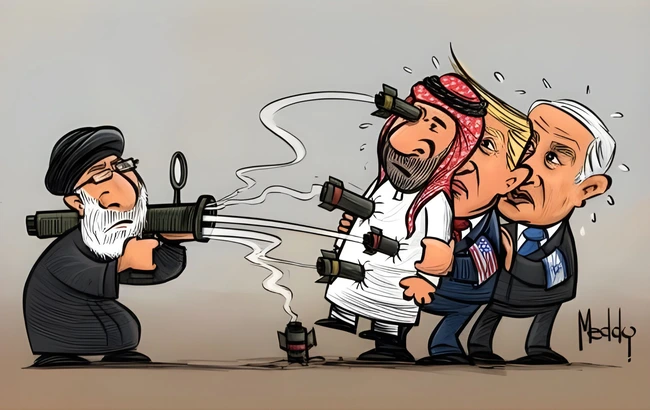
Dr. Meddy has a different analysis, pointing out that Iran’s attempt at counterpunching only harms their neighbors, not their ultimate enemies. But of course the answer is that those who host American military bases are taking sides and can’t claim kinship as a shield.
Arguing over what is admirable and what is counterproductive leads nowhere. The question is what is inevitable, which, by the way, makes “Who started it?” a foolish question because it can always be traced back to something your opponent did. Putin claims Ukraine started their war, Trump says the Iranians started his.

Ella Baron works at the disadvantage of having visited several war zones, spent time talking to the local people and seen it for herself. It is much easier to assess the war from a safe distance, in terms of “them,” and thus to judge effectiveness in technical, rather than in human, terms.
After all, we’re led by a commander who lied to avoid going to war himself, and his assistant, who lobbied on behalf of soldiers convicted for shooting and killing civilians, and who does not believe in war crimes or in following rules of engagement.
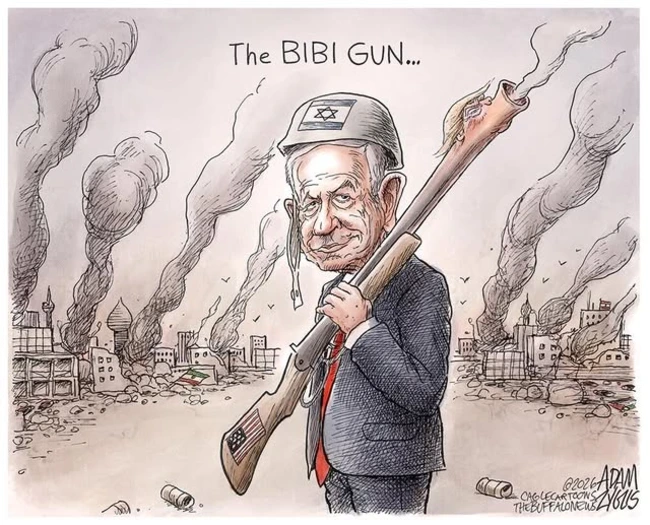
Adam Zyglis sums up both the role of Trump and Hegseth and the rear-echelon stature of Bibi Netanyahu, who seemingly had more to do with our entry into the war than did our own legislature.
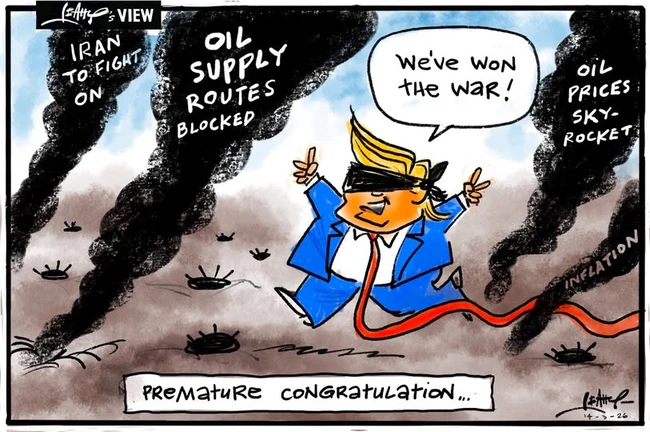
Leahy comments on the vainglorious claims of victory in the face of having touched of a series of crises, and it’s hard to keep up with the latter: Apparently the Houthis of Yemen intend to choke off the Bab el-Mandeb Strait, which is the outlet at the southern end of the Red Sea, in solidarity with Iran.
Closing this off would essentially shut down the Suez Canal, and you may recall the impact on supply chains in 2021 when the canal was blocked by a grounded freighter for six days. If the Houthis follow through on their threat, it won’t look like victory, even to Fearless Leader.
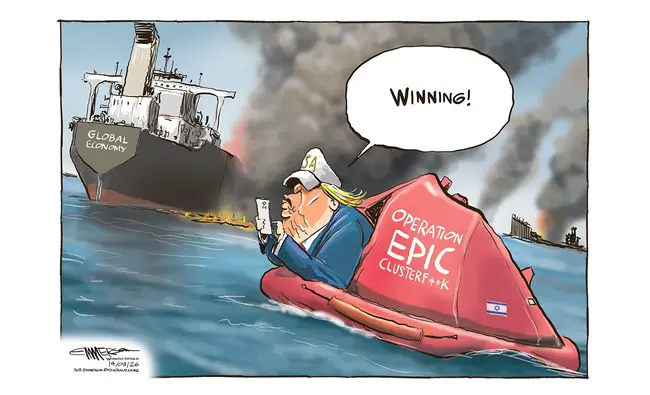
Though as Emmerson warns, we shouldn’t underestimate Fearless Leader’s ability to see triumphs where no-one else can find them.
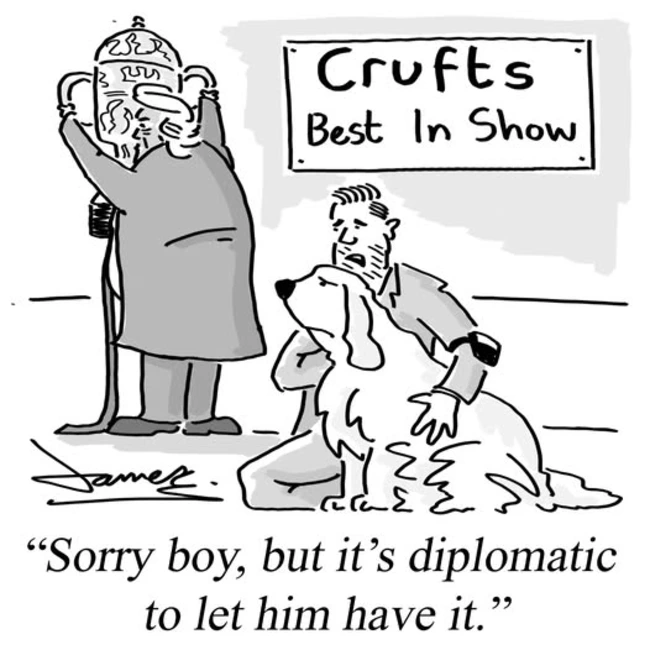
In fact, his irrational, overwhelming lust for meaningless awards and for awards actually given to other people is so well-known around the world that even non-political cartoonists mine it for laughter.
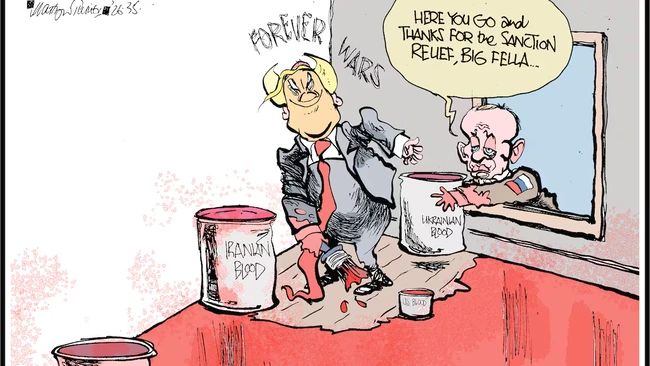
Turner notes that the need to be right and the need to win is so much a part of his personality that he is willing to change coats and alter loyalties in order to get the help he needs to make failure appear to be victory.
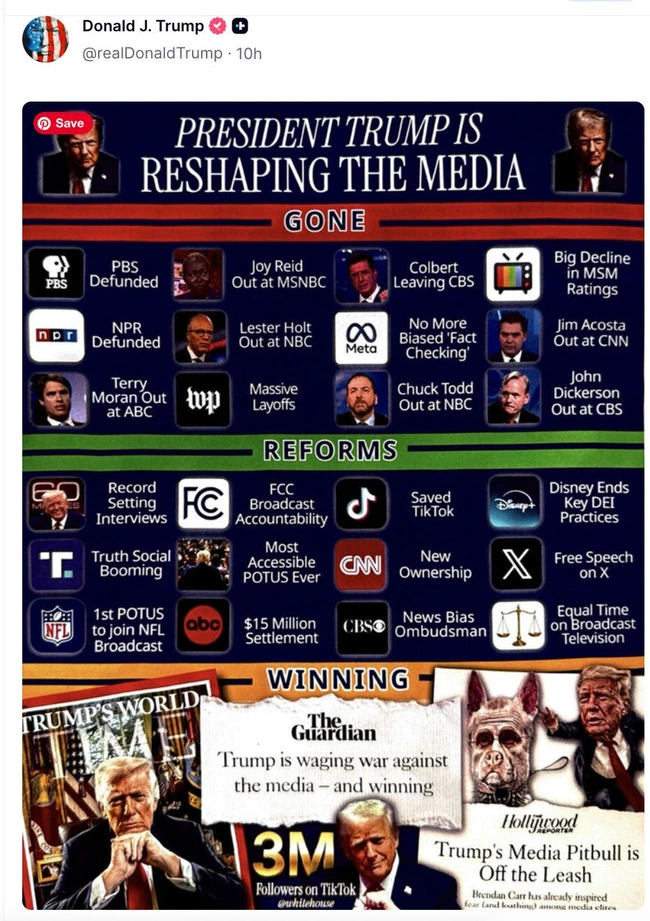
But you’d better look fast, because he is working to control the media, and has a loyalist in charge of the FCC who sees dissent as unpatriotic and something that could cost broadcasters their licenses. When Fearless Leader boasts of choking off the voices of opposition, and you realize what he’s accomplished so far, you shouldn’t assume it’s empty bragging.
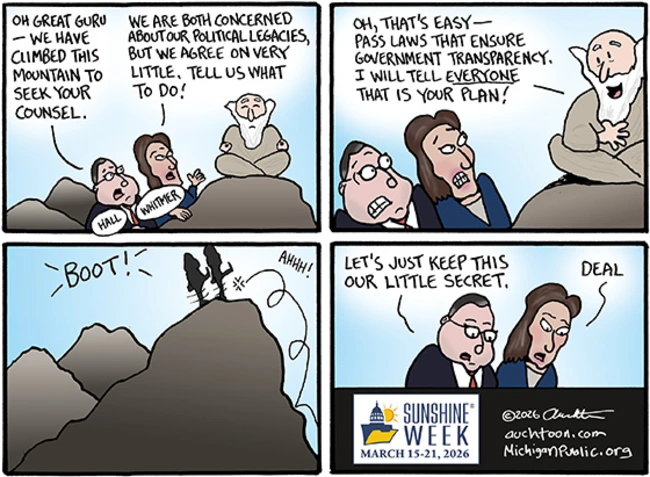
Nor should you wait for someone else to pick up the gauntlet. A few years ago, lots of newspapers marked Sunshine Week and many cartoonists created cartoons celebrating press freedom. This year, I found only John Auchter of Michigan Public Radio offering a cry for transparency.
And public radio has already been put through the wringer, which may explain why his station felt bold enough to come out in favor of the First Amendment.
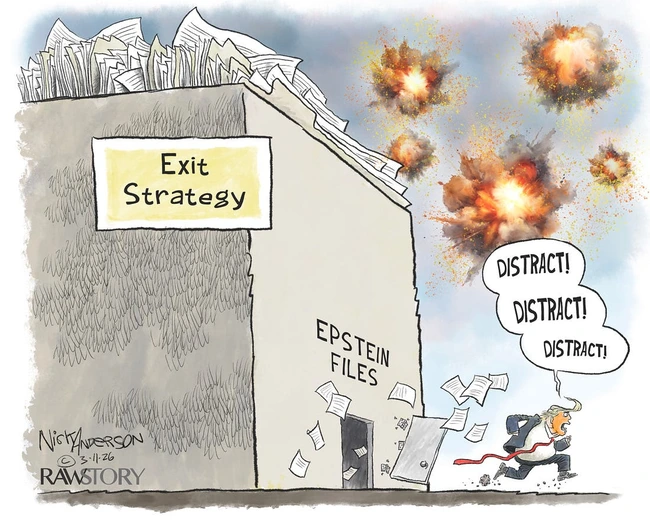
But Nick Anderson indicates the real motivation for the current war, and it’s not about oil, nor is it a sudden interest in human rights in Iran. It is a loud, dangerous distraction, and the real battle remains in unreleased documents and blacked-out names and missing pages.
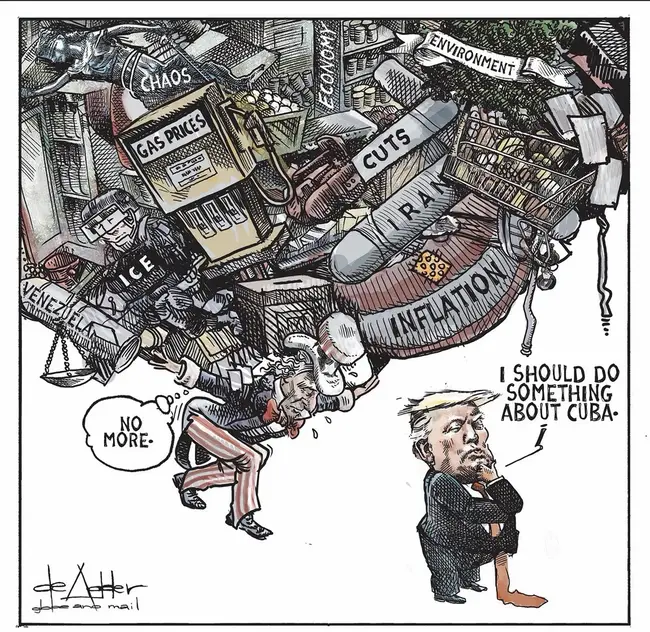
There are plenty of distractions out there, and plenty more if these don’t work.
Don’t be distracted. Use your head. Stiffen your spine.
Keep the faith.
Comments 7