CSotD: I Don’t Believe in Them, but They’re There
Skip to comments
The difference between a skeptic and a cynic is that a skeptic demands proof while a cynic rejects it. The Irish believe in believing, and so take a middle ground, saying of the fairy folk, “I don’t believe in them, but they’re there.”
This is the story of a pooka, or, in Irish, púca, which Rinacat and I taught classrooms about, and of which Yeats wrote
The Pooka, rectè Púca, seems essentially an animal spirit. Some derive his name from poc, a he-goat; and speculative persons consider him the forefather of Shakespere’s “Puck.” On solitary mountains and among old ruins he lives, “grown monstrous with much solitude,” and is of the race of the nightmare.
The story of the Kildare Pooka.
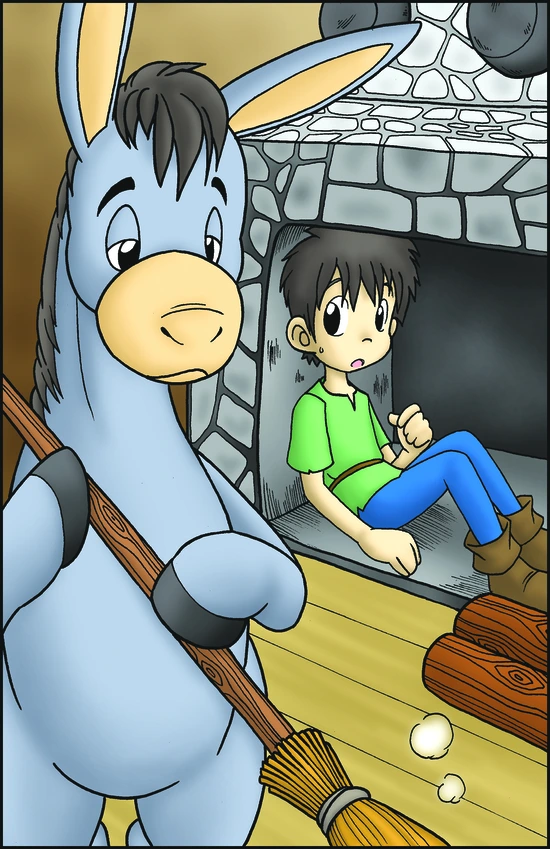
There was once a great house in Ireland in which the servants seldom slept well at all.
It wasn’t that they weren’t tired enough to sleep, for they worked hard all day. And it wasn’t that they were too hungry to sleep, for it was a prosperous home and they were given good food.
But every night, after they’d gone to bed, they would hear noises in the kitchen. They’d hear doors slamming, and cupboards opening and closing, and the clink of plates and silverware and the clattering of pots and pans.
And yet when they came downstairs in the morning, there’d be nothing out of place, and the whole kitchen would be just as spotless as they’d left it the night before.
It was a great mystery and they used to talk about it in hushed tones, but nobody could explain it, until one night when they stayed up late.
They had been talking of the mysterious sounds while they worked, and once they had finished and the kitchen was all clean, they sat around telling stories of ghosts and suchlike.
It got very late, and there was one little fellow, a scullery boy who used to fetch and tote and clean around the place, who wanted very much to go to bed, for he was very tired.
But the stories they told were so scary that he didn’t dare to go up to the attic all alone, so he sat and listened, and at last he climbed into the hearth, which was all cleaned out at one end but warm from the day’s fire, which was now just a pile of glowing coals at the other end of the big fireplace.
He sat listening to the stories until he fell asleep, and when the other servants finished their talk and went off to bed, nobody noticed the little lad in the dark corner.
It was the sound of the door opening that woke him up, and the sound of hoofs on the floor. He looked out, and there was a donkey, big as life, sitting right in front of the fireplace, warming himself at what was left of the fire.
The donkey then put a few sticks of wood on the coals so that the fire sprang up fresh. He looked at the boy for a moment, and then reached in and pulled him out of the hearth, away from the growing fire, without saying a word.
Then the donkey began to fetch pails of water from the pump at the sink, and to fill a great pot which he hung over the fire.
When the water was hot, the donkey began to open all the cupboards and bring out all the dishes and cups and glasses and silverware and put them into the hot water. Then he washed every one of them, dried them carefully and put them back where they belonged.
After that, he swept the floor and mopped it, wiped down all the counters and tables and then dumped out the water from the big pot he’d used to wash the dishes. He rinsed the pot, wiped it dry, hung it back where it belonged, raked up the fire and went out the door.
When the boy told the other servants the next day, they didn’t believe him at first, but then one of the serving girls said, “Well, if the donkey is going to do all that, what are we bothering with it for?”
And nobody had a good answer, so they decided to give it a test, and that night they went to bed without lifting a finger to clean up after dinner.
Sure enough, the next morning, the kitchen was absolutely spotless. And it was the same the next night, and the night after that, too, until the servants got used to the idea that they didn’t have to bother themselves in the evening at all.
This went on for some weeks, until one night the boy decided he’d stay up and see the pooka again (for that indeed was what it was, and not a real donkey at all, of course).
When the donkey came in the door, the boy stayed quiet in a corner for a few minutes, watching as he cleaned the kitchen . As the donkey was getting ready to leave, the boy stepped forward and said, “Excuse me. Can you tell me who you are, and why you come here to work every night the way you do?”
“I work here now because I didn’t work here before,” the pooka replied. “When I was alive, I was a servant here, but a very lazy one who ate the squire’s food and accepted his warm clothes and never did a lick of work to pay him back. So my punishment now is to clean the kitchen every night, for being such an ungrateful, lazy soul.”
“Well, I hope you won’t take it wrong,” the boy said, “but you’ve made our lives very nice indeed. Is there anything we can do to help you out?”
The donkey looked at him for a moment. “Well, the rest of the night I don’t stay in a warm kitchen, and it’s cold out there in the dark. If I had a nice jacket, it would make me a bit more comfortable.”
It took a few days for the servants to make such a coat, but as soon as it was done, the boy stayed up to present it to the pooka as soon as he came in the door.
The donkey tried the jacket on, and turned this way and that, looking back along his gray sides to see how it looked.
“We just wanted to say ‘thank you,'” the boy said, and the donkey smiled and began to leave. “But wait,” the boy called after him. “Aren’t you going to clean the kitchen?”
“My punishment was to learn the lesson of ingratitude,” the pooka said. “I had to work until someone rewarded me for doing my duty. And you have, so now I don’t have to do this anymore.” And out the door he went.
After that the servants were left to do all the work, and to wonder if the pooka had really learned anything at all.
retold by Mike Peterson, c. 2005; illustrations by Marina Tay, c. 2005
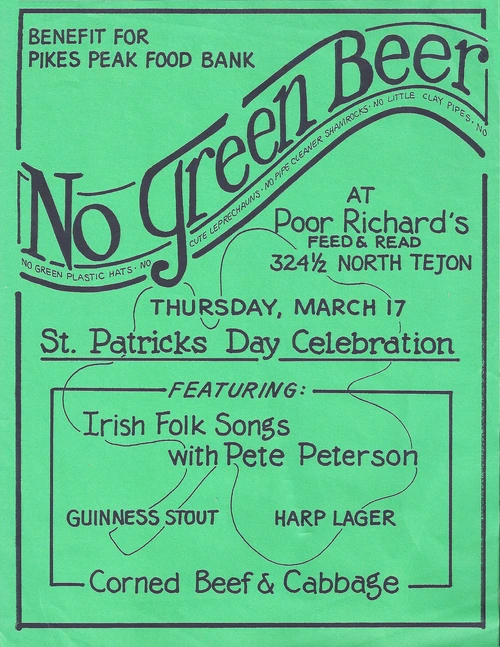
One of my best St. Pat’s came just after my band and my marriage had broken up and I told a very cool local restaurateur that I’d play for free if he didn’t serve green beer or hand out plastic shamrocks.
We had a great night of genuinely Irish craic and genuinely interested people, whom we treated with songs like this:
Mike Peterson has posted his "Comic Strip of the Day" column every day since 2010. His opinions are his own, but we welcome comments either agreeing or in opposition.

Comments 5
Comments are closed.