Cartoonist Chronicles
Skip to comments
Featuring Tom Toro, Cathy Guisewite, Tomi Ungerer, Denis Kitchen, Hunt Emerson, and some comics Boomers may remember.
Tom Toro: New Book and New Interview
Nicole Kinning from GoComics interviews Tom Toro about his new book from Andrews McMeel.
In October, Andrews McMeel Publishing released Tom Toro’s debut cartoon collection, And to Think We Started as a Book Club…. The book gathers one-panel gags from Toro’s 15-year career as a New Yorker cartoonist—including some that never made it into the magazine. Toro, who’s also the creator of “Home Free”here on GoComics, has a wry, laugh-out-loud sense of humor that captures modern absurdity.
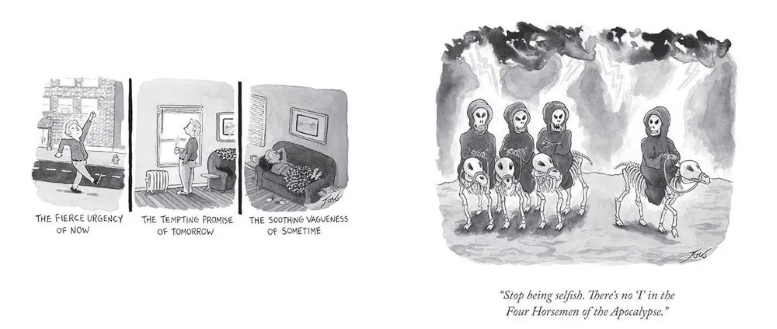
How did you go about choosing which pieces to include?
I knew I wanted to include my greatest hits, the cartoons that have gone viral on social media or sold lots of prints, but I also wanted to pepper in weirder ones that never appeared in respectable publications. In that sense, the collection showcases my full range of humor. There had to be a structure to it as well, so I chose cartoons that fit into thematic chapters. But ultimately, each cartoon had to meet the same basic criteria: be very, very funny.
Cathy, Cartoonist and Comic Character
Cathy Guisewite is also out with a new Andrews McMeel book. Cathy 50th Anniversary Collection is actually a boxed set collecting “curated” (not “complete”) Cathy comic strips in four hardcover volumes. Cathy, the cartoonist not the cartoon, got a visit from Lizz Schumer of People magazine.
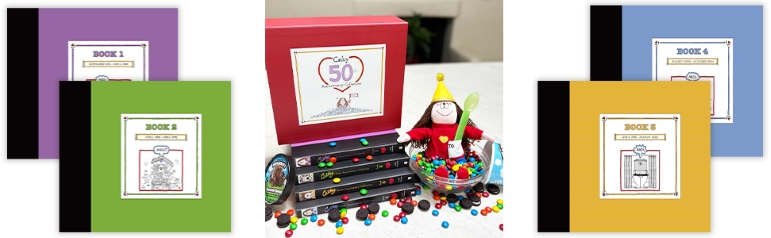
“I had a wonderful career and a miserable love life,” Guisewite tells PEOPLE for a story in this week’s print issue of the strip’s birth in 1976. At the time, she was working as a 26-year-old vice president at an advertising agency.
“One night I drew a picture of what I looked like sitting there waiting and writing and eating,” she says. “The picture made me laugh. And laughing made me feel better.” She sent it to her mom, Anne. “My mother had always encouraged me to keep my innermost feelings private,” Guisewite says. “But she insisted these drawings could be a comic strip for millions of people to enjoy.”


Another one of those lists I have trouble with…
6 Classic Comic Strips Only Baby Boomers Will Remember
MSN re-presents a Son of Grey column about comic strips baby boomers may be nostalgic about.
Long before digital comics and webtoons, newspapers were the daily source of humor, adventure, and social commentary. Baby Boomers grew up during the golden age of newspaper comic strips, when the funny pages were filled with distinct characters, timeless jokes, and serialized storylines that kids eagerly followed every morning. While some classics survived into the modern era, many others have faded from print and memory. Here are comic strips only Baby Boomers are likely to remember.


Naturally a couple of the strips continue in newspapers to this day, though I suppose it could be argued that only baby boomers still read newspapers these days. And Son of Grey acknowledges that:
While the strip technically survives in limited syndication, it no longer holds the cultural dominance it once did, making it a nostalgic memory for many older readers.
While a modern reboot exists today, the version Baby Boomers remember—complete with its peculiar comedic style—is a relic of the mid-century newspaper era.
And then there is this:
Although Little Lulu began decades before the Baby Boomer era, it remained a newspaper staple throughout their childhoods… The strip eventually disappeared from American papers, but its influence lives on in the memories of older readers who adored its gentle humor.
I would argue that The Greatest Generation remembered the Saturday Evening Post panel by Buell and that Baby Boomers remember the John Stanley comic book. Certainly some remember the comic strip, but the small circulation of that puts it in the categories he relegates Dick Tracy and Nancy to.
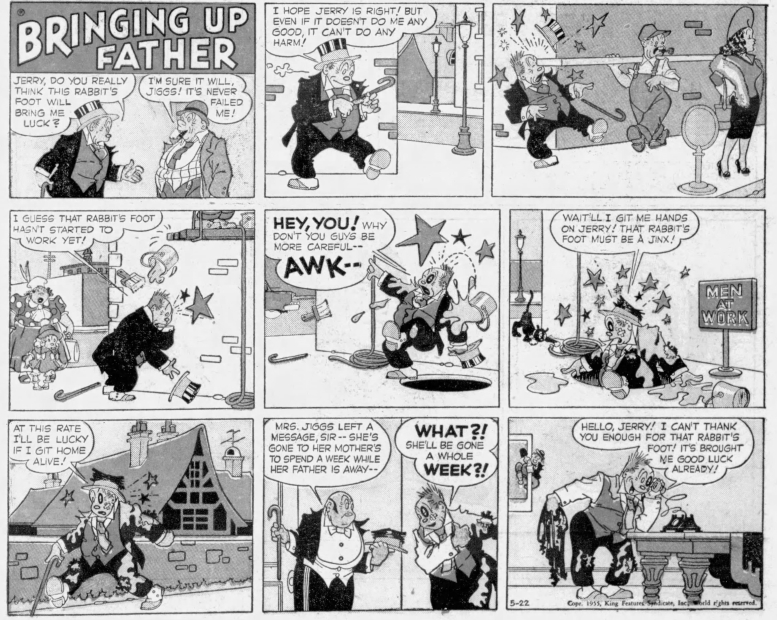
George McManus’s Bringing Up Father followed Jiggs … and Maggie.
Boomers remember its exaggerated art deco style and humorous take on social climbing. The strip ended in the early 2000s, but its popularity had faded long before that.
I would maintain that by the time Boomers were reading the comic strip it had passed from McManus and Zekley to Vernon Greene and Kanvanagh and Fletcher.
Tomi Ungerer Interview from 2015
Steven Heller at Printmag retrieves an interview with Tomi Ungerer from the recent past.
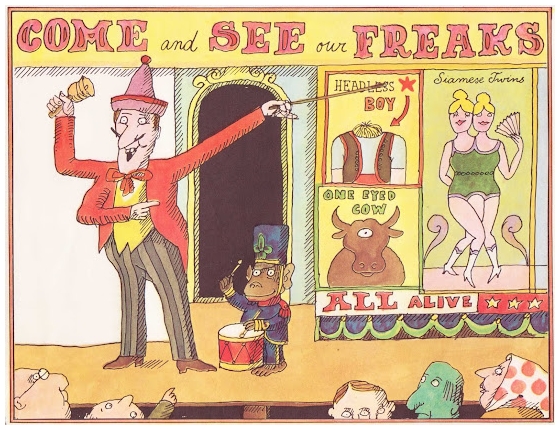
When I was a kid I knew Tomi Ungerer’s (1831-2019) work well from The Underground Sketchbook, which I spent a lot of time copying. It’s crazy that as he was a such an important figure in American graphic humor, graphic commentary and satire, his show at the Drawing Center in New York [January 2015 was] the first of its kind in the U.S.
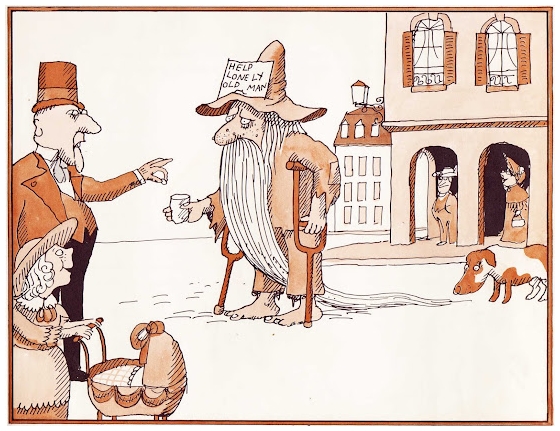
Your advertising campaigns for the Village Voice and The New York Times were brilliant. So why was it that you were essentially banned and had to leave New York?
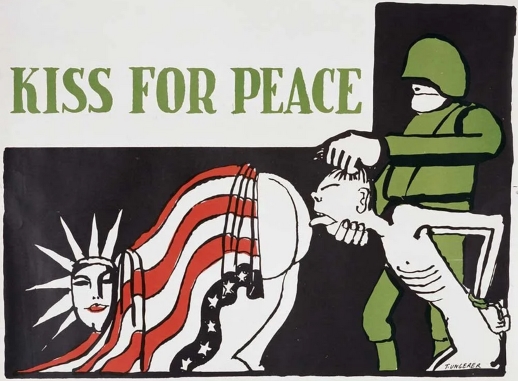
These were the McCarthy years and the witch hunt … and actually I might just as well tell the story: General de Gaulle, the president of France, was the first one to recognize Red China [in 1965] as a state, and me being a French citizen, Newsweek was going to send me to China to make a reportage. I went to Paris and I got my visa, but there was a telex from the State Department stating that if I went to China I would never be allowed back to the United States. So I gave up my trip and came back. In those days Kennedy was Idlewild Airport; I went through customs and I was in the middle of the hall and—this was just like a scenario out of a movie—there was one man on my right, one on my left, one in my back, really the caricature of these kind of guys, you know, with …
Denis Kitchen and the Kitchen Sink
Paul Buhle for Milwaukee’s Shepard Express reviews Conversations with Denis Kitchen.
Let’s start at the beginning, as we can do easily with this volume of interviews collected by comics scholar (and noted curator/exhibitor) Kim Munson. Born in 1946, spending his first years in suburban Caledonia, then onward to high school in Racine, Kitchen published an adolescent ‘zine that predicted much ahead. He went on to UWM, majored in journalism, and put out a college humor magazine, Snide, the first in the school’s history. He was going somewhere, but not Vietnam, dismissed from the Army after 22 days.
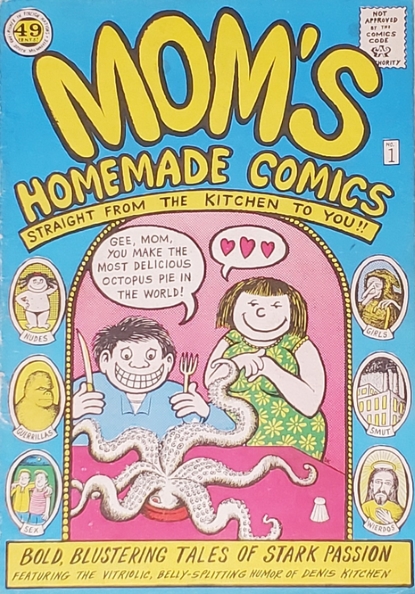
Few may now remember the Great Schlitz Parade of 1969 these days, but it was a perfect place to sell Mom’s Homemade Comics, Kitchen’s newest and most predictive invention. Mom’s appeared just in time to meet the upward climb of the undergrounds originated mainly in the Bay Area.
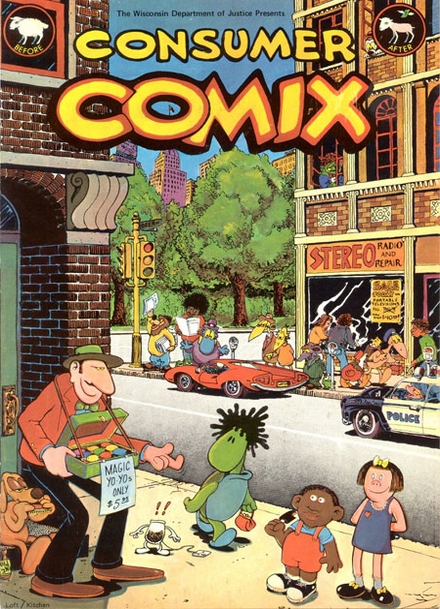
Personally, Denis described himself as a socialist; commercially, he was a counterculture businessman of the most inventive kind. He was also, in his way, a model public servant: he published a highly illustrated Consumer Comx (1975) for the Wisconsin Department of Consumer Affairs, distributed free to all state high school students…
Hunt Emerson, Phenomenist
Sticking with underground cartoonists for another round we have Hunt Emerson‘s upcoming memoir.
John Freeman of downthetubes reveals:
Cartoonist Hunt Emerson – widely acclaimed for his brilliant graphic novels, his creation, Calculus Cat and work for titles as divers as BEANO and Fortean Times – is working on a new memoir with journalist Rory Milne.
Planned for release next year, 50-Odd Years of Big Noses, which will be the focus of a Zoop crowdfunding campaign, is “a sort-of memoir, sort-of interview, sort of biography,” says Hunt.
“It’s a book full of pretty obscure and – dare I say it? – rare comix and cartoons,” he teased this week. “It has a lot of laughs, little-known facts about the Largecow Comix years, and it’s like not many other books like it.
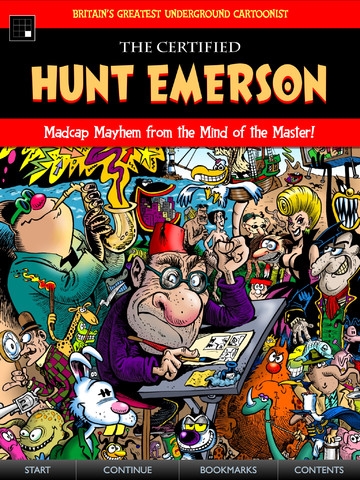

Hunt Emerson is a comics artist and cartoonist who’s been writing and drawing comics since the early 1970s, and he’s still doing it! His comics are published regularly in The Beano, Fiesta magazine, and Fortean Times, and sporadically in many other publications. He’s published over 30 comic books, mostly with Knockabout Comics.


Comments
Comments are closed.