CSotD: Can You Hear The People Vote?
Skip to comments
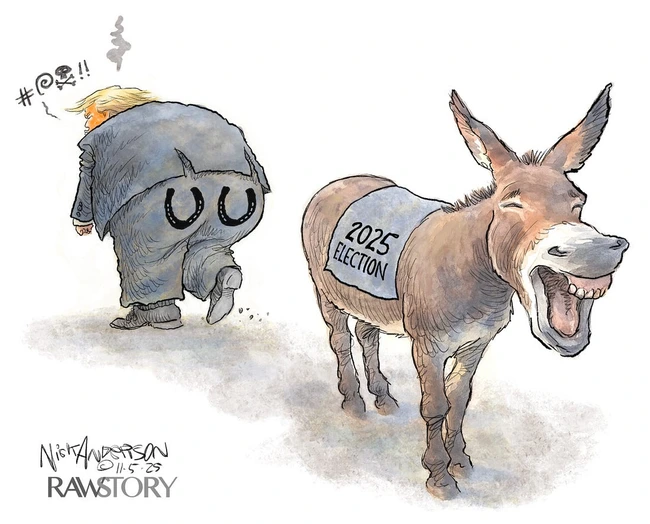
Anderson tells the story economically and all but wordlessly. We assume that whatever Dear Leader is saying doesn’t count as actual dialogue, and the donkey’s smile is so eloquent that the blanket on his back was unnecessary. We all know what he’s hee-hawing about.
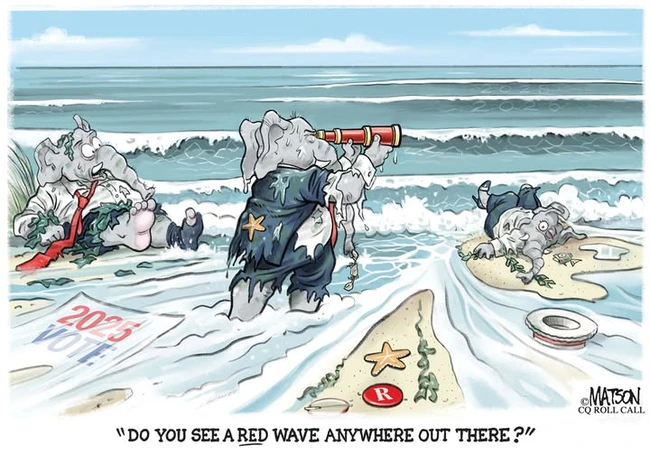
It was, to be sure, a first-class ass kicking, and Matson correctly sums up the response of Republican sources, who are coming up with “The dog ate our elections” excuses for what happened. The big claim seems to be that it only happened in Blue states, which doesn’t explain the number of Republican incumbents who went down and doesn’t explain Mississippi at all.
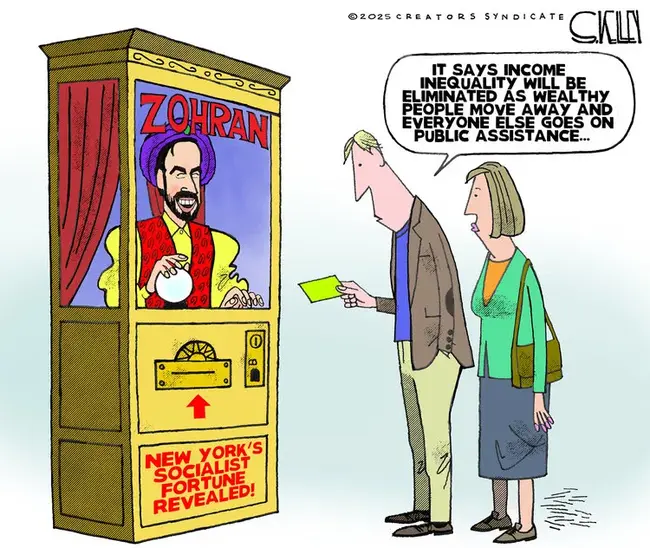
Kelley continues to beat the anti-socialist drum and repeat the prediction that wealthy New Yorkers will pack up and leave, a threat that pops up from both sides in every election and hasn’t come to pass in significant numbers since the Loyalists moved to Canada.
At least Kelley is articulate in his pessimism. Other conservatives seem to have simply repeated the insults and paranoia they aimed at Mamdani before the election. And he makes a clever pun on Zohran and the fortune-telling machine “Zoltar.”
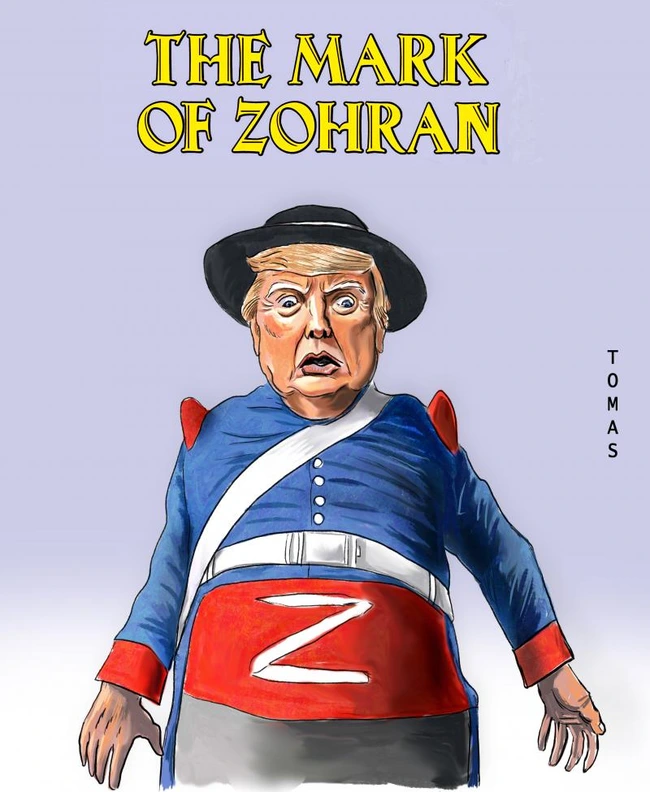
But Italian cartoonist Tomas makes a better pun, going from Zohran to Zorro, as well as comparing Trump to Sgt. Garcia, who was always portrayed as a fat, somewhat dim-witted opponent to the nimble fox.
The fact that an Italian cartoonist is familiar with an American TV show is also yet another sign of our cultural hegemony, as well as a sign that the whole world is always watching.

And it seems Batman has made it to Jordan, though Hajjaj depicts Dear Leader as a villain rather than a comical dupe, and has him facing a more foreboding opponent than the dashing Zorro. There’s not nearly as much triumphant humor here as was seen in Tomas’ cartoon.
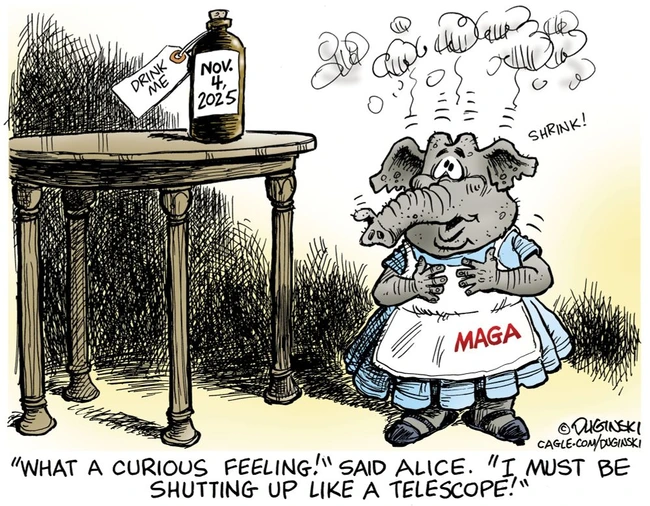
Meanwhile, back in the USA, Duginski makes yet another cultural reference, this one drilling much more deeply into the implications of the elections. In this case, it’s not so much that MAGA was shrunken by the results so much as it was revealed to be smaller and less influential.
Part of that is an echo of a recent complaint about the media. In addition to those who point out that major media covered Biden’s apparently failing capacities far more extensively than they’ve dealt with Trump’s clearly diminishing cognition, there has been discussion lately of how much attention the Tea Party gatherings got a few decades ago, compared to how little attention has been spent on the No Kings rallies, which were much larger.
Meanwhile, Dear Leader has repeated his asinine claim that people have to show identification in order to buy groceries, and still wants Republican senators to do away with the filibuster despite the shrinkage of GOP influence and the stunning resurgence of the Democratic Party.

If the key to the results in NYC can’t be seen in Washington, they seem clear from the vantage point of Australia, where Katauskas sounds a warning to Democrats that they need to take a lesson from that election in particular, though there are similar things to be learnt from the gubernatorial races in Virginia and New Jersey.
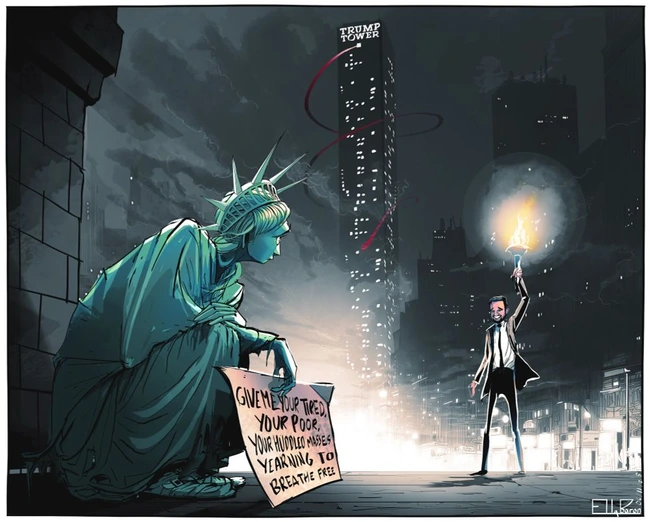
And, from England, Baron submits this sublime commentary, which dovetails with Katauskas’ opinion about filling the real vacuums people feel rather than focus-grouped pap, and, in doing so, Baron obliterates the mass of Statue of Liberty cartoons that have appeared but that say far less about the actual election.
Reaching for the Statue of Liberty is lazy, but she reminds us that it can be done thoughtfully and well, particularly if you focus on its significance rather than just its torch, though she makes astonishing and touching use of that as well.
Is she overly optimistic? We’ll see, but there’s nothing wrong with giving people hope.
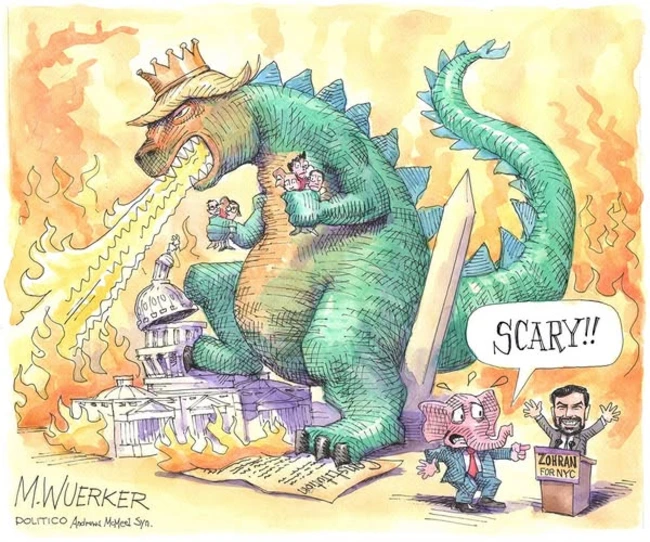
A little optimism may help as we can expect a flood of anti-Mamdani criticism by those who will track every promise he’s made, while ignoring how well candidates of their stripe have done in keeping theirs.
As Wuerker says, the GOP seems obsessed with invoking fear of socialism and hatred of Muslims while ignoring the ongoing challenges to Constitutional law happening on the federal level.

We can expect more of this bigoted hatemongering on social media, and what we need is for more people like Stephen King to stand up to it. Silence, after all, not only implies consent but is largely how we got here.
We need more Stephen Kings to make the point that most Americans are good and decent people, and more No King rallies to encourage each other to stand up and speak up in the face of hate.
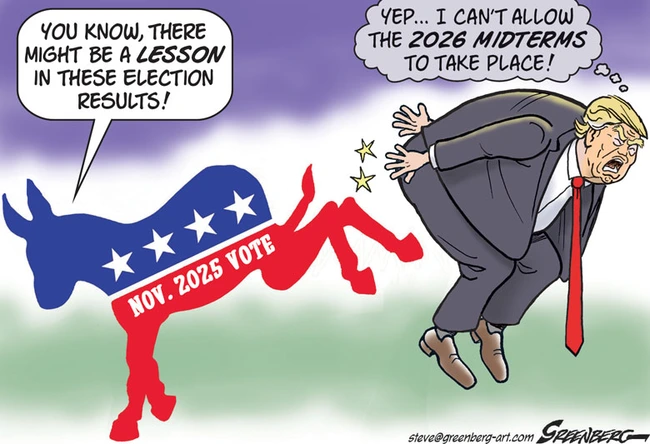
Along which lines Steve Greenberg sounds a warning, just as the courts are beginning to examine the various ways in which the administration is hoping to limit voting. And it’s all well and good that a federal court has struck down Trump’s attempt to impose prove-your-citizenship election laws on the nation, but we shouldn’t sit around hoping for them to preserve democracy.
It seems more important and to the point that voters in Maine — the purplest of allegedly blue states — defeated a ballot measure to restrict voting by a 2-to-1 margin.
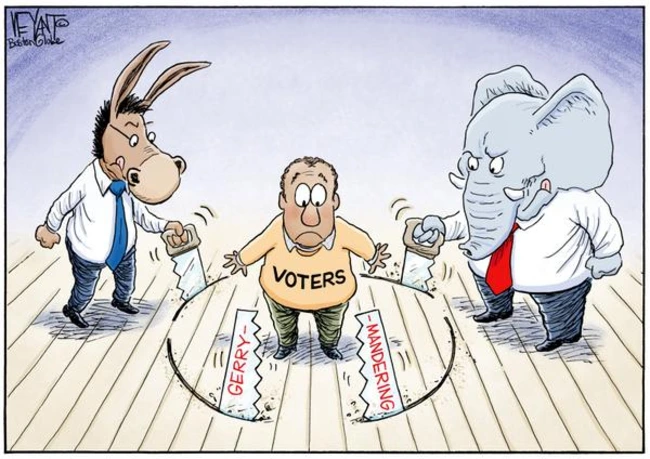
I don’t often disagree with Weyant, but he’s way off-target here. It’s certainly true that gerrymandering works against the intent of democracy and is, therefore, inherently unpatriotic and evil. However, the effort in California — which voters also approved roughly 2-to-1 — is a response to the Republican move in Texas to provide additional GOP seats in Congress.
Much as GOP faithful may whine over the results in California, it carries a strong stench of “He punched me in the fist with his face.” Self-defense remains a valid plea.
Meanwhile, whatever balls and strikes the Roberts Court may choose to call, it’s unlikely that the decisions of lower courts could be appealed and reversed in time to affect the midterms.
And if the midterms echo this week’s results, we could see at least a sea-anchor on MAGA policies, if not a complete reversal before 2028.
Couldn’t someone rewrite these lyrics to fit?


Comments 11
Comments are closed.