TDC@20: Print v Webcomics—Someday We’ll Look Back at This and Laugh?
Skip to comments
As we look back at the last 20 years of The Daily Cartoonist, its history would not be complete without talking about the sometimes contentious four year period between 2007 and 2011 when the comment section often became the center of heated discussions about webcomics and the future of print comics. Most comment threads were civil and productive however any topic involving webcomics often became heated between those in webcomic community and those whose livelihood was based in print.
TDC had four rules for participating in the comments but subject matter, personalities, and internet comment culture tested those rules. I’ll argue things started with the announcement of the launch of the webcomic “Diesel Sweeties” by rstevens. Over the next four years, seven of the ten most-commented posts on the TDC involved the webcomics-versus-print debate. I was an active moderator. For the unruly, I placed some people’s comments on manually approve while temporarily banning others. On February 1, 2011 I announce I had permanently banned a number of cartoonists from future participation and announced I was closing the comments for good—which thankfully was never enforced.
Was I too heavy handed? Not heavy enough? Am I the right person to write about this period of TDC’s history? Maybe, Maybe, probably not? I reached out to two individuals, Scott Kurtz and Ted Rall, who were central figures in those debates. Since both had been permanently banned in 2011, I invited them to recount their experience during this period.
One editorial note before we begin: I interviewed Scott and Ted separately via email. Both were asked the same questions with different follow-ups depending on their responses. I have weaved their responses together into one Q&A for easier reading. Other than spelling and minor grammatical edits, their responses are unchanged.
Alan: First, tell me what you’re doing now. Where has your career taken you?
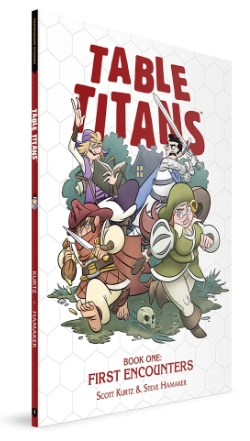
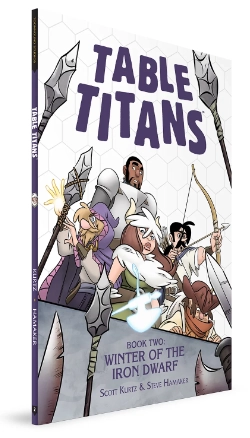
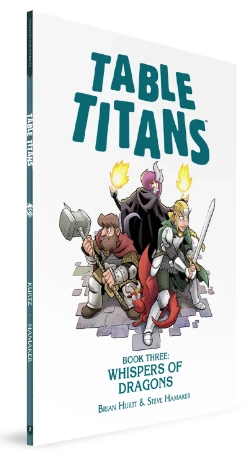
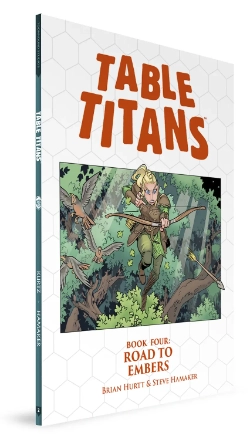
Scott: Well for one, I’m not doing webcomics anymore. PvP went on hiatus when I became primary caregiver for my father in 2018, and I only posted new strips sporadically after that and during COVID. Once I got to a point where I could work consistently again, I didn’t want to return to webcomics and the grind of the daily strip. Nor did I want to jump back on the other grind of finding new ways to monetize online content. Especially after online advertising dried up. It’s a lot to manage a website, online store, convention appearances, and crowdfunding campaigns. Certainly, that’s a young person’s game. I decided to focus on creating comics for younger readers, as that’s where the audience is these days. I got a literary agent, put together some pitches, and we sold a series to Holiday House Publishing in 2022. Our first book, Table Titans Club, came out in March of 2024, and book two hits in March 2026. So these days I’m a kid-lit author and illustrator.
Ted: Like most older political cartoonists (at 62, I’m one of the younger ones!), my client list has evaporated to a tiny fraction of the newspapers and magazines that were running my work back then. Now my clients are specific readers rather than editors—I can hear webcartoonists laughing, he finally gets the “thousand true fans” thing—who support me through direct donations and commissions. I always had a pretty diversified portfolio (editorial cartoons, books, travel journalism, radio). If anything, it’s more diversified now. My main area of growth is doing podcasts, which is bringing in some significant income and feels exciting because it’s growing and the fans are really enthusiastic in a way that cartoons has not in years. When I do a cartoon now, it’s mainly for my own pleasure. I rarely hear any feedback. Podcasts feel like cartooning did in the 1990s, especially in the alt weeklies.
Alan: As far as your experience, do you recall what prompted you to begin what turned out to be a fairly regular four year comment engagement?
Scott: If I recall correctly, the beginnings of my rifts with the NCS and syndicated cartoonists in general started on the old Weisenheimer forum. That was the place in the late 90’s where all the professional cartoonists commiserated online. I was thrilled to get invited to participate in that forum and devastated when it became clear I wasn’t welcome there by everyone. Certainly, things started there.
Ted: My reasons for wanting to post originally were not complicated. I’m a commentator, it’s what I have always done, so it was natural to chime in whenever I read something that I disagreed with or wanted more details about. I love talking to fellow cartoonists. This was that. I care deeply about cartooning as an art and as a profession, so of course I liked to mix it up with my colleagues. Overall, though I found it to a frustrating experience. This was less about TDC than Internet culture, especially younger Internet culture. I came of age during Internet 1.0, when it felt more like an online version of an IRL convo over beers. By 2008, the whole Web had degenerated to namecalling, trolling, and sockpuppeting. I hate that crap. It gets in the way of communicating. As for how I was received, I think there was a culture of fanboyishness that I could never get behind: backstab behind people’s backs, pretend to be nice, praise lousy work that everyone knows is lousy, congratulate prizewinners everyone knows don’t deserve it. Team comics, rah rah. Yeah…no.
Alan: Do you recall how your comments and participation were received initially?
Scott: I remember introducing myself on the Weisenheimer board and being met with not-so-great responses. I was excited about what we were doing to be cartoonists and wanted to share it. The Weisenheimer crowd was not so excited about it.
I’m sure I unfairly forget all the kind remarks I received early on from traditional cartoonists. But I certainly remember being told that by giving away my comics online for free, I was a part of the problem. That by doing so, I was devaluing the worth of comic strips and hurting syndicated cartoonists. I remember trying to share with the forum how we did things, and nobody wanted to hear it. We were told we were not real cartoonists and that we were tee-shirt merchants.
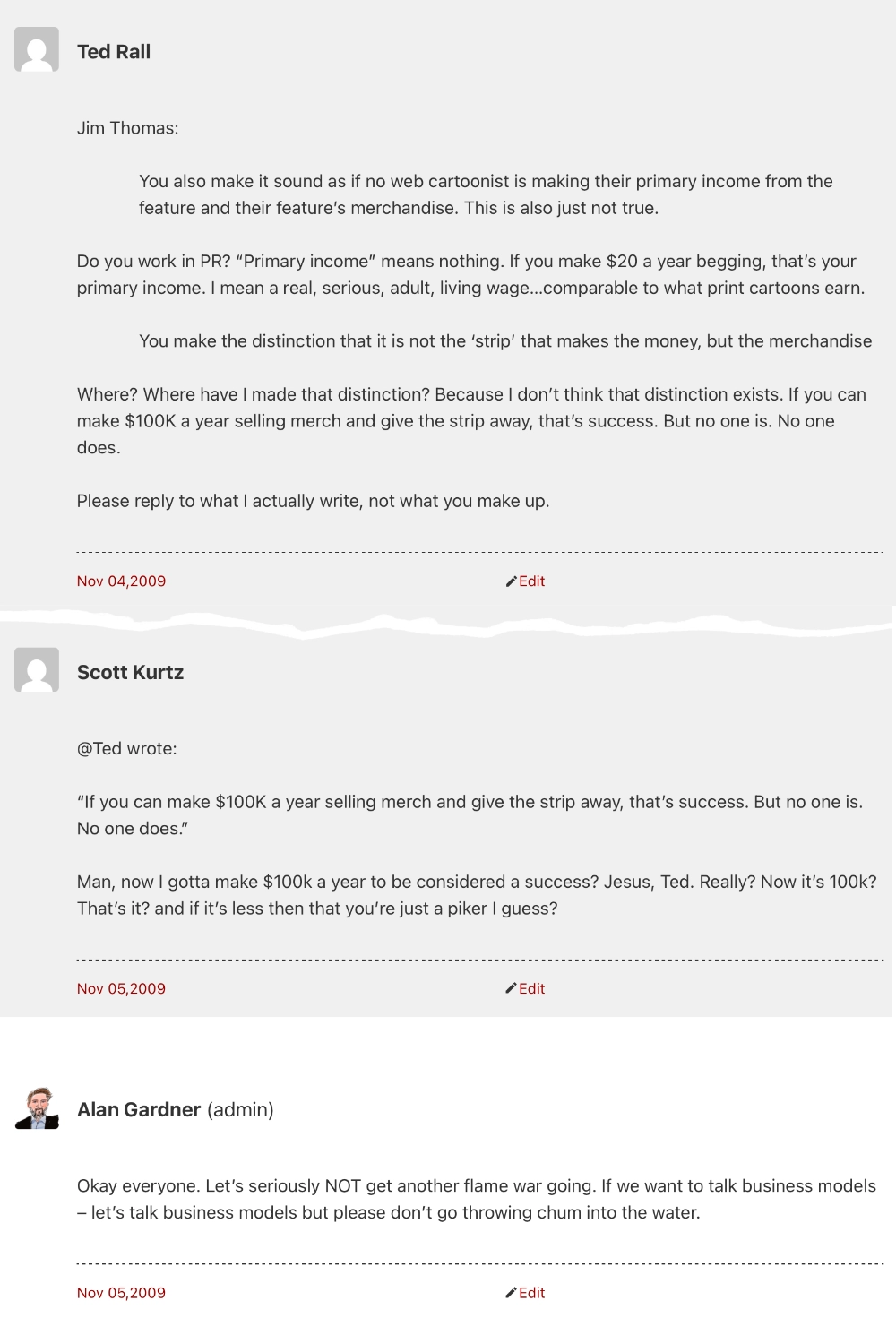
I remember Ted Rall falsely insisting that most of us were “trust fund babies” and that we didn’t really earn a living from our websites and work. He refused to believe we had real businesses and demanded to see our tax returns.
So, the way I remember it, I was really excited about being a full-time cartoonist and joining the NCS (as income from cartooning was a requirement at the time) and being met with “You can’t sit with us” right out of the gate.
Ted: I always thought of the print vs. webcomics discussion as a subset of the broader, highly necessary “what is the future of cartoons/comics/how will people make a living doing this” discussion that had been and continues to dominate a lot of conversations between cartoonists and those involved more broadly in the business. The decline and fall of print was devastating the old monetization models—no one denied that—and what I was personally interested in was a way forward in the digital age. Instead of an intelligent discussion among colleagues trying to work out solutions to difficult professional problems, however, that discussion rapidly degenerated into an even more infantile form of tribalism than usual.
I make no claim to have been above the fray. I gave and still give as good as I get, and I never hesitated to point out bullshit wherever I thought I found it. Looking back, I’m sure I could have been more diplomatic. If I had to do it again, I would. Or I would simply shut up. On the Internet, that usually seems to be the right move.
I’m sure they felt the same way about me, but I found everything about the self-described “webcartoonists” irritating, beginning with the name. You’re a cartoonist, your work appears (exclusively) online—how does that inherently make you different from a cartoonist whose work appeared online as well as in print? It was, of course, a comics genre, a professional subculture that struggled to define itself. I could have been less pedantic. As I saw it, the House of Cartooning was burning merrily and was in danger of burning all the way down to the ground. Of course, there were and still are more ways than ever to distribute comics online, in a basically frictionless way. But the Professional Cartoonist, the artist who lives and breaths political cartoons or comic strips or gag panels or whatever, was on the way to going extinct. Webcartoonists on TDC kept claiming to have The Answer (TM), but it was one they refused to be specific about and it smelled strongly of hype/lies. I wanted to know how a cartoonist could replace a print living, where $100,000/year wasn’t ridiculous to ask. For most webcartoonists, who were satisfied with establishing a fan base and disseminating their work, earning real full-time money wasn’t important. But that’s what I wanted to know, that’s what webcartoonists claim to be able to do, but it was also what they refused to explain credibly.
Alan to Ted: To the question of making a living as a cartoonist, how does one make $100,000/year or at least a living wage depending on where they are living today?
Ted: There is not and never has been a single business model that works for all cartoonists within a genre, much less all cartoonists. No two career paths are identical. Still, some things seem consistent: You are the brand, not your creation. Your readers are the client, not a gatekeeper. The more you control your IP, the more insulated you are from fickle employers. The more you learn to do yourself—coding, distribution, etc.—the more profitable you will be. Diversification pays; specialization is dangerous. Don’t be afraid of extreme styles, opinions, etc.—that’s what people want. None of these things was true 30 years ago. Basically, it is not possible for even the most talented cartoonists to make a living wage from cartooning alone. Sure, there are a few exceptions, but they’re outliers. For the foreseeable future, we have to be realistic and view cartooning as a passion, a hobby, a side hustle. Unless you’re a trust fund kid, you’re going to need a real job. I know, it sucks.
Alan to Scott: How successful do you think you were in influencing anyone toward webcomics or the webcomics model either in the comments or in private conversations?
Scott: No I don’t think I convinced anyone with my comments on The Daily Cartoonist. I probably convinced a lot of people I was an immature asshole though. Ha ha.
Alan: Is the webcomic model that you championed still viable today?
Scott: That’s a really difficult question for me to answer. Things are very different now than they were in the late 90’s and 2000’s-2010’s. There are more resources and existing platforms for creators. We didn’t start with Webtoons, Kickstarter, Patreon, and Substack, etc. But there’s way more content out there too.
Building an audience on social media is kind of over now. Those platforms run on algorithms, not follower counts. There’s no way to take advantage of those platforms for promotions like we used to.
My gut tells me that it’s not as viable, but I’m also in a place where the idea of that dual grind no longer appeals to me. I can’t keep up with the grind of the art and the grind of keeping up with the changing landscape of the web.
Alan: What do you recall of your interaction with me? How do you think I handled moderation of the threads? Do you recall any of the instances of being banned and if so, how did you take it? How did you feel about it?
Scott: First, let me say that you handled moderation like a pro with great aplomb. If and when you ever threw elbows and blew up, it was because you were dealing with a bunch of grown children, and anyone else in your position would have felt the same way.
I remember wanting to fight. And I remember wanting it to be public. You have to understand that the fight started privately. (Rick) Stromoski was working in private behind the scenes to keep me out of the NCS that was confirmed to me by “Arlo and Janis” creator Jim Johnson. I wanted everyone to know what these guys were like. I wanted to fight it out in public. So when you banned me, I was mad that I couldn’t fight anymore. But I was too selfish to consider how unfair it was to use your site or hijack your comments section for that grudge match.
Ted: I was put off by the sense that you viewed moderating comments as a pain in the ass that you would have rather not had to bother with. I get that you are one guy and that moderation can be annoying. But reader engagement matters on the web, and the comments were where that happened on TDC. I concluded that you tended to dislike me and people like me who were opinionated—which is, of course, many cartoonists. I got banned at least once, maybe twice, I don’t remember—snd I felt it was deeply unfair because I adhered, and still do, to a code of conduct online. I answer questions in a straightforward way. I admit when I’m mistaken. I do not namecall. I do not troll. My online persona is little different than my IRL one. I didn’t deserve to be banned and, indeed, have never been banned from any other fora. On the other hand, I figured, it’s his website and he can be as arbitrary and capricious as he wants to. If he doesn’t like the cut of my jib—which was the impression I got—so be it. Nothing was stopping me from starting my own comics news website, and I never did.
Thank you to both Scott and Ted for taking time from their schedules to revisit this period of TDC history.
You can check out Scott’s Table Titans series over on his website.
And also check out Ted’s Podcasts:
Now, let’s all behave in the comments. 😀

Comments 7
Comments are closed.