Sunday Schooled
Skip to comments
News stuff about old stuff and vice versa.
Harvey Kurtzman MAD Logo Illustration Original Art
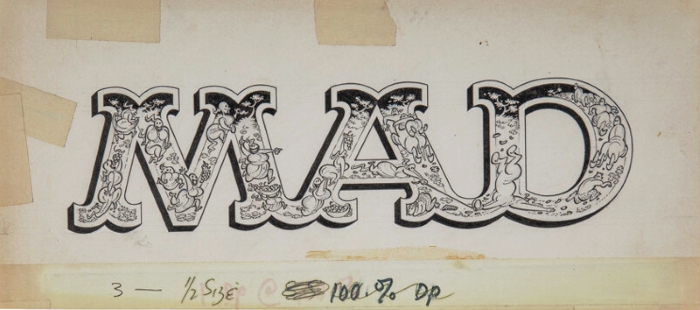
Heritage Auctions is previewing a coming item they will be putting up for bid:
When Harvey Kurtzman created this MAD logo art for the new magazine format that started with issue #24 [link added], he gave visual form to the comic’s unruly heart. Each letter swells with playful, doughy figures locked in an endless frolic, capturing the madcap energy that fueled every issue. Though the in-logo characters vanished after issue #95…
The news of this coming auction inspired Mark Evanier to blog about the logo’s history:
The fine folks at Heritage Auctions are about to auction off the original artwork to the second logo — the one that became pretty much official — and a lot of online folks are unaware there were two versions of that logo. There were, of course, lots of variations of it on MAD and MAD products over the years. Kurtzman’s nymphs took the covers of #55, #67, #78 off, were parodied on the cover of #76, and then disappeared after #86 only to reappear on #93, #95 and very rarely after that. Sergio Aragonés, Al Jaffee, Don Martin and Antonio Prohias all took turns replacing Kurtzman’s creatures with their own.
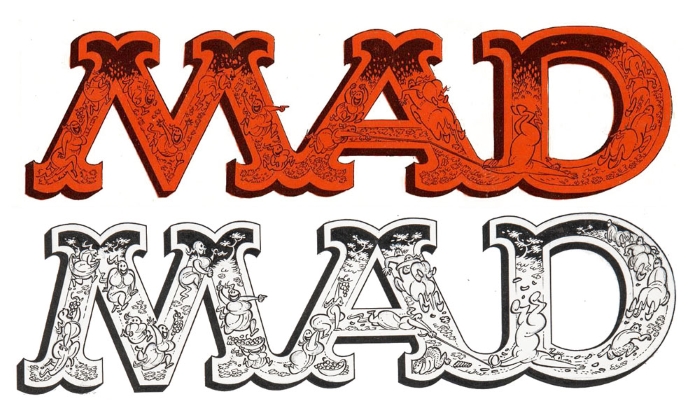
When The New Yorker Banned The Addams Family
Witney Seibold for Slash Film tells why The Addams Family cartoons disappeared from The New Yorker.
Charles “Chas” Addams began working as a cartoonist for the New Yorker in 1932, regularly turning out single-panel cartoon strips, typically with a macabre edge. In 1938, he drew a strip with a striking family of ghouls living in a haunted mansion, clearly rejecting the cleanliness, light, and verve of average American homes. The unnamed haunted house family soon began making regular appearances in the New Yorker, eventually rounding out to seven members. The creepy clan, nicknamed the Addams Family, appeared in 58 of Addams’ strips in the 1950s. They were very popular…
Addams’ family was adapted into a TV sitcom in 1964 (called, natch, “The Addams Family”), further cementing their place in the pop culture firmament.
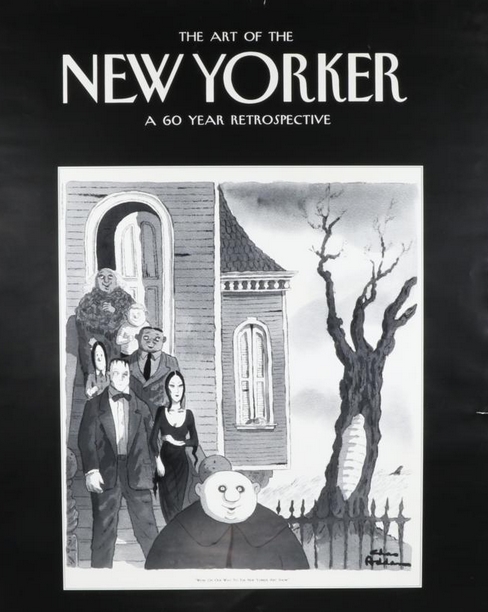
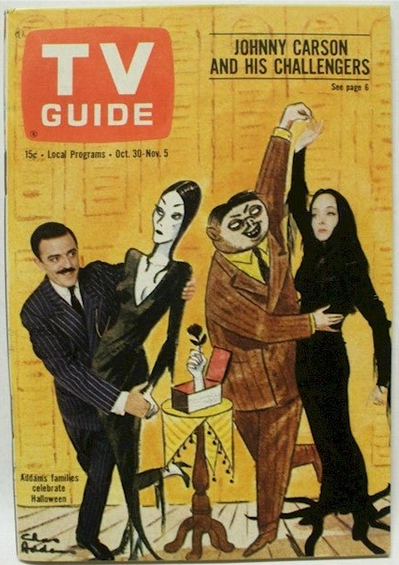
However, according to various sources around the internet (including an artist profile at the Swann Gallery and a 2019 article in Smithsonian Magazine), the sitcom caused a bit of a stir at the New Yorker offices. It seems that editor William Shawn hated the “Addams Family” sitcom so much (mainly for its “low” humor) that he banned Chas Addams from drawing any more Family cartoons…
Playing Out the Layout
Many single panel newspaper comics are created with vertical and horizontal versions to give editors a choice of how to present the comic to their readers. In this week’s News from Wayno® (scroll down) Wayno describes a recent, particularly troublesome, Bizarro panel and how he dealt with it.
As many of you know, every day I produce Bizarro in two different layouts. There’s the vertical panel, which I think of as the “normal” one, and a horizontal strip for newspaper clients who choose to run it that way.
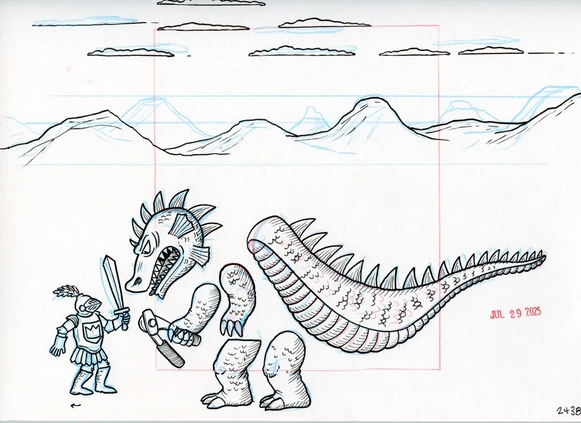
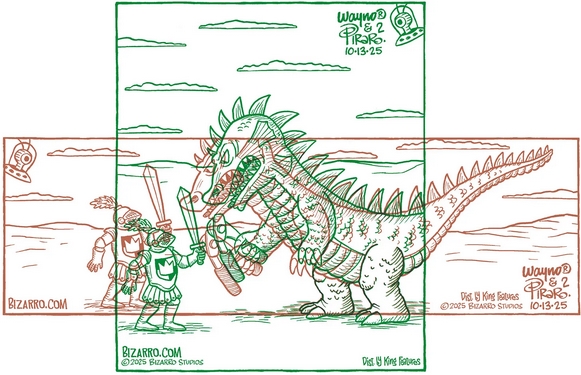
I knew that the dragon in the panel would be too tall for the strip unless I significantly reduced its size, but shrinking the art that much would have made the knight too tiny to read in print…
In Retrospect
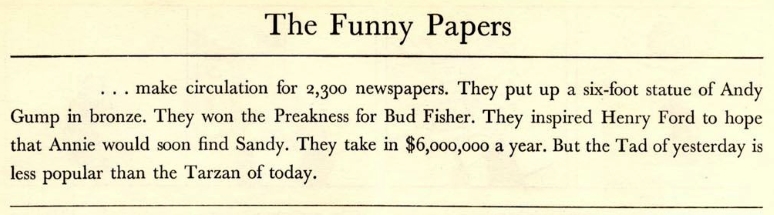
At Panels & Prose Sreve Smith reviews the accounting and assumptions of a 1933 Fortune magazine article about comics strip with the help of nearly a hundred years of hindsight.
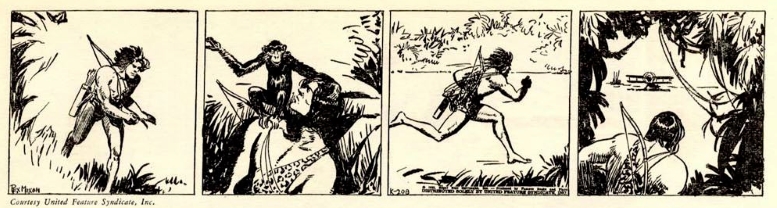
Who could say such a thing in 1933, just as Flash Gordon, Dick Tracy, Buck Rogers, Tarzan and Terry were about to launch what many consider a “golden age” of American comic strips? But in a major feature in its April 1933 number, Fortune magazine lamented the new adventure trend as a sign of the medium’s decline. In their telling, comics were losing an antic, satirical edge that had distinguished them from the gentility of American literature or saccharine romance of silent film. In particular, the Fortune piece (unattributed so far as I could tell), bemoaned the rise of the dramatic “continuity” strip in place of gags. They single out Tarzan in particular as a corporate product that suffers from too many scribes and artists not working together. “The strip wanders through continents and cannibals with incredible incoherence,” they say. And to be fair, who could have foreseen in 1933 that Flash, Dick, Terry and Prince Val were about to redirect the “funnies” from hapless hubbies and bigfoot aesthetics towards hyper-masculinized heroism and a new realism that readers found far from “spurious?”
Onion Cartoonist Stan Kelly Does The Simpsons
All American political cartoonist Stan Kelly guest arts tonight’s The Simpsons introduction.
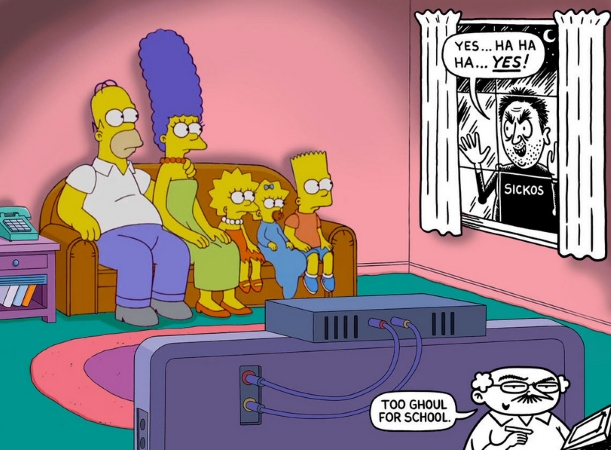
Stan Kelly, editorial cartoonist for The Onion, makes his animation debut as a featured guest artist during the opening segment of The Simpsons. The 20-second segment will be part of “Treehouse of Horror XXXVI,” [link added] the latest installment of The Simpson’s annual Halloween special, airing October 19.
Kelly, who has refused AAEC membership, declined to comment. But his alter-ego, cartoonist Ward Sutton, provided the following statement from Kelly about the upcoming animated segment:
“Finally! I’ve broken through the glass ceiling for old, white men hoping to work in animation: I’m gracing The Simpsons as Guest Artist for the opening segment of this year’s “Treehouse of Horror” episode, which will debut Sunday, October 19.* Be sure to tune in. As I tell all my lovers, this might just be the best 20 seconds of your life.”
feature image is detail from The Simpsons October 19, 2025 opener

Comments 3
Comments are closed.