Wayback Whensday: ImageTexT v15#3
Skip to comments
ImageText, a web-based journal from the Department of English at the University of Florida with free and full public access, has released their most recent and very interesting issue (Vol15 #3) with four feature articles.
The articles are:
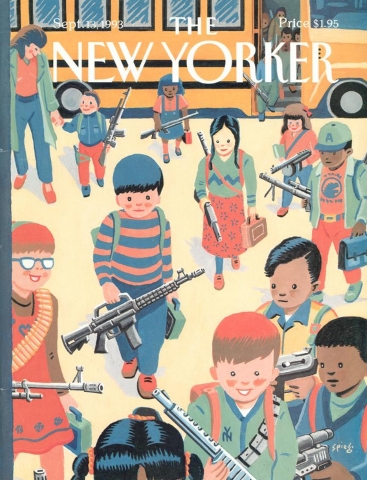
Chris Ware’s New Yorker Covers and American School Shootings by Ryan Banfi
The New Yorker commissions and accepts Ware’s art, which critiques social issues in the U.S. Evident from his comics, Ware’s work is rife with anxiety, and those worries translate to his New Yorker magazine covers, which explore subjects such as techno-culture and school shootings. According to Ware, The New Yorker’s covers remain one of the few vital ways for artists to speak truth to power within the mainstream media news cycle. He states, “The one thing that magazine designers and editors just don’t get now is that one of the real powers of a New Yorker cover in and of itself is that there is no type on it. It is an image. Moreover, it has a power to itself that allows the artist to make the image” (Slauter 195).
This article explores Chris Ware’s depiction of gun violence in the U.S. by analyzing Ware’s school shooting New Yorker covers: “Back to School” (September 17th, 2012), “Threshold” (January 7th, 2013), and “Lockdown” (October 17th, 2022). While Patrick Jagoda and Hillary Chute describe Ware’s New Yorker covers as innovative because he “introduced sequential narrative to The New Yorker” (3), Ware’s covers (such as these three) primarily consist of single images.
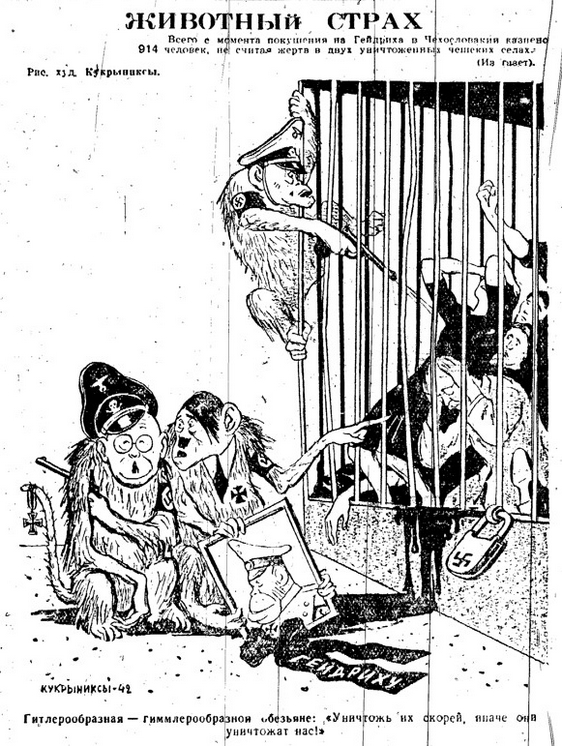
Hitler’s Dogs: Non-Human Animals in Soviet Political Cartoons of the “Great Patriotic War,” 1941–1945 by Reeta Kangas
During wartime, propaganda has a significant role in raising the fighting morale of the nation as well as in stirring up animosity towards the enemy. One of the most famous artists groups taking part in the visual propaganda effort in the Soviet Union during World War II was the Kukryniksy trio, consisting of Mikhail Kupriyanov, Porfiri Krylov and Nikolai Sokolov. Their use of symbolic devices derived largely from cultural memory. In this article, with close reading and contextualization, [Reeta examines] the interplay of the visual and textual devices in Kukryniksy’s work during the “Great Patriotic War” (1941–1945). More specifically, I concentrate on the political cartoons with non-human animals in them. The animal symbols vary from ones evoking fear and hatred to ones that humiliate and belittle.
Visualizing Prejudice: Australian Cartoon Focused on Attacking Chinese Men and White Women’s Relationship, c.1870–1888 by Harry Jiandang Tan
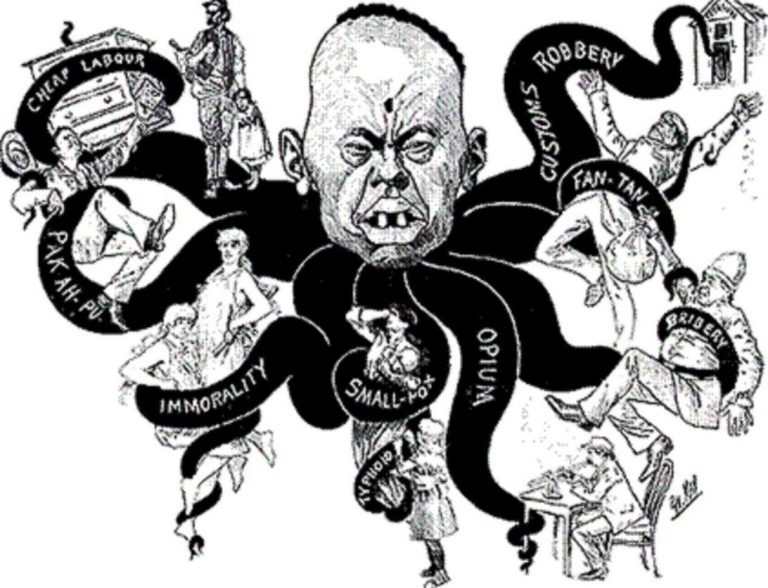
This article analyses a significant series of cartoons published in Australia since the 1870s that targeted relationships between Chinese men and White women, frequently casting Chinese men as morally corrupt figures. Iconic works such as Thomas Selby Cousins’s Christian Mothers Selling Their Daughters to the Chinese, Phil May’s Mr. & Mrs. Sin Fat and The Mongolian Octopus became central to anti-Chinese visual rhetoric, employing exaggerated themes of immorality to incite public fear and deepen racial prejudice. Through systematically crafted symbols and visual narratives, these cartoons portrayed Chinese individuals as a societal menace, fostering racial hostility and embedding anti-Chinese sentiment within Australian society. The symbols employed in these works functioned as powerful tools of visual propaganda, inciting prejudice and framing exclusionary policies against Chinese laborers as moral imperatives. This study situates these cartoons and their creators within the broader context of Australian political history, examining the evolution of anti-Chinese visual icons, the narratives that supported them, and the ideological foundations they established for subsequent anti-Chinese political discourse.
Mainstream “Comix”: Examining Political Limitations in Comics at the Intersection of Underground and Mainstream by Eli Lerner
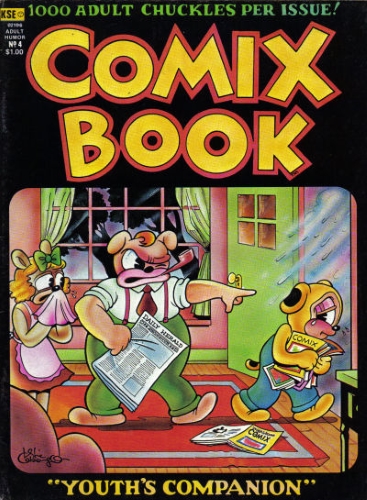
Scholars exploring the history of the comic book industry in the United States frequently operate under the assumption that there was a sharp division between politically timid mainstream comics and politically radical underground comix. However, few have zoomed in on the comics in the gray area between the mainstream and the underground and attempted to locate that dividing line. Through a case study of mainstream comics that incorporated elements of the politically subversive underground comix movement, Howard the Duck and Comix Book, in comparison with a similar underground comix magazine Arcade: the Comics Revue, [Eli attempts] to locate the barrier that separated mainstream and underground comix. Unsurprisingly, Eli finds] that there was a rigid barrier preventing mainstream comics from including as much explicit content as underground comix. This was largely motivated by the corporate drive for mainstream comics publishers to uphold a reputable brand image. However, the idea that mainstream and underground comics are politically separated by this barrier flattens a nuanced reality. In fact, mainstream comics could, and did, take many of the same radical political stances as their underground counterparts, although underground comix framed those statements in a more provocative manner.
plus:
A Review of Robin Ha’s The Fox Maidens by Hyunjung Kim
A Review of Jordan Holt’s Theseus Volumes 1 and 2 by Patrick Callahan
Taylor Swift Illustrated: A Class Project – illustrations inspired by Taylor Swift songs


Comments 1
Comments are closed.