CSotD: They are who we thought they were
Skip to comments
Dennis Green is gone, but his rant lives on, not because it applied to a football game, but because it continues to apply to people who look a threat straight in the eye and decide not to see it.
Green said what he should have said, but that’s what nobody ever says because we’d rather be polite and analytical and logical and not admit how badly we misjudged a critical situation.
It’s nice and safe and kind of funny when it’s applied to a football game, but not so amusing when the stakes are higher.
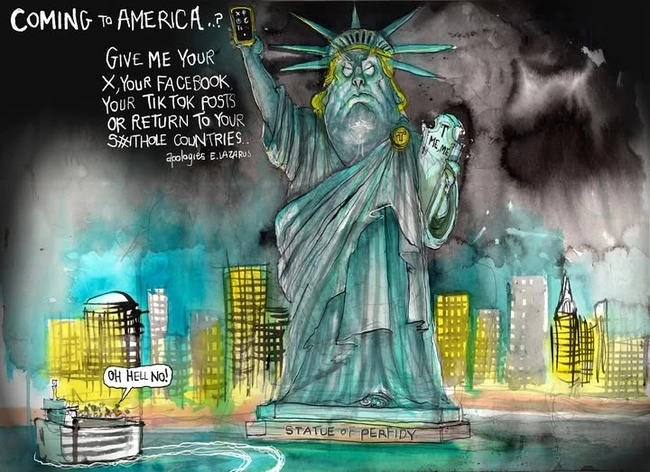
Now here we are facing a situation in which he is who we thought he was, and we’ve let him off the hook. Dennis Green demanded to know why you’d bother to even play if you weren’t going to take things seriously, and Olivia Troye demands to know the same thing, but on a much larger, more important scale.
Troye knows as much about national intelligence as Dennis Green knew about football, and her essay is headlined “I’ve Sat in the Rooms Where These Are Written. This One Stunned Me,” as America shifts its attitude towards the world away from the understanding that has prevailed at least since World War II.
As Rowe puts it, we’ve shut down the symbol of welcome that was once our public image, and have retreated not just into isolationism but into active hostility towards the rest of the world. The most absurd, insulting evidence of this shift is a proposal to make all tourists submit five years of their social media postings for approval before they can enter the country.
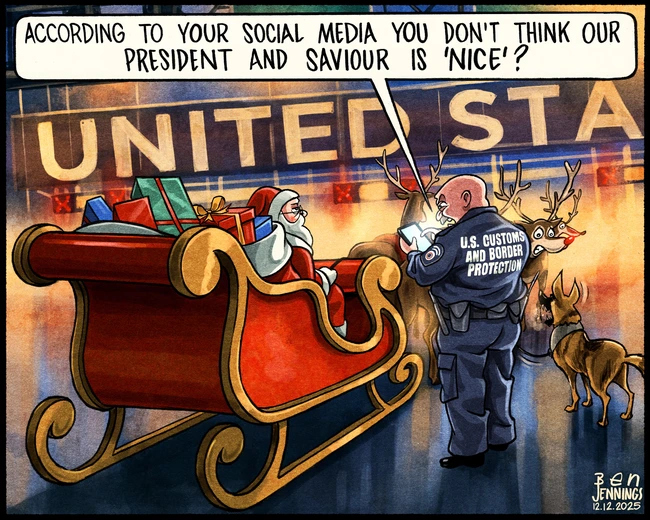
Jennings calls it a level of inquisition that Santa Claus himself couldn’t pass, given that the obvious intent is not to screen people but to find reasons to exclude them, which may not be firmly stated in the proposal itself but is made clear by remarks confirming Trump’s disdain for people from “shithole countries” and his preference for those from Scandinavian nations, and cultures.
Which is a nice way to avoid using the term “Aryan,” but, as Dennis Green would say, they are who we thought they were.
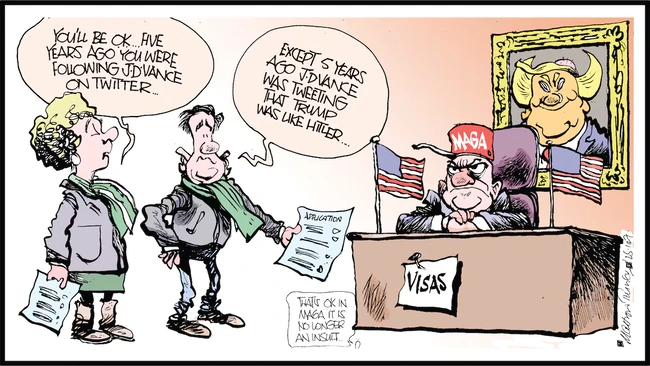
Turner points out that, if you apply the proposal with the milquetoast innocence of its surface, half of Trump’s cabinet would be denied entrance. To put an innocent spin on the concept, and on the fundamental attitude behind it, goes well beyond naive and deep into intentional ignorance.
It’s important to read Olivia Troye’s well-reasoned, well-experienced explanation of our shift in national priorities. To ignore the situation means letting them off the hook.
If you want to crown them, that’s your choice, but letting them off the hook appears to have been ours.
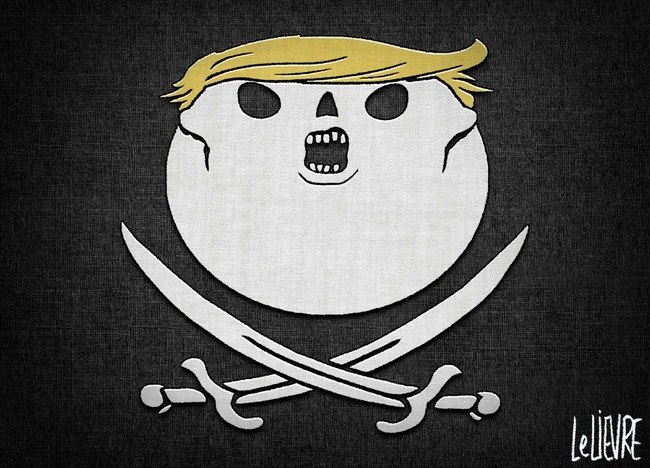
Le Lievre is one of several cartoonists and commentators to observe that seizing ships on the high seas is piracy. Obviously, in a state of war, such seizures are normal, but we’re not in a state of war, nor has Congress passed any legal statement imposing sanctions that would justify our seizing an oil tanker in international waters.
The problem I have with Le Lievre’s imagery is that it seems humorous, and could be viewed as dismissive, as a chuckle and a pat on the shoulder of “Naughty boy!”
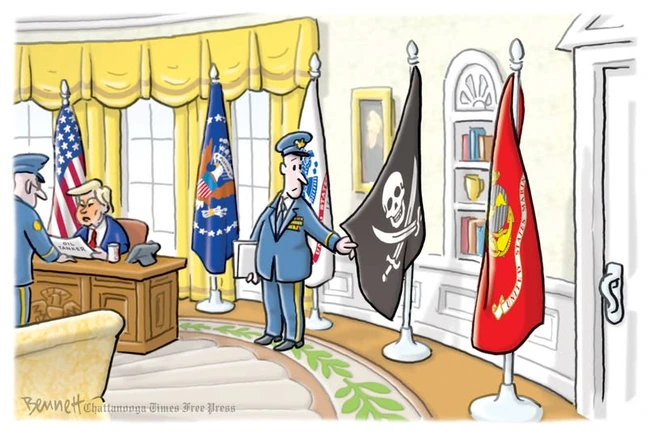
By contrast, Bennett offers a suggestion of “Hey, wait a minute …”
One of his trademark touches is the puzzled expression on an authority figure suddenly flummoxed by a reality he hadn’t anticipated, and he employs it here with precision. The argument, of course, is that there’s no excuse for surprise, that any reasonable level of experience would have made things clear before now.
They are who we thought they were, or, at least, they are who we should have thought they were.
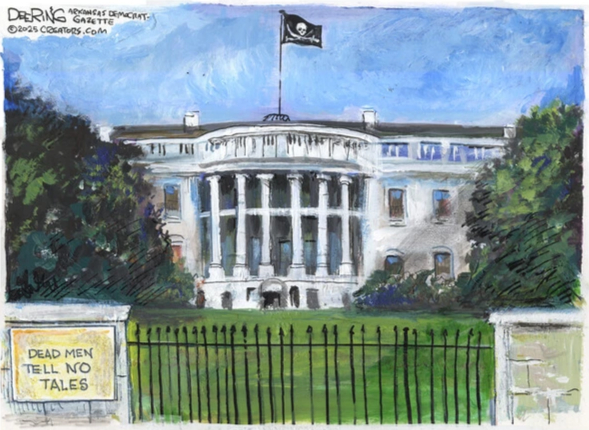
Deering doesn’t play around: He hoists the Jolly Roger over the White House, but then, in case you don’t take it seriously, adds a piratical motto that combines the seizure of the tanker with the earlier killing of purported smugglers without any effort at proving their guilt or following international law.
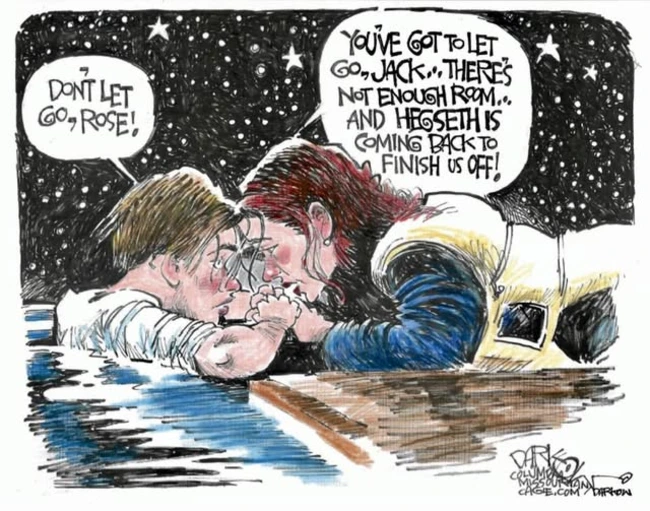
And for those who see stranded sailors as blips on a screen or concepts in a theoretical discussion, Darkow offers a less analytical view of shipwrecked individuals whom we have been taught to see as real people with real lives. Granted, Jack and Rose are fictional characters, but they’re a great deal more genuine than the disembodied “narcoterrorists” imagined, but not proven, and so who remain real individuals deliberately executed by our administration.
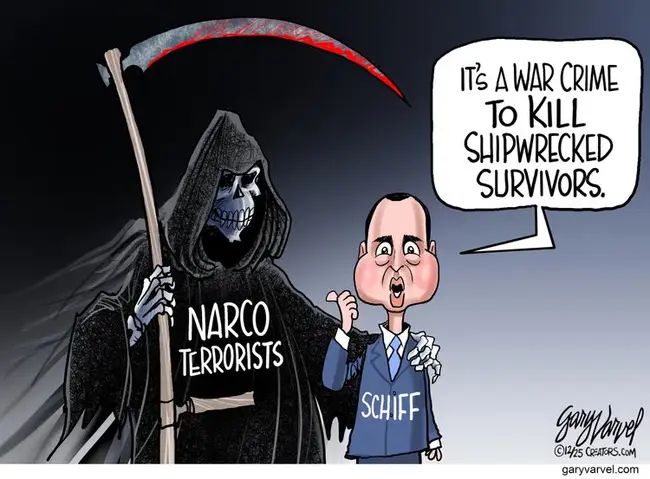
Each piece of art should stand by itself, but Varvel has made his Christian beliefs such a constant element in his work that it is both difficult and dubious not to question his declaration that war crimes are not wrong if they are committed against people we dislike.
Christ specifically condemned religious people who would leave a wounded man to suffer in a ditch, listing two such pious hypocrites before praising the non-believer who demonstrated an instinctive commitment to God’s will.
And now show me the part of the New Testament in which he said people suspected of bad acts should be murdered, rather than the part where he said none of us have the moral standing to cast that first stone.
He who has ears, let him hear.
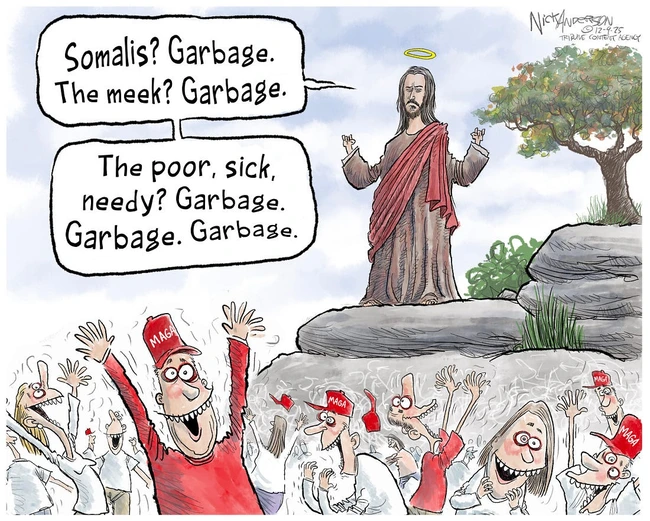
Why do you not understand what I am saying? It is because you are unable to accept My message. You belong to your father, the devil, and you want to carry out his desires. He was a murderer from the beginning, refusing to uphold the truth, because there is no truth in him. When he lies, he speaks his native language, because he is a liar and the father of lies. But because I speak the truth, you do not believe Me! — John 8, 43-45
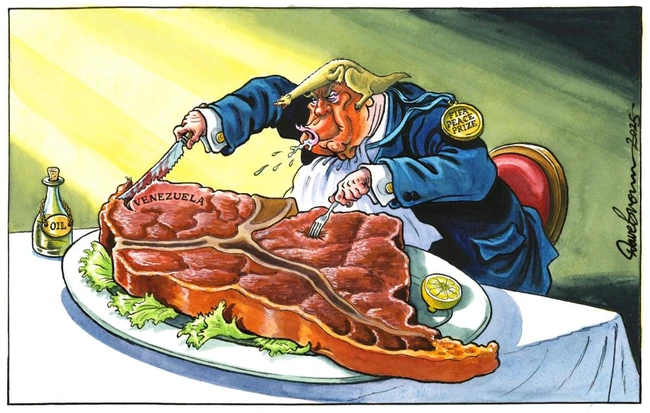
Perhaps the best approach is to skip the clever metaphors and go straight to the point, and Brown describes the so-called “Trump Corollary to the Monroe Doctrine” with a knife in Venezuela and a fork in Brazil and a future worth contemplating in depth.
It starts with recognizing that they are who we thought they were.
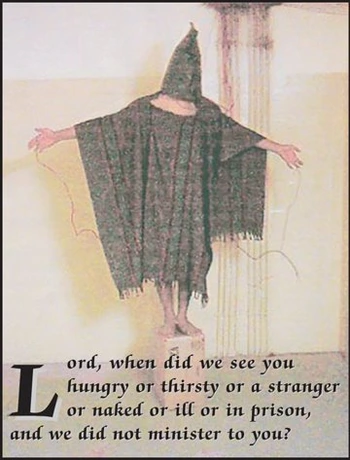
And that we are who they thought we were.
Mike Peterson has posted his "Comic Strip of the Day" column every day since 2010. His opinions are his own, but we welcome comments either agreeing or in opposition.
Comments 15
Comments are closed.