CSotD: Saturday Morning Comics Again
Skip to comments
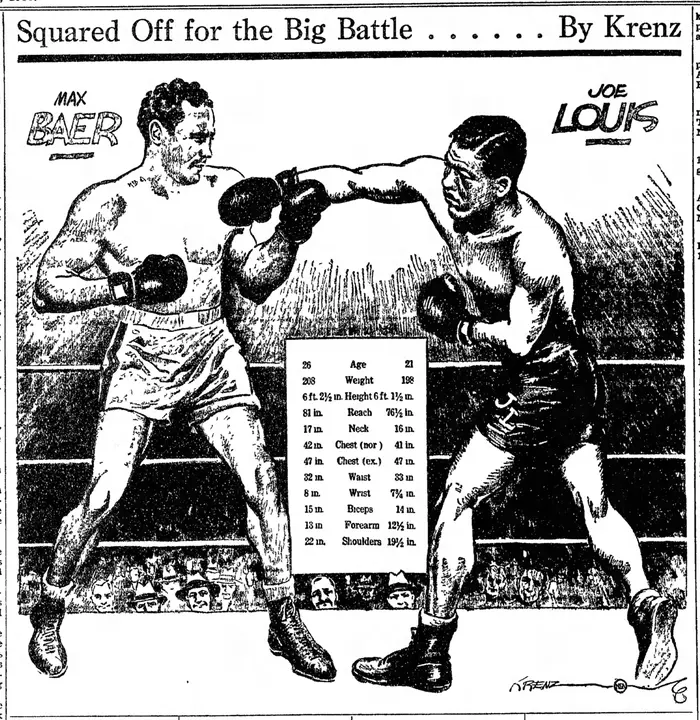
I was playing around in 1935 newspapers and came across this Art Krenz illustration with the tale of the tape for the upcoming fight between Max Baer (yes, Jethro’s father) and Joe Louis.
Sports cartoons often had a lot of word balloons and commentary, but Krenz plays this straight because interest in the fight was intense and there was no need to add opinions.
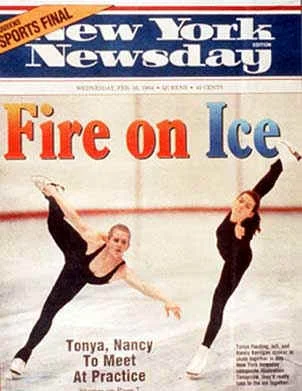
Krenz draws an anticipated meeting, which is fair game in a cartoon. By contrast, during the 1994 Lillehammer Olympics, Newsday published a Photoshopped image of Nancy Kerrigan and Tonya Harding on the ice together, which was not okay and drew a lot of condemnation. I miss sports cartoons because they allowed for imagination that photography does (should) not.
As for the fight, which you can watch here, Baer once said “I define fear as standing across the ring from Joe Louis and knowing he wants to go home early.”
Joe got his wish in this bout, which lasted some of one round. (Update: No, it ended in the fourth.)
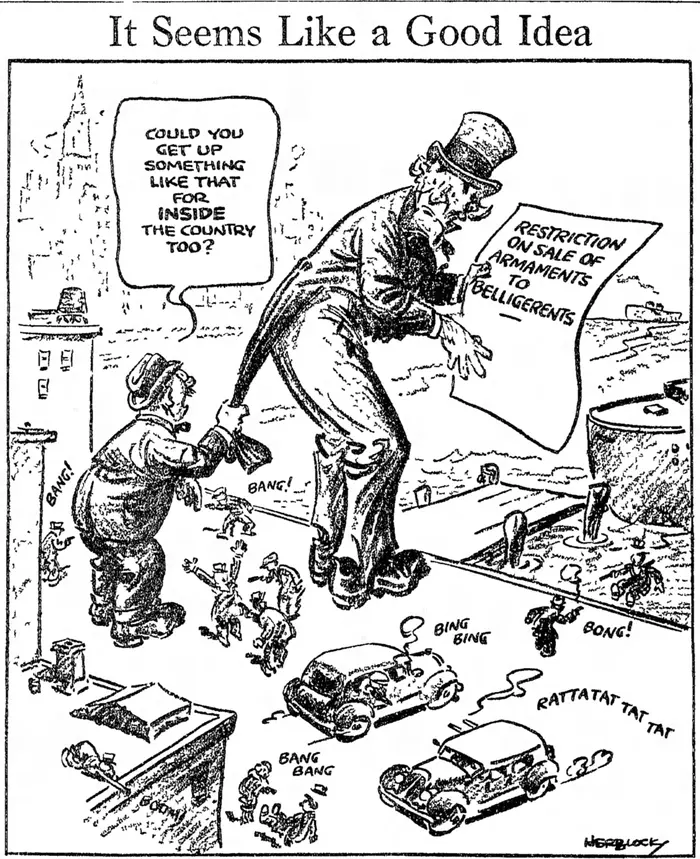
One more from 1935: It seems Herblock’s appetite for gun control legislation went back quite a few decades. And it seems our ability to resist such pressure also goes back a ways.
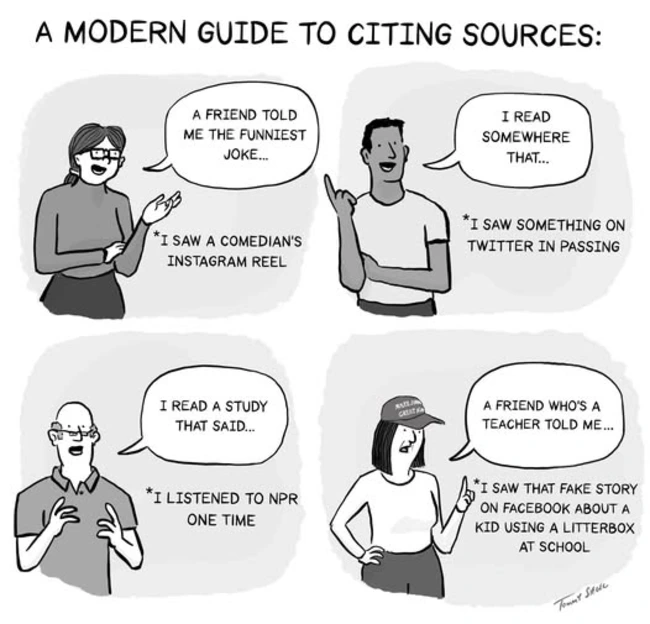
Let’s come back to 2025 for Siegel’s analysis of current scholarship, and, specifically, how people dress up their comments to make them seem authoritative.
I don’t really mind the first three, which fall under the category of puffery, though of course while it’s okay to bluff about your source, you’re under an obligation to repeat the information correctly.
It’s that fourth one that makes me crazy, because, IMHO, it crosses the line into a lie, particularly since it’s often a way of passing on fake stories and gossip.
Hateful nonsense aside, the Intertubes are currently full of “I wish I’d said that” stories and scripted videos of what the Saturday Evening Post used to call “The Perfect Squelch.” I’d be willing to bet that no more than five percent of them ever really happened, which cheapens the value of that five percent.
In a small town, you know who the fabulists are, you know who the liars and gossips are, and you can enjoy entertaining fables while dismissing actual lies and toxicity.
But on-line it’s best to assume anything without a linked source is horse pucky.
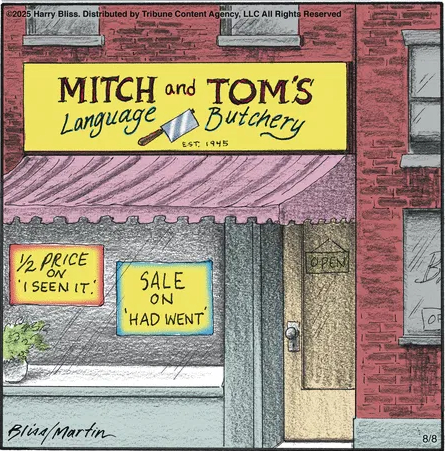
I find most kvetching about grammar and usage to be tedious, but if Bliss and Martin call it “Language Butchery” I’ll concede that certain constructions set my teeth on edge.
OTOH, “had went” and “had gone” are synonymous, after all. I save my contempt for well-educated people who, for instance, don’t know the difference between “may have” and “might have,” which mean two very different, important things.
Clarity and thought matter more than grammar.
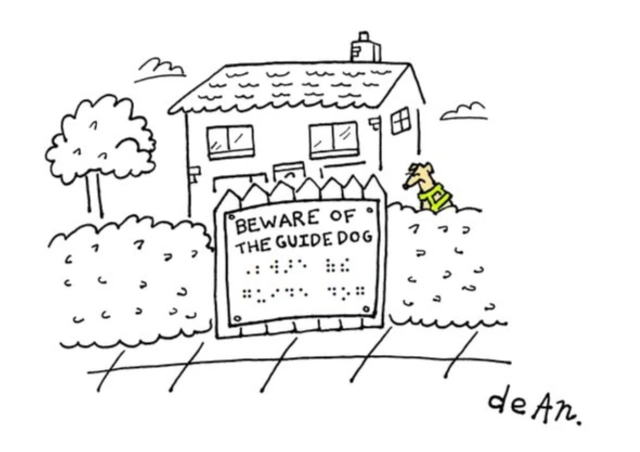
This one took me a minute.
You periodically hear from a genius who asks why they have Braille at bank drive-ups, apparently unaware that pedestrians also use the machines, that some ATMs are not placed where cars can drive up to them at all, and that it’s possible for a sighted person to give a blind friend a ride to a drive-up and pull forward so the back passenger window is at the ATM. Also it would be foolishly expensive to make some signs with Braille and some signs without.
It’s the kind of question that you should keep to yourself for the two minutes it would take a reasonably intelligent person to process it, on the ancient principle that it’s better to remain silent and be thought a fool than to speak up and remove all doubt.
Anyway, the oxymoron of a fierce guide dog also cracked me up.
Juxtaposition of the Day
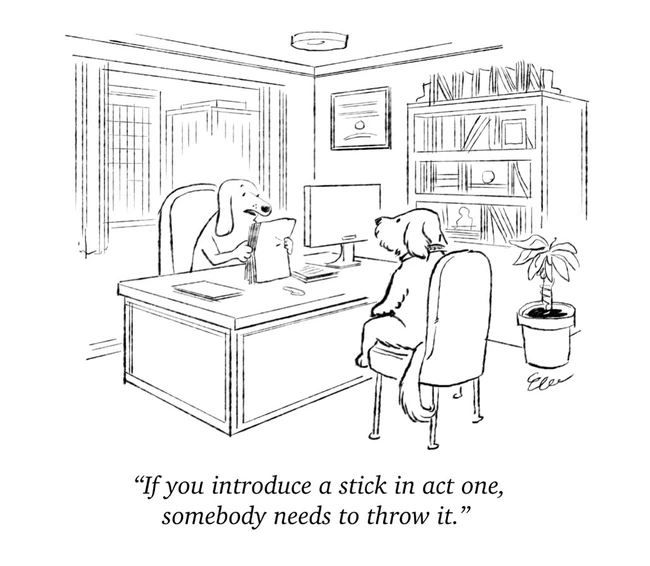
I got a laugh out of dogs referencing Chekhov. The principle is not only interesting but absolutely correct, but the additional gag is that, if you pick up a stick, your dog will tell you it must absolutely be thrown.
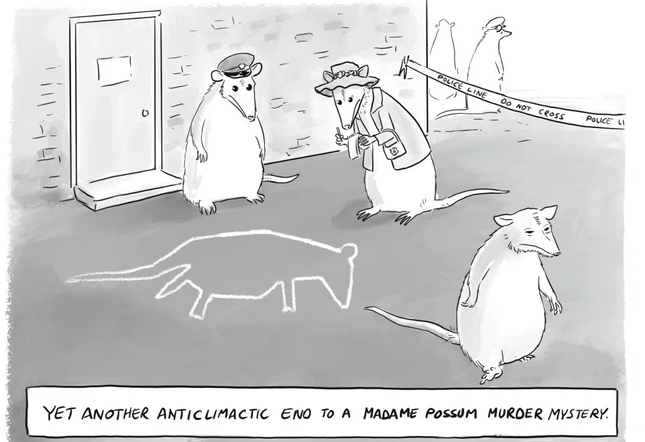
I’ve juxtaposed it with Boothby’s cartoon — which is very funny all by itself — because part of mystery writing seems to involve adding as many red herrings as possible.
In the hands of a master, that’s not a bad thing, and Agatha Christie loaded stories like “Ten Little Indians” and “Murder on the Orient Express” full of clues that aren’t clues, the master-touch being that, in the end, everything made sense, and even the red herrings were plausible if irrelevant.
The problem with writers who aren’t Agatha Christie is that they have characters saying things that aren’t accurate, so you think, “Ah ha! He’s not really a surgeon!” but it’s the writer who isn’t. That’s not a red herring, it’s just bad writing.
Meanwhile, Boothby’s cartoon is twice as funny as necessary because of the archetypal little old possum lady standing by to solve the murder. Jamie Lee Curtis is about to step into Angela Lansbury’s shoes in a reboot of Murder She Wrote, which I guess shows how old she’s getting to be.
How’s that for a segue?
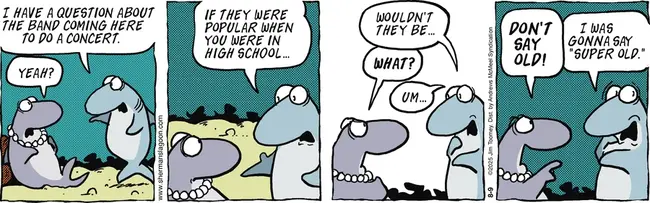
I find it odd that some of us accept the concept of time while others seem surprised by it. At this stage of life, I’m less shocked at some hero’s death than I am that they were still alive. As Sherman explains it, if they were famous when you were in high school, well, look in the mirror and then add a few years.
Even the Monkees, who were fresh-faced kids when they popped up on TV in 1966, were older than I was, and, at 16, I had already outgrown most of my adolescent hero-worship. The Monkees were my little sisters’ faves.
Still, Mike Nesmith and Peter Tork were eight years older than me, while Davy Jones and Micky Dolenz were five years older. It wouldn’t be impossible for all four to still be alive, but it’s not surprising that Dolenz, at 80, is the sole survivor.
Like John Donne — who is also older than I am — I regret any person’s death, but I don’t expect anyone to live forever, though I’m willing to give it a try myself.
These guys, for example, are all dead, but they had a good attitude about age and all sorts of things, which is how come they got blacklisted.
Mike Peterson has posted his "Comic Strip of the Day" column every day since 2010. His opinions are his own, but we welcome comments either agreeing or in opposition.


Comments 17
Comments are closed.