CSotD: The Sound of One Man Ranting
Skip to comments
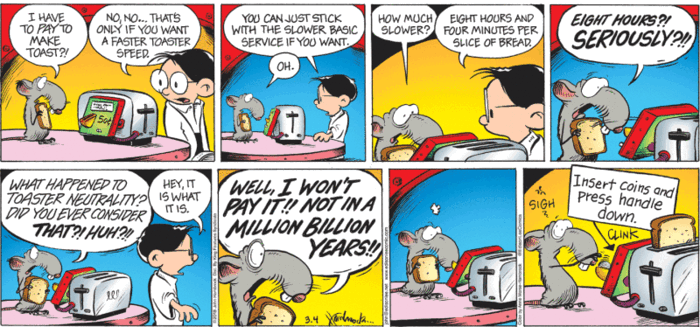
Back from a quick road trip, and the fact that I wrote yesterday's post in advance means I couldn't feature this Edison Lee Sunday piece.
I particularly like the last panel, which is excellent but not in a hopeful way. "Excellent" in depicting what we're gonna do about it, which is to accept what we're given.
 Maybe Elon Musk will save us, however. I am uncomfortable with adding these boatloads of mini-satellites to space, but people are already developing ways to tackle space garbage and I'm inclined to look the other way if Starlink can do for broadband access what MCI did for long-distance telephone service.
And the benefit of Starlink is that, by offering wireless access from Very Low Earth Orbit satellites, it negates the roadblock that MCI and other phone companies had to break through of sharing lines with Ma Bell.
Before cell phones, you needed to string wires, and so there needed to be court-ordered sharing of existing wires before there could be competition in providing telephone service which included low-cost and, later, no-cost long distance.
Don't expect that lightning bolt to strike the same place again: As long as Comcast is who strung the cable access lines, Comcast is who gets to use those lines.
Musk promises that Starlink will offer faster and more reliable non-cable broadband access than DirectTV, and that could be a game-changer for people in rural areas as well as an end-run for everyone around the net-neutrality issue.
Sure would be nice if, just as we have to explain to our grandchildren how long-distance phone calls once worked, we'll have to explain to their kids what Internet access was once like.
Speaking of Old Media
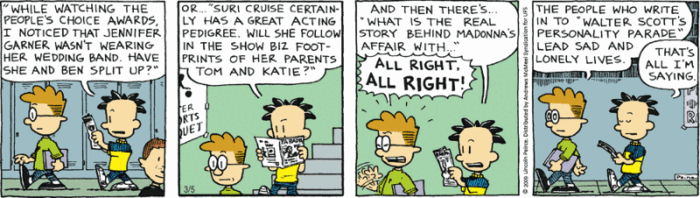
Big Nate touches off another Old Man Rant with this morning's cartoon.
I'm not sure how old I was when I noticed how often people asked Walter Scott questions that just happened to fit a piece of gossip he had handy, but this Wikipedia article suggests how public relations, common sense and inside knowledge clouded the issue.
I was a little older when I realized that the other articles in Sunday rotogravure sections (or "magazine sections") were mostly bland, outdated junk.
These magazine sections were a great thing for small papers who couldn't print color, and, just as they had their Sunday comics sections printed by someone else, so, too, they purchased one or the other magazine section to add another splash of color to their Sunday papers.
This meant that these tabloids had to be printed weeks in advance and shipped out to client newspapers to be inserted into the paper along with the funnies and the various shopping inserts.
Then two things happened: One was that newspapers gained more ability to print color, so that the main benefit of the rotogravure section became a bit obsolete.
The other was that, as major chains began driving locally owned stores out of business, advertising shifted from in-paper ads to color flyers called "inserts" because they were inserted into the Sunday paper.
At one paper where I worked in marketing, we ran out of inserter capacity on Sundays. We decided to shift our TV section to Saturday, hoping it would free up an inserter for Sunday and inspire people to pick up the Saturday paper, our weakest single-copy sales day.
Instead, all hell broke loose because people bought the Sunday paper for the funnies, the ads and the TV section.
So we put the TV section back in the Sunday and shifted the magazine section to Saturday.
Not a peep.
We were paying a significant chunk of change for that section, and our multi-year contract was coming up for renewal. So we tried leaving it out entirely.
Not a peep.
We could save thousands by letting the contract expire and readers wouldn't care!
Then, just as we were congratulating ourselves on finding a way to ease our budget and free up an inserting unit, we got an email from our VP at Corporate.
He had renewed the contract for us, for several years. That is, he had signed the contract. We still had to pay for it.
Oh, I forgot to mention that the two leading national magazine sections were in heavy competition with one another and it was not unknown for a piece of paper containing the words "Pay to the Order of" to follow the signing of a new contract.
But, of course, we hadn't signed the contract. Our VP at Corporate did that.
Bless his heart.
He still wanted us to cut costs, of course.
Note: There were two major nationally-distributed magazine sections and I've worked at several papers, so I'm not accusing anyone in particular specifically of anything. Particularly not kickbacks. Which never ever happened.
Juxtaposition of the Day
 (
(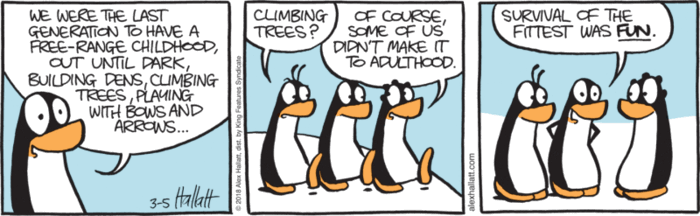 (
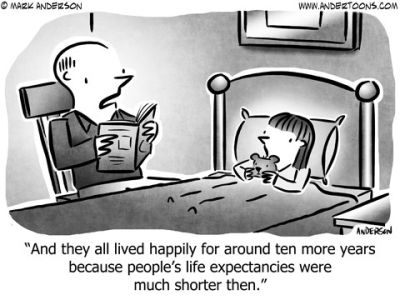
(I'm pretty sure Mark Anderson was simply making a historical joke there, and I liked it, but Alex Hallatt focuses things a little more sharply and touches off yet another Old Man Rant.
I'm no fan of helicopter parents and wish we'd give kids a little more credit for being able to go out and play without constant supervision, and those who fear that perverts and murderers lurk around every corner should move to some place where they don't.
Or seek help for your anxieties rather than letting them suffocate your children.
On the other hand, those Facebook memes about how, dagnabit, we grew up without all these safe playgrounds and over-supervised sports do, as Alex Hallatt notes, ignore the fact that a lot of risk-taking kids paid a price.
 Not a political point, just a fact: Kids used to die a lot more often.
It would be nice to strike a balance between paranoid over-protection and practical common sense.
The Old Man's More Cheerful Side
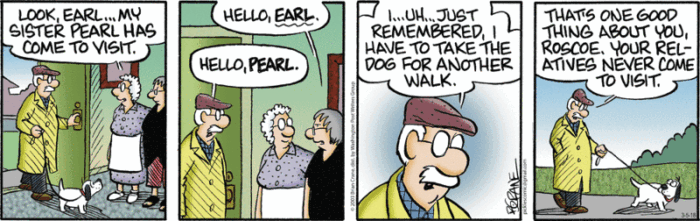
I'll admit that the young folks probably didn't get an earworm from today's Pickles, but I sure did. Pardon me while I try to vanquish it.
Mike Peterson has posted his "Comic Strip of the Day" column every day since 2010. His opinions are his own, but we welcome comments either agreeing or in opposition.
Comments 14
Comments are closed.