CSotD: AAEC Day 2
Skip to comments
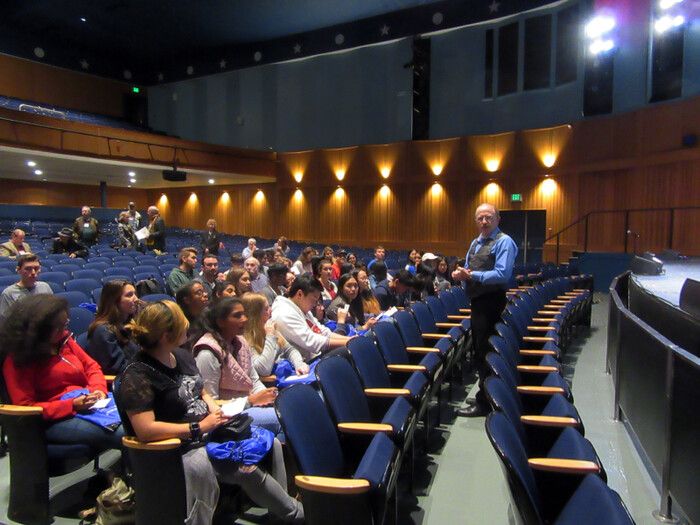
The second day of the American Association of Editorial Cartoonists convention was a little more laid back, which was a good thing after the density of the first day's panels. (Though, again, this is written in haste, barely edited, and you'll have to Google where I've failed to add links)
Most of the events are happening at Hofstra, and there was a little payback in the form of a how-it-works session for students. In the above pic, Kal Kallaugher, who led the session, chats with high school art students before things got started. There was a delay waiting for a class from the Bronx until word came that their bus had simply not shown up, which prompted some "oh no — they'll have to go to class!" jokes, but was really tragic given how rare an opportunity like this is.
He recounted — and reconstructed — a cartoon he had done in fifth grade of one of his nuns, which then got passed around his class until she discovered the source of the merriment, grabbed him by the ear and dragged him down to the boys' room where he was forced to take a bite of soap. (No, I'm not sure the logical connection either. I suppose you had to be there.)
"'Don't you ever draw another cartoon again!' she told me," Kal recalled. "And I've been doing it ever since."
Kal did some demonstrations for them as well as showing some slides, then brought AAEC President Ann Telnaes and Matt Davies from conference host Newsday up for some discussion of their approach and style, after which there was a panel of cartoonists to offer yet more perspectives.
Matt — their local cartoonist — built on Kal's classroom story by noting that, while anyone can draw Trump, local cartoons have more impact not only on readers but on the politicians themselves.
Meanwhile, while I've seen many classroom presentations on cartooning generally, both Kal and Ann in particular broke away from static images on paper to address the current formats, with Kal recalling not just creating animations but doing so wearing motion-capture suits and 3D imaging, and Ann demonstrating her own animations and going through that process.
As they told the kids, there are a lot of ways of doing editorial cartooning and the next ones up don't have to simply copy what their parents and grandparents did.
It was invaluable to the kids, and one of the things Kal said to them was that there are only about 100 editorial cartoonists working in the USA at the moment — a much lower per-capita count than in most countries — but we have theoretically now doubled it by turning them out into the world.
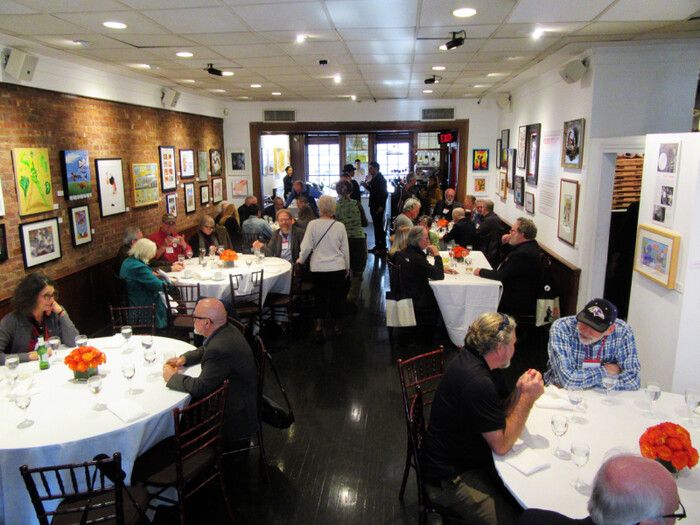
We then piled into buses and headed into the city for the Society of Illustrators, where we had lunch and congeniality so congenial that, by the time I thought to take photos, people had finished eating and were heading downstairs for the Ed Sorel's presentation.
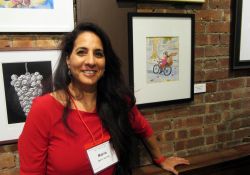 However, I did happen to notice that Maria Scrivan, who was in the room, had a pair of illustrations on the wall, and this is she and one of her pieces.
I should add that the AAEC had invited National Society of Cartoonist members to come by, and several from the region, like Maria, did, at least for one event or another if not the full conference.

I should also add that, if you have to go to the bathroom, it's good to start early because you will be distracted along the route. They're mounting a George Booth exhibition which opens next week but, in the meantime, his work is quite nicely displayed on the walls in the hallway to the facilities. (Don't forget that you can click on these pics for a larger version)
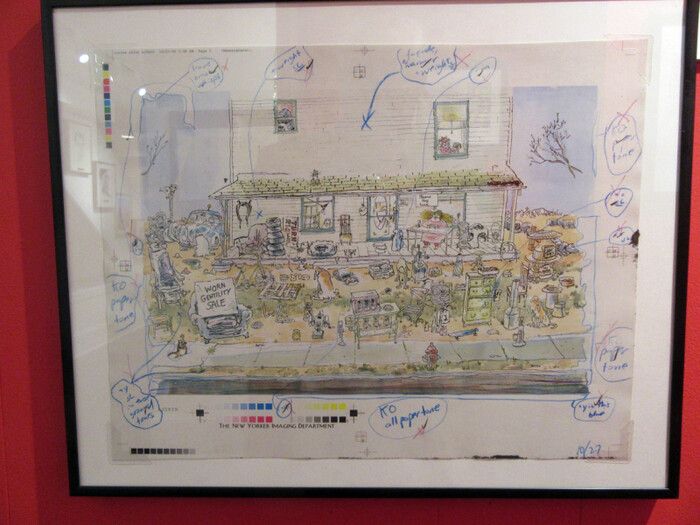
Cartoonists, and artists of all types, like to see originals because you get a more direct and intimate look at the process itself. There also has to be, if only on a subconscious level, a heartening when you can see not only the repair and cover-up of errors but sometimes the external editorial and technical back-and-forth. This stuff doesn't simply flow out of a genius pen but is the normal process everyone goes through, perhaps enhanced by that genius.
These two pieces, showing the process for a New Yorker cover, got some attention:

The first is, obviously, the black-and-white starting point, as the man starts to lose his pants and his balance on the ladder (as, of course, an oblivious, semi-crazed dog lurks on the border).

Then we see the colored layer laid over it, in which he laid over a piece of acetate on which he'd spilled the paint for this accident.
And, if you're there in person, you can get a sideview to better see the way the layers interact.
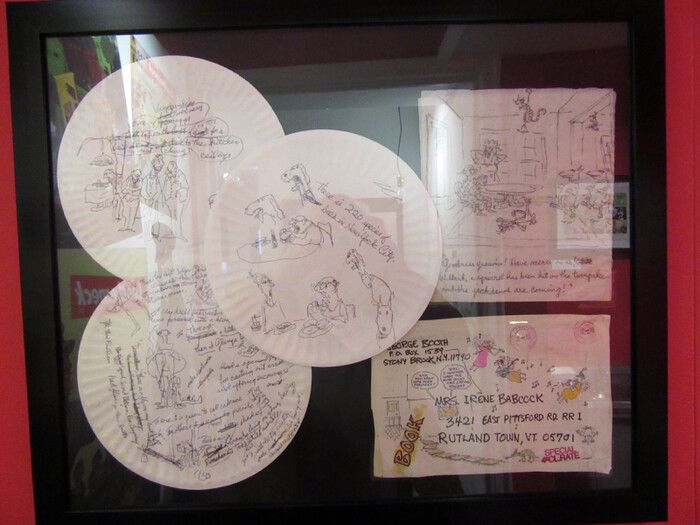
Which is all probably very inspiring, I would think, until you realize that his doodles are better than your finished work.
I didn't hear anyone actually say that, but I did remember, as I looked at Booth's work, taking a musician friend to a "Boys of the Lough" concert, after which he said that, usually when you were at a good concert, you couldn't wait to get home and play, but that hearing them made him anxious to get home and smash all his instruments.
And that's only on the way to the bathroom. The main event hadn't even started yet.
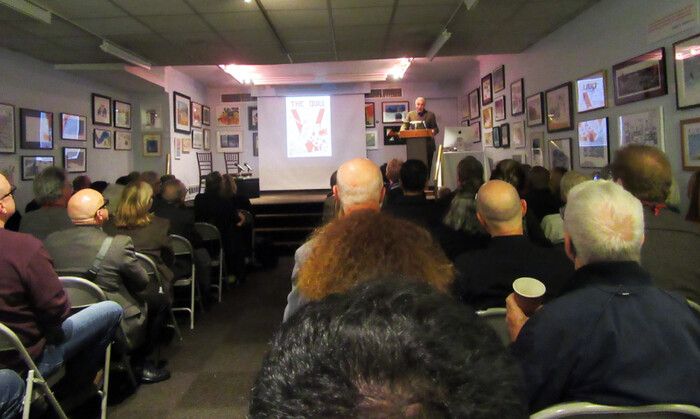
Edward Sorel is a legendarily crusty and talented curmudgeon, and he began his presentation with repeated apologies and promises to get to the artwork shortly, but he first needed to deliver a hilariously acerbic diatribe on every president since FDR.
Suffice it to say that Ed Sorel is not wild about Harry, whom he charges with instituting loyalty oaths and creating the Domino Theory of foreign relations, with one outcome being the Korean War, which led down the path of good intentions to our current situation, or, as Ed put it, "For 60 years, we've been supporting despots, and now we have a despot of our own!"

And he wasn't particularly fond of Richard Nixon, either, even when he opened China, a point when I remember a lot of leftists swooning. Sorel is not an easy swoon.

He not only didn't care who knew it, he also didn't care where he said it. Here's a cover he did for Screw Magazine, showing Judge Sirica listening to the White House tapes ("Bebe" being Nixon confidante and financial benefactor Charles "BeBe" Rebozo)
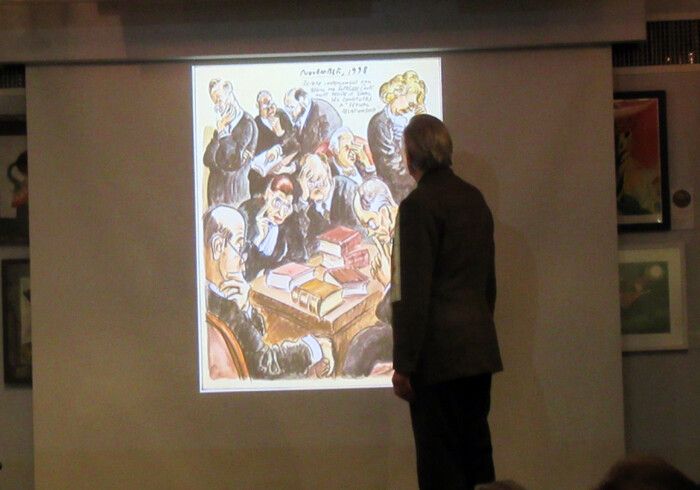
A theme somewhat echoed a few decades later as the Supreme Court Justices confer on whether oral sex rises to the level of an impeachable sexual relationship.
First of all, I can only imagine the hilarity that would have ensued if young Edward Sorel had surfaced in the classroom of the nun who felt compelled to wash out Kal's mouth for a simple caricature.
Second of all, he's only exaggerating; it's not like he has to make this stuff up out of whole cloth.
In the words of Hamilton — by whom I mean Margaret and not Alexander — "What a world! What a world!"

He even took a dim view of poor old decent Gerry Ford, who I thought of as the sort of bland bureaucrat we needed in the aftermath of Nixon, but whom Sorel saw in other lights.
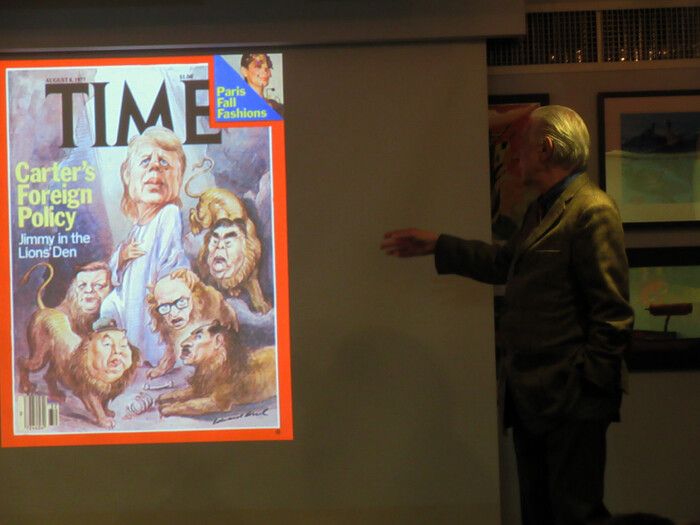
He's kinder to Jimmy Carter, but it's a matter of degree as he continues to inveigh against most of the system surrounding anyone in the position.

Ditto with Obama, shown here beset by the system.

Sorel takes a somewhat dimmer view of the current administration.

And here it all is lumped up in a multi-panel extravanganza, which I will transcribe for those who can't make out the individual captions:
- Now that all the hoopla about the end of World War II has ended, let me tell you what really happened.
- In 1939, while Edward G.Robinson was cornering subversives in "Confessions of a Nazi Spy
- John Foster Dulles was making big bucks at Sullivan and Cromwell representing German cartels like L.G.Farben
- In 1940, while James Stewart was facing down Nazi thugs in "The Mortal Storm"
- John Foster Dulles was making speeches about how important it was to keep absolutely neutral, what was going on in Germany was none of our business, he insisted.
- In 1943, thanks largely to John Garfield's selfless heroism in "Air Force," the tide of war turned in favor of the Allies.
- With an Allied victory now inevitable, Dulles began a new speaking tour. This time his cause was a "Christian Peace" for Germany.
- After the war, Robinson was blacklisted, Garfield was blacklisted, and Dulles became Secretary of State.
- Of course, if the war had gone the other way, Dulles might have done even better.
But, no, he's not opinionated.
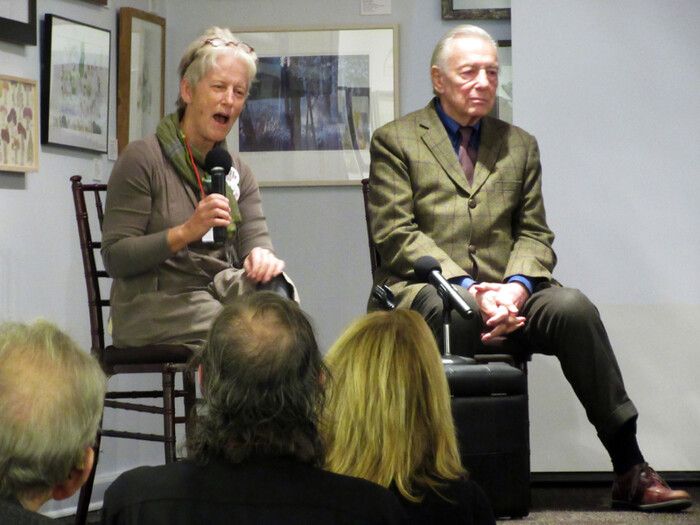
Which came up in the Q&A afterwards, and he was introduced by Signe Wilkinson largely on the basis of her having brought her portfolio to him as a young artist and his having basically told her it was shit.
I should say that I am generally in favor of discouraging anyone who can be talked out of the thankless world of creativity, but Sorel didn't just trash her work but whipped out a pen and showed her some basic principles she needed to grasp, before sending her on her way.
And here's what I've learned over the years: Gentle criticism tends to sound like praise. Either don't criticize or come down with both feet so there is no doubt of your intentions.
In response to a question, Sorel went on about his method of work, which is too involved to recap here, and besides it's your fault you weren't there, but he concluded by noting that "a sketch has a vitality that's often lost when you do the final piece."
He also downplayed the value of art education, stating that it took him so long to get started in his work because he had to overcome what he'd been taught at Cooper Union, mostly, he said, abstract expressionism when he had been inspired by John Sloan and the Ashcan movement.
And he offered the encouraging advice to try to do a book, adding that "books don't pay but the odds of having success with a book are better than buying a lottery ticket."
"Or buy a newspaper, by which I mean BUY a NEWSPAPER."
Even more encouragement: "The world has changed and they don't need us anymore. I have no answers."
Again, those who can be talked out of wasting their time should be and Ed Sorel is doing the work of angels. If he'd met Somerset Maugham in time, "Of Human Bondage" could have been a 16-page pamphlet instead of an entire novel. (Which you should read.)
And, asked what he thought of the current state of cartooning, he snapped, "Have you seen in the cartoons in the New Yorker? How dare they!"
But then he softened a bit in conclusion, "Look, I don't draw as well as those guys in the 18th century did, and the guys in the 21st century don't draw as well as I do."
A shrug, well-earned and hard-bought and gratefully noted.
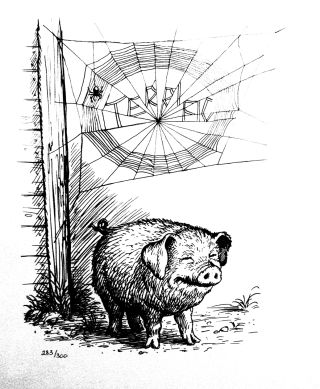
(Yeah, they had some Garth Williams there, too!)
Mike Peterson has posted his "Comic Strip of the Day" column every day since 2010. His opinions are his own, but we welcome comments either agreeing or in opposition.
Comments
Comments are closed.