CSotD: What journalists seem to do
Skip to comments
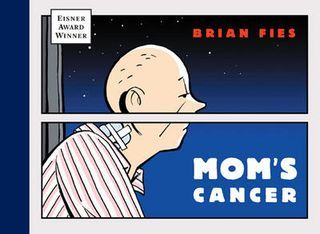 I've known Brian Fies since the turn of the century, before he began unveiling pages of "Mom's Cancer"at rec.arts.comics.strips for feedback, when he was simply one more poster there, though an amusing and insightful one.
As his project evolved from webcomic to book, the group got a good look at how Brian views the intersection of life and art.
I wrote about it at some length here, back when I was only part of the book's evolution and not yet a member of the cancer club, which makes my remarks somewhat less skewed than they might appear now.
It also gets me off the hook, I hope, for thinking, when I learned that Brian and his wife, Karen, had lost their home in the fires earlier this week, "I hope he cartoons this."
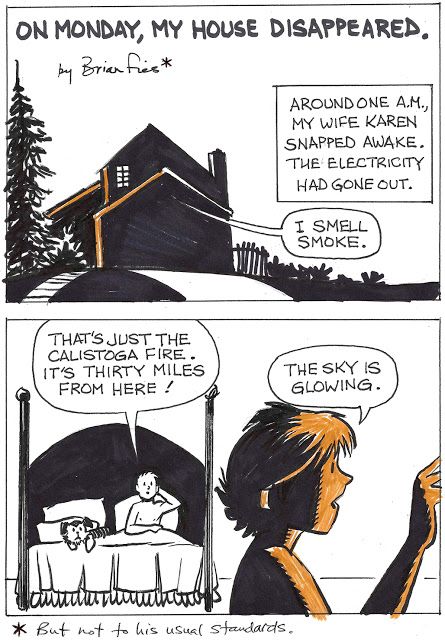
Because, in unveiling Part One of a short graphic memoir of the event — of which these are only the opening panels — he comments "My house burned down. I made a comic about it. That seems to be how I handle trauma. It's kind of a feature and a bug."
And then he goes on to apologize for the unfinished nature of the work and I'm a good enough friend to say, "Bullshit."
(I'm also a good enough friend not to swipe the whole thing.
Go read the rest and then come back.)
He's under no obligation to furnish us with finished art.
He's under no obligation at all, of course, but particularly not that, because we need to see now, and, if perfection stands in the way of "now," then perfection is going to have to step aside.
"Journalism" has the mission of bringing the reader to the moment, but sometimes that mission is thoughtful and considered, and at other times it is immediate and urgent.
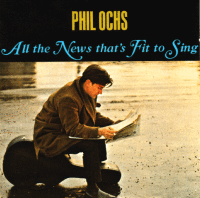 Phil Ochs considered himself a journalist who worked in song, and, while many of his songs were about injustices that were evergreen, others, like the sinking of the Thresher, needed to be sung about immediately and lost a lot of punch by the time they came out on vinyl.
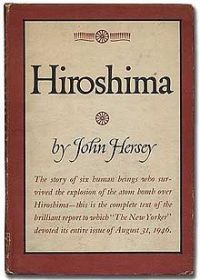 But John Hersey's Hiroshima had impact perhaps in part because, while he had been on the scene in the immediate aftermath of the bombing, his book came out a year later, after he, and the rest of the world, had had a chance to absorb the concept but before many had had a chance to actually learn what had happened there.
In the case of the California fires, there may well be underlying issues and long-range thoughts to be brought forward, but the journalistic mandate is for immediacy: We need to know what has happened, right now, not simply while it is fresh but while it is ongoing, before it has settled into comfortable history that can be discussed around a coffeetable.
I want to hear it from the person still wrapped in a blanket at the shelter, now, before they can contextualize it.
And I want to hear it from someone whose natural bent is to turn his own experience into mine, who has earned the right, through his artistry, to say, "That seems to be how I handle trauma. It's kind of a feature and a bug."
There's a lot of graphic journalism going around these days, and most of it isn't very good, in part because the young artists are often trying to describe a level of adolescent angst that appears a lot more remarkable when you're going through it than it does a decade or two later, but mostly because they are still working to develop a voice.
That's not a slam: I say it as someone who spent a dozen or more years trying to be JD Salinger before I realized there already was one.
And not every good artist/writer can be a good journalist. One of my favorite authors, Ivan Turgenev, covered the execution of a noted killer step by step, until he fainted at the moment of truth and the story suddenly became not about what happened but about what a sensitive soul he was, a journalistic failure lampooned by Dostoevsky in "The Possessed."
Turgenev was still a great author; sometimes, artistry and journalism don't meld.
And sometimes the artist/writer is wise enough to take another tack.
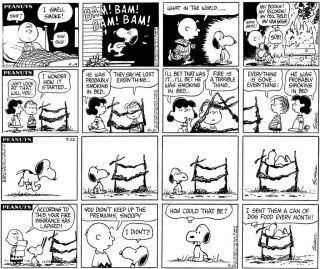 In the aftermath of Jean Schulz also losing her house in Santa Rosa, where she and her late husband Charles had lived, Jeff Parker dug up and posted a series of Peanuts strips Charles Schulz did after his studio burned down in 1966. (click on them to embiggen)
I'm sure it was cathartic for him and it was amusing for readers and probably familiar for others who had dealt with fire and insurance companies and suchlike, but it wasn't journalism.
That's also not a slam, just a definition.
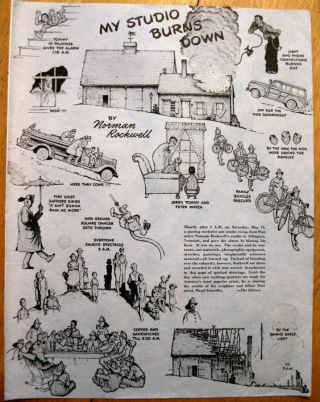 However, in answer to Parker's Facebook posting, Richard Bartholomew posted this Norman Rockwell piece, which followed the loss of his studio in 1943, and which is journalism.
In fact, what Rockwell has done is to take the quick-response sketches he made that night and then put them into a finished form that not both preserved the immediacy while adding some context, but met his artistic criteria as well.
I'll be waiting to see Part Two of Brian's saga, and I hope I don't have to wait long, because this is immediate journalism and it matters.
Though, if he wants to Rockwellize it later, I wouldn't mind that, either.
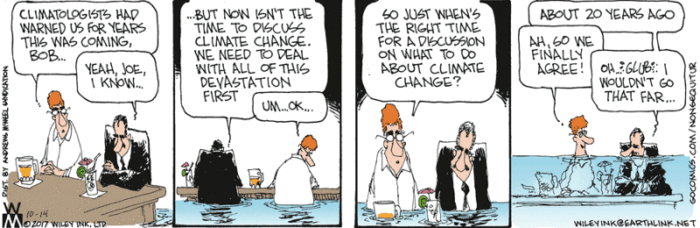
Meanwhile, Wiley Miller reminds us that, as I noted the other day, we've passed well beyond the point where we could expect to reverse what has happened in Northern California, or in Texas, or in Houston, or in that faraway island in the middle of the ocean.
They will happen again, regularly, from here on out.
Which doesn't mean we should give up and let it get worse.
Because the next house may be yours.
Mike Peterson has posted his "Comic Strip of the Day" column every day since 2010. His opinions are his own, but we welcome comments either agreeing or in opposition.
Comments 3
Comments are closed.