CSotD: Truffaldonald
Skip to comments
 The classic exchange in Goldoni's "Servant of Two Masters" comes as the other characters try to figure out Truffaldino, the harlequin of the play:
Pantalone: What are we to make of this fellow? Is he knave or fool?
Doctore: I really don't know. Probably a little of both.
Brighella: I should say he was just a zany (lunatic). He comes from Bergamo; I can't think he is a knave.
Smeraldina: He's not such a fool, neither.
It is a crucial question now in understanding Donald J. Trump: Does he actually believe the obvious, nonsensical lies that come out of his mouth, or is he simply counting on us to?
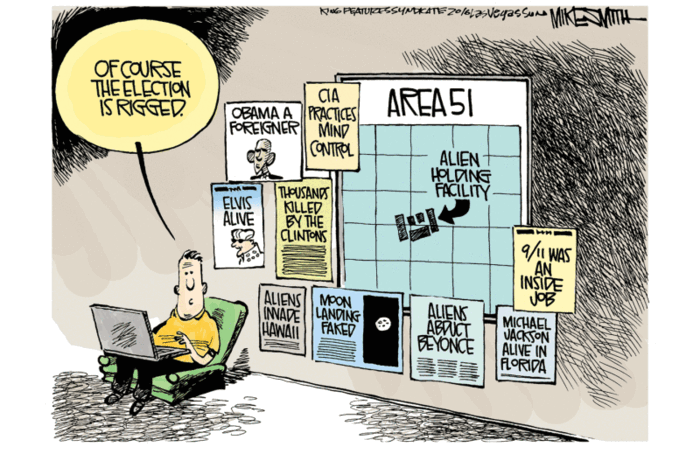
Mike Smith doesn't answer that question, but he raises it well, suggesting that the man who so actively promoted the birther fraud is being followed by a significant corps of nincompoops who believe such ridiculous twaddle, people whom we would call "gullible" if "gullible" were an actual word in the dictionary.
Spin has, of course, always been part of politics, and not just in democracies: Nearly every government remains in power by re-packaging facts in palatable forms or, as necessary, by outright falsehoods.
And as Goldoni created laughter around such manipulative duplicity, so did the Russian people:
The Soviet leadership suddenly realizes that, for the first time, they have a general secretary who is significantly younger than the American president, and so Gorbachev challenges Reagan to a foot race. But to their surprise, the old American is remarkably fit and breaks the tape well ahead of his Russian counterpart.
The next day, Isvestia reports the results: "Gorbachev wins second in race; American president finishes next to last."
It's not so funny, however, when the subject is the heroic resistance and rescue of Jessica Lynch, or the weapons of mass destruction that caused her to be in Iraq in the first place, distortions and lies that cost lives and have permanently altered the course of international politics.
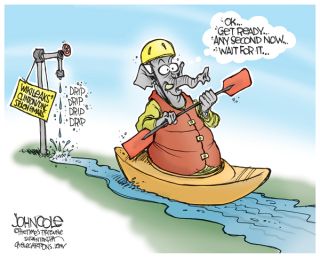 And now we have an election in which a major party is basing its hopes, as John Cole illustrates, on rumors and smears that have more impact when you declare them to exist than when their actual revelations emerge.
(There's even a meta element in play: Last night I saw a totally, utterly insane, birther-level, Elvis-lives proposal that was supposedly part of a Wikileaks document and it occurred to me that anything can now be sourced to Wikileaks because how would we know?)
This is nothing new and, again, the Truffaldino question is in play: The paranoid lunacy of the Vince Foster "murder" was an obvious and deliberate fraud, while Whitewater was more a matter of packaging the facts of a relatively typical commercial development project in a way that people outside the industry would misinterpret.
In both cases, though, it's hard to determine who was passing the faux scandals along out of sincere, misguided gullibility and who was promoting them through deliberate dishonesty.
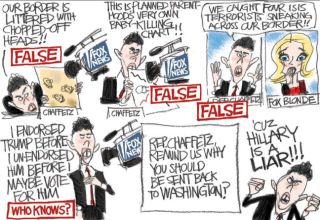 Pat Bagley offers this analysis of his local congressman's efforts to win re-election, and watching Chaffetz harrangue and harrass Hillary Clinton in a series of partisan, taxpayer-funded Congressional witch hunts has made it hard to believe his pursuit of non-existent crimes was an innocent misunderstanding of the facts.
Bagley suggests that the man is more knave than fool, given the difficulty in believing that someone actually so factually challenged would be able to find his way to his congressional office each morning.
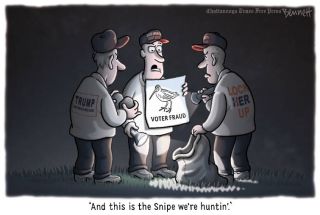 And Clay Bennett is similarly skeptical about the Republican fight against voter fraud, an effort that has succeeded mostly in creating "evidence" on a par with Isvestia's reporting of the race results in that old Russian joke.
Again, the analysis provided by Goldoni's characters applies: We're left wondering if these people are knaves, fools or lunatics, while the future of the nation hangs in the balance.
Part of the fun of "Servants" is in watching how readily fooled the pompous Pantalone and Doctore are by Truffaldino, and laughing at their consternation, such that it doesn't really matter if he is doing it on purpose or they are simply trapped within an absurd situation.
In our case, the answer is that it really doesn't matter what Truffaldonald says to fool us versus what he actually believes, because the results are exactly the same and our goal needs to be not so much to figure him out as to find a way to avoid becoming trapped ourselves.
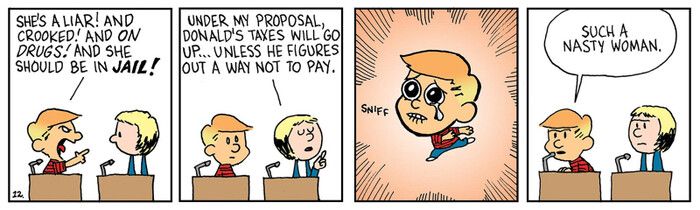
But if you promise to take the issue itself seriously while you laugh at the way in which it unfolds, I will direct you to Ruben Bolling's sendup of "Calvin and Hobbes," currently at the Nib.
Meanwhile …
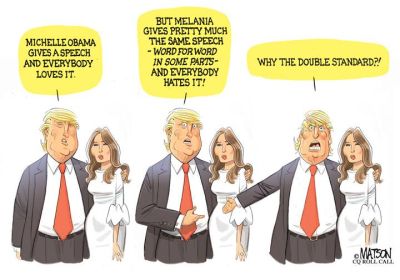
Trump's best gag at the Al Smith dinner the other night was a wife-deprecating joke about the speech his wife stole and delivered at the Republican National Convention.
A gag that he stole from this July 19 R.J. Matson cartoon.
So, is Truffaldonald a knave who blatantly, deliberately plagiarises other people's work, or simply an incompetent fool who, even after being burned, continues to employ speechwriters who don't understand the concept?
Let's put him in the White House and find out!
Scenes from a 2017 Cabinet Meeting:
Comments 3
Comments are closed.