CSotD: A National Park Service, If You Can Keep It
Skip to comments
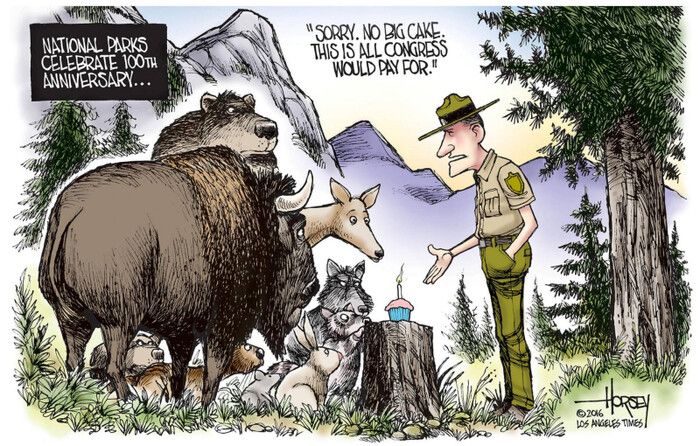
David Horsey celebrates the centennial of our National Parks by pointing out their neglect, which not only limits that celebration but, more critically, forces moderation in defending them against the champions of free market exploitation.
As he notes in his essay, while budget constraints are an indicator of how strong the privatization and exploitation forces are in lobbying to undermine the National Park System, they are also the heritage of the system:
From the time of Roosevelt, there have always been politicians in thrall to mining companies and other corporate interests that oppose the idea of holding federal land in trust for all the people of the United States and keeping it out of the hands of private owners.
Roosevelt enraged politicians in the Western states by setting aside 150 million acres of land as national forests. Congress tried to block him from doing more, but he found ways to work around the reactionaries in the House and Senate
Okay, step aside, pal: I've got this.
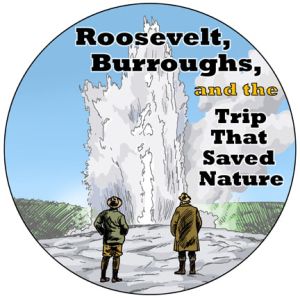 Two years ago, Christopher Baldwin and I collaborated on a children's series about the 1903 trip to Yellowstone that Roosevelt took with nature writer John Burroughs, using it as the framework upon which to build a quick history of the conservation movement.
Aside from the journals of TR, Burroughs, John Muir and others, as well as contemporary newspaper accounts, I drew substantially on Douglas Brinkley's The Wilderness Warrior: Theodore Roosevelt and the Crusade for America, which I strongly recommend as a fascinating look into how TR exercised his reformist will in the face of opposition.
And, yes, as I wrote, he did find his way around the opposition:
One of the places where plume hunters were killing birds was on Pelican Island in Florida, and a group of bird lovers came to visit Roosevelt at the White House. They wanted more protection for the island’s birds, but worried that it would take too long to pass a law, and that some in Congress would object to the idea.
Roosevelt listened carefully, then turned to one of his advisors.
“"Is there any law that will prevent me from declaring Pelican Island a Federal Bird Reservation?” he asked. The island was already owned by the government, so the advisor answered that there was nothing standing in Roosevelt’s way.
“Very well then,” Roosevelt said, “I so declare it!”
Pelican Island became the nation’s first national wildlife refuge. Later, Roosevelt would “so declare it” 50 more times to protect birds with national refuges.
He also used executive orders to preserve archaelogical sites like Chaco Canyon from being pillaged by souvenir sellers, and, to the extent possible, to protect Grand Canyon and other natural wonders from destruction.
Congress didn't much like executive orders back then, either.
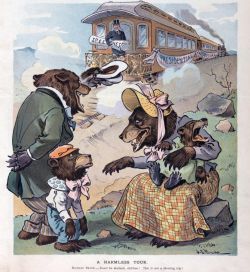 The critical aspect of that 1903 trip and the influences of friends and allies like Burroughs, Muir and George Bird Grinnell, was a sharpening of focus on the difference between "conservation" and "preservation," and a profound shift in our view of "empty, unused" land.
It's easy enough to dismiss US land use policy as some Machiavellian imposition of the Protestant Work Ethic, but the idea that it was entirely decided cynically and purposefully by a cabal of heartless capitalists is unfair and misses the point of why the conflict existed to begin with.
Much of US territory remained unowned and unused in 1903, and Americans were a people who, when they looked at open land, wondered if they should perhaps plant corn there, or harvest some timber, or how they might otherwise "put it to good use."
What made it practical to set Yellowstone aside was its lack of value as a resource: You couldn't grow crops there and the timber was pretty scraggly.
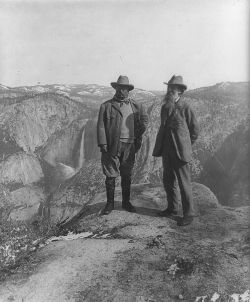 Still, the notion of preservation (no use), rather than conservation (wise use), was very much a minority opinion, limited to a few sincere, inspiring cranks like John Muir, with whom Roosevelt maintained a friendship, but with whom he also clashed, notably over creating water resources for the growing cities of California.
Muir wanted nothing touched; Roosevelt wanted nothing exploited and wasted, and therein lies a mighty divide.
In a speech in Kansas in 1910, TR said
I recognize the right and duty of this generation to develop and use the nature resources of our land; but I do not recognize the right to waste them, or to rob, by wasteful use, the generations that come after us.
Moreover, while he was supportive of Muir in general, their Yosemite camping trip, part of that 1903 outing, brought some disillusion, since Muir's appreciation of nature seemed more spiritual than scientific: Roosevelt was surprised that, as they sat around the fire, Muir was not only unable to identify various birds by their calls, but was uninterested in the entire topic.
As a conservationist, TR was learning hard scientific lessons about things like balancing, rather than eliminating, predator populations. He — and conservationists like Grinnell and Burroughs — were much more interested in wise stewardship than some idealised, angelic form of benign neglect.
Meanwhile, at about the time the National Parks were being set aside, the concept of a "park" was very much in flux.
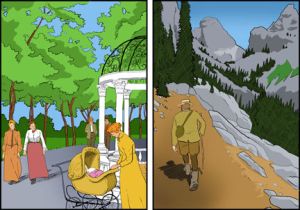 As it happens, the current issue of Atlantic Monthly has a short article about Frederic Law Olmstead and the establishment of urban parks including Central Park, which emphasizes that Olmsead's vision traced "parks" back to the exquisitely sculpted and maintained landscapes of Europe's upper crust, and applied much of that consciousness to the parks he built.
The result was that his "parks," while not quite that artificial, were yet a combination of paved paths, bandshells and sculpted landscapes, not the rough-and-tumble wilderness TR had championed in the Adirondacks of New York when he was governor there.
Just before the Republicans nominated him to be Vice President to keep "that damned cowboy" from further interfering with things as they should be.
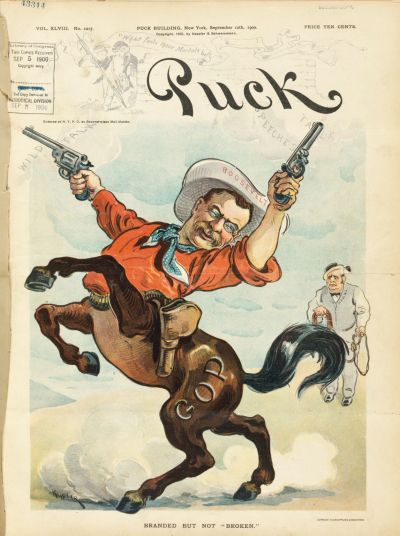
We could use a few damned cowboys today.
Personal note
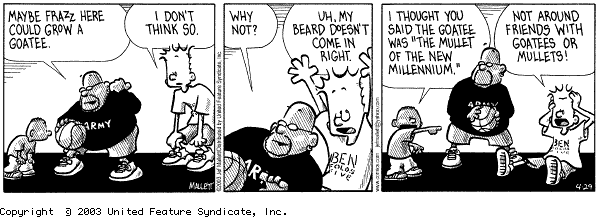
This classic Frazz has been on my mind lately, since a couple of two-or-three day pops back into the hospital for readjustment (nothing serious) have provided a couple of two-or-three day vacations from the razor and thus a chance to see how my beard has changed in the 35 years or so since I last let it grow.
The answer is that I can still grow a pretty good facial mullett goatee.
And that I'd forgotten that I don't like the feeling of hair on my face.
So now I know, and knowing is half the battle.
Here's the other, more zen half:
Mike Peterson has posted his "Comic Strip of the Day" column every day since 2010. His opinions are his own, but we welcome comments either agreeing or in opposition.
Comments
Comments are closed.