CSotD: The cartoon normally seen at this time will not be shown …
Skip to comments
… so that we may bring you this important message about taste and sensitivity
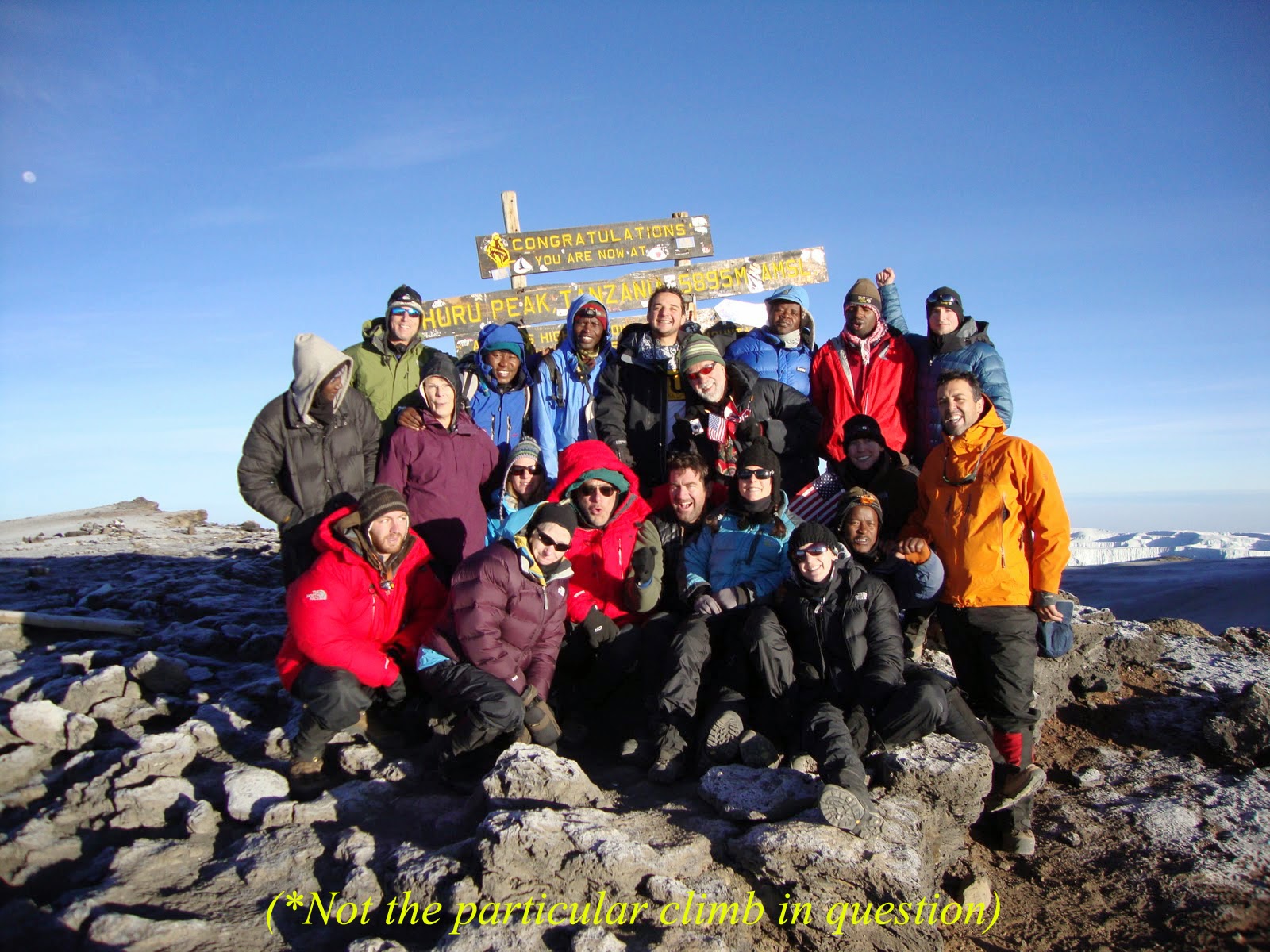
About six years ago, I interviewed a fellow in Rangeley, Maine, who had climbed Kilimanjaro, a feat that involves significant conditioning but no technical climbing and is popular among those who can afford to do it. He had sold his pharmacy to Rite Aid and so he could climb Kilimanjaro.
He was a very pleasant fellow, but when I said something about ecotourism and its impact on local economies, he reported that, yes, a lot of men showed up hoping to be hired as bearers, and added that many of them did not have the cold-weather gear required for the job, so that the American tourists often let them borrow clothing.
And then he blandly added that two of the bearers on his climb had died along the way and went back to telling me about his great adventure.
I was literally taken aback — a phrase that comes from the wind shifting in such a way that the ship stops dead in the water and loses both progress and steering.
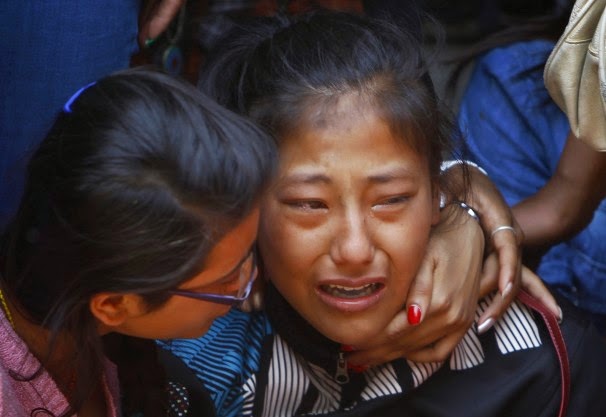
I thought of that when the Sherpas of Nepal spoke of cancelling the climbing season in the wake of the avalanche that killed several of them on Everest last week.
Nobody thought that 16 dead Sherpas was funny, or , at least, nobody made cartoons about it. Perhaps, like that fellow in Rangeley, they didn't find it particularly significant.
But I thought of it again this week when the story of a stowaway in the wheel well of an airliner provoked a raft of cartoons about how cramped airline seating is and how you can't bring a bottle of shampoo on the plane.
While I realize he was not a third-world refugee, the overall topic is still unamusing. It's like making a joke about a kid driving drunk down the wrong lane of the expressway because, gosh, it's better than being stuck in traffic.
That aside from the air of what they call "First World Problems."
In lieu of running one of those cartoons, let me make up to the families of those unmourned African men who died on Kilimanjaro, and show some sympathy with the Sherpas, by citing something about desperate people attempting to better their situation:
"Worldwide, there have been 105 known people who stowed away since 1947, according to data kept by the Federal Aviation Administration. Counting the California teen, 25 made it alive, for a survival rate of about 1 in 4.
But the FAA notes that the rate may be lower because people could have stowed away and fallen out of the wheel well without anyone ever knowing."
Sorry about the cramped seating and that discarded three-dollar bottle of Head-and-Shoulders, pal, but I ain't runnin' your cartoon.
And speaking of insensitivity:
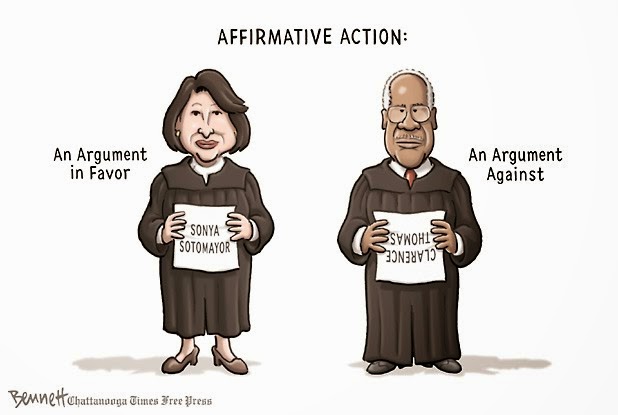
There used to be a saying in the black community that there are no rearview mirrors in Cadillacs. I don't know if anyone still says that, but I like Clay Bennett's commentary on yesterday's Supreme Court decision.
I will admit I have not read the decisions, so I can't comment on whether the ruling is a wedge against civil rights, though the executive summary of the Scalia/Thomas response is disquieting. But the SCOTUSblog summary suggests more reasoned and limited views were dominant.
Still, I would have to see specifically what the Michigan statute allowed, because, for example, I know that there are provisions back in my part of the world that give students from rural areas some kind of help in adjusting to college and while, in rural Mississippi, which might apply to a largely black group, in northern New York, it does not.
And yet that is, in fact, "affirmative action" — contending that some people who are capable of succeeding are not well-prepared to jump right in.
I heard Hari Kondabolu interviewed on Fresh Air Monday, and one of the clips they played from his new album, "Waiting for 2024," included a dig at the fact that white people don't see "white" as a very specific thing, but describe their heritage as “I’m 1/3 German, and a 1/4 Irish…and 1/40th Native American for college applications…”
But he also spoke of his respect for what his immigrant parents went through:
And the thing is, a lot of my parents' friends in India are retired now. My parents can't retire, like they have to keep going. So it's funny because, I think, because I talk about class a lot, I think there's the assumption that I'm a working class kid and that I struggled a ton and that's a lot of what informs my perspective. And the truth is that I was a middle-class kid – an upwardly mobile middle-class kid – and I got what I wanted and I went to rich kid's school and I was informed by that education. And it's not, you know, which is the truth. It doesn't mean I don't have a conscience and I don't talk about things that affect me, but that is also the truth. Sometimes I get bitter, like how come my parents are hogging all the struggle? (Laughter) Rich kids get a trust fund, they get money, they get legacy and they get to go to these nice colleges. Why isn't there a struggle trust fund? Why can't I take some of their struggle to give myself some legitimacy?
The notion that the struggle is over is as wrong now as it was 50 years ago when the Civil Rights Act was passed, and as wrong as it was when the 14th Amendment was passed. Maybe the struggle never ends, but it surely is not over now.
I've heard a lot recently, for instance, from Neal Degrasse Tyson, but also from a woman scientist on another NPR show which I've forgotten, about how people assume black people need more than "a leg up" but are, in fact, unqualified, and how the requirement to keep proving you belong there never ends.
But, while it may explain the bitterness of some people, it does not justify ripping the rearview mirror out of your Cadillac, and, if Clarence Thomas whined about an "electronic lynching" during his confirmation hearings, it was Sotomayer who drew fire for suggesting that perhaps a few different perspectives might improve things.
And it is Sotomayer who remains grateful for the help she got and doesn't feel self-conscious about what she made of the chance.
And who checks the rearview mirror regularly.
Oh, and, whether Michigan's statute was all about race, the question of fresh perspective on the Supreme Court is not. Check out this exchange, as the justices ponder the future of on-line video streaming in American Broadcasting Company vs Aereo:
JUSTICE SCALIA: Mr. Frederick, your – your client is — is just using this for local signals -
MR. FREDERICK: Yes.
JUSTICE SCALIA: – right now. But if we approve that, is there any reason it couldn't be used for distant signals as well?
MR. FREDERICK: Possibly.
JUSTICE SCALIA: Possibly what? There is possibly a reason or it could possibly be used?
MR. FREDERICK: It can’t be used for distance, but it implicates –
JUSTICE SCALIA: What would the difference be? I mean, you could take HBO, right? You could – you could carry that without – without performing.
MR. FREDERICK: No, because HBO is not done over the airwaves. It's done through a private service.
In other words, Antonin Scalia does not know that HBO is not broadcast over the air. He doesn't know the difference between cable and broadcast, and yet he's sitting in judgment …
Never mind the rearview mirror. Dude can't even see through the windshield.
Mike Peterson has posted his "Comic Strip of the Day" column every day since 2010. His opinions are his own, but we welcome comments either agreeing or in opposition.
Comments 4
Comments are closed.