Editorial cartooning International Newspaper industry Publications Publishers

Reporters Without Borders 2025 World Press Freedom Index

For World Press Freedom Day Reporters Without Borders has released their 2025 review of journalistic freedom around the world. Spoiler: Of the 180 countries listed the United States is not in the top (best) 50.

Although physical attacks against journalists are the most visible violations of press freedom, economic pressure is also a major, more insidious problem. The economic indicator on the RSF World Press Freedom Index now stands at an unprecedented, critical low as its decline continued in 2025. As a result, the global state of press freedom is now classified as a “difficult situation” for the first time in the history of the Index.
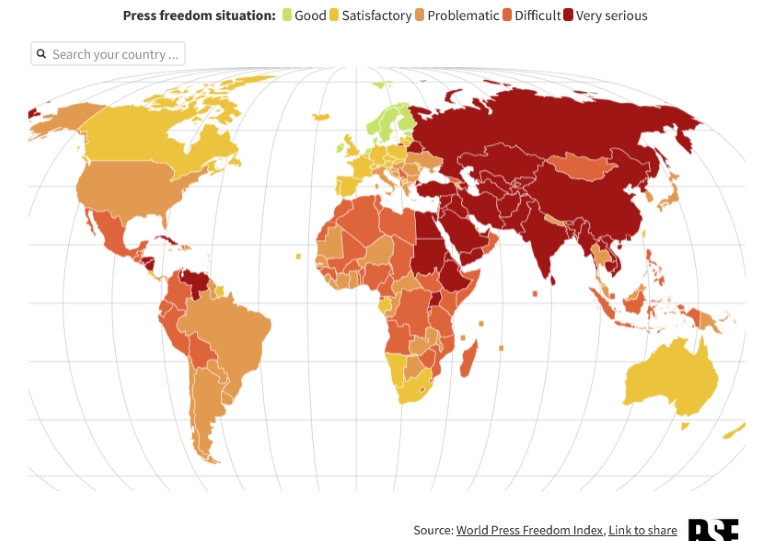
Press Freedom Around the World – the lighter the color the better

Concerning the U.S.:

In the United States (57th, down 2 places), where the economic indicator has dropped by more than 14 points in two years, vast regions are turning into news deserts. Local journalism is bearing the brunt of the economic downturn: over 60 per cent of journalists and media experts surveyed by RSF in Arizona, Florida, Nevada and Pennsylvania agree that it is “difficult to earn a living wage as a journalist,” and 75 per cent believe that “the average media outlet struggles for economic viability.” The country’s 28-place drop in the social indicator reveals that the press operates in an increasingly hostile environment. 

President Donald Trump’s second term has already intensified this trend as false economic pretexts are used to bring the press into line…

The specific United States section.

Massive waves of layoffs swept the U.S. media throughout 2023 and 2024 and have continued into 2025, affecting both local newsrooms and major legacy outlets. Many parts of the country are now considered news deserts, with the disappearance of local news outlets reaching crisis levels.

Previous Post
Miss Cellany Rounds Up
Next Post
CSotD: Which reminds me of a story …

Comments 5

  1. Since no context is given for “false economic pretexts”, the difficulty is in saying what “bring the press into line” means. Definitely, the liberal press I read and see (think The View) has no lack of freedom. The liberal press uses liberal pronouns and shows subtle support for terrorist organizations like Hamas, M-13 and Tren de Aragua. Gone under the Trump Administration is the Democrat’s “Truth Ministry”, which made it illegal to disagree with Democrats, MSNBC, CNN, CBS, NBC, ABC and especially The View. The internet has given us greater freedom in speaking our minds as Americans. More conservative voices are being heard and opposing voices are holding each other accountable. It’s a great time for freedom of the press. Newspapers can survive as internet entities if their owners are savvy enough. America’s melting pot of voices continues to be heard, simply not in the way that it once was heard. That is not the lessening of freedom, that is the increase of freedom.

    1. While this summary of the article does not provide context for “false economic pretexts”, the article it is quoting does. The rest of the paragraph discusses how cuts to the US Agency for Global Media and US Agency for International Development cause economic instability for hundreds of news outlets.

      Reading the executive orders that shut down these agencies, I don’t see economics mentioned, so I’m not sure I agree with the article’s description of these as “false economic pretexts”. Instead the executive orders seem to focus on how supporting these media outlets are no longer considered to be in the interests of the United States by the current executive branch. So a straightforward attack rather than one done with false pretext.

      But outside the executive orders, there has been a lot of talk about how the United State is bankrupt and can only afford the essentials, so I can understand why the author may have chosen to lump these cuts in.

      Regarding the network television and newspapers, the article seems to focus on the problems caused by concentration of advertising revenue by a few tech companies and concentration of news outlets by a few media companies, and how this makes them vulnerable to government coercion.

  2. give the big orange vegetable time (say another 18 months) and we will be down around, if not at the bottom, of the list.

  3. I think we found another news desert in Ira’s head.

  4. Did they omit Greenland from that map because they were afraid that someone might steal it?

Comments are closed.

Search

Subscribe to our newsletter

Get a daily recap of the news posted each day.