CSotD: It’s Monday Morning Quarterback Time
Skip to comments
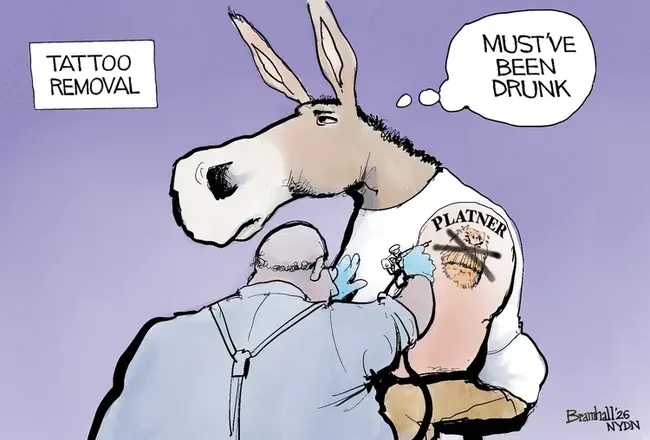
There seems to be an epidemic of “I Told You So, Maine” erupting across the nation, or at least erupting across the editorial cartooning world. I kind of thought I’d covered the Graham Platner thing the other day and we would move on, but I was mistaken.
Bramhall isn’t particularly snarky in his commentary, which plays on the tattoo Platner got in Croatia, apparently on a night of revels with fellow Marines. It’s unclear whether the tattoo really is a Nazi symbol or just resembles one, and it’s equally unclear exactly when Platner learned its connotations, but it’s clear that he had it covered up before he ran for office, and all that lack of clarity is covered by Snopes.
In any case, it’s a handy symbol of the negative background items that surfaced in the course of Platner’s campaign, and it doesn’t matter whether those things were brought out by opposition research or sincerely concerned people. But several skeletons in his closet had to do with his treatment of women, which he said he regretted and chalked up to PTSD, the final revelation in those stories being too recent and too specific to sweep under the carpet.
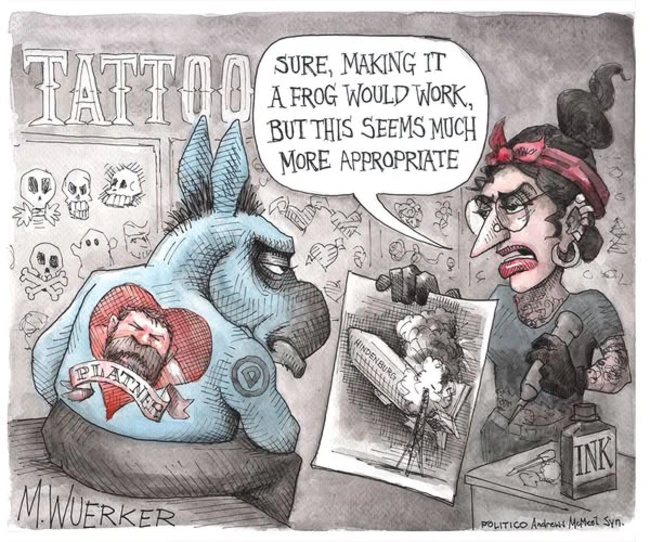
Bramhall’s tattoo cartoon suggests that the Democrats would like to cover it up and pretend it never happened, but Wuerker’s variation says that won’t be possible and that the affair is a disaster for the party.
That interpretation is based on the emphasis in the midterms on controlling the Senate. When the elections were first being discussed, the standard analysis was that the Democrats had an excellent chance of gaining a majority in the House but not too much of a chance to take the Senate.
However, that was before Dear Leader committed a series of blunders and goofy moves that not only offended a lot of people but drove gas prices through the ceiling. The Senate began to look like more of a possible goal, which, in turn, drew attention to the race in Maine. Susan Collins is a lightning rod for progressives nationally, and the question has been how much power she continues to have in her home state, which she has served since 1996.
The obvious view is that Platner’s forced withdrawal doesn’t give Democrats time to mount a credible campaign between now and November, particularly because he had so soundly defeated his opponent in the primary, Governor Janet Mills.
But, despite Wuerker’s prediction, things remain at the “We’ll see” stage.

Kearney offers a bit of “What were you thinking?” and he’s right that Platner arrived with a number of red flags already visible, starting with his complete lack of political experience, which made him attractive to populists but not so much to pragmatists. It didn’t take long, either, for stories of ungentlemanly behavior to leak, and while the initial story came from a rightwing activist, others were harder to dismiss as opposition slagging.
But the fact that Platner’s (alleged) history began to come out early muddies predictions, because, while his populist message attracted support, those red flags may not, as Kearney charges, have been ignored by everyone. There is speculation among the commentariat that a cleaner candidate could attract voters initially turned off by Platner’s questionable past.
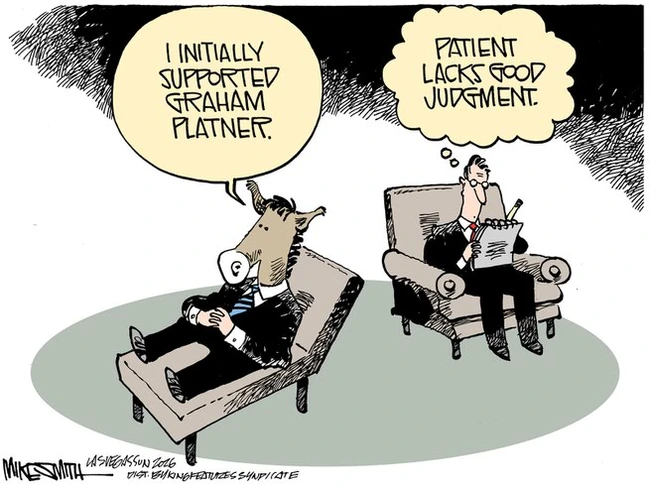
Smith echoes the “I told you so” message but adds a bit more of an insult, not just saying, as Kearney does, that Democrats were willfully blind, but that they were delusional.
This assumes that the point of the election is to beatify a saint, not elect a senator. Initially supporting a charismatic person who was drawing crowds and blasting through the primaries may suggest improper vetting, but it’s not crazy if the point is to win the election.
Susan Collins had better not start popping champagne corks yet. Given that polls showed a statistical tie between her and Platner (given the margin of error) it wouldn’t take a whole lot to swing the balance, and Maine is a tiny, intimate state.
Platner’s withdrawal leaves the selection of a candidate to a hastily-assembled convention of Maine political figures, and they aren’t likely to choose some unknown face in the crowd the way primary voters did.
The first credible replacement I thought of was Chellie Pingree, but her daughter is currently the leading candidate for governor, and, besides, she doesn’t want to read anymore dumb-ass columns on the Internet.
But they’ll find someone. It’s a small state, and that intimacy may help Democrats sort things out in time to get back in the race.
Juxtaposition of the Day
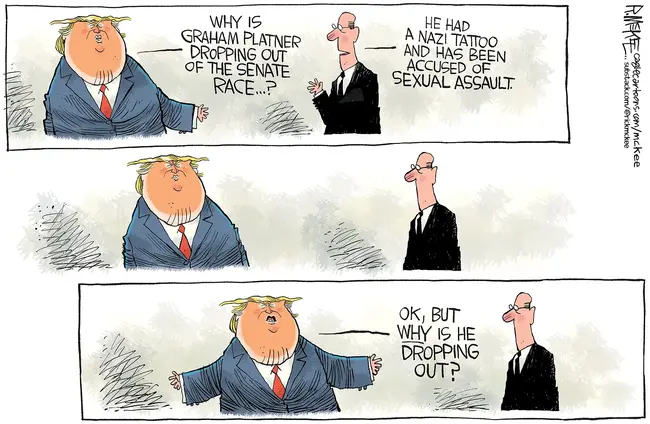


McKee makes a joke, but Milbrath isn’t laughing, and Luckovich makes his point by simply laying it out for all to see. For all the “I told you so” and “What were you thinking?” flying around over the Platner nomination, it would take a great deal of hypocrisy for the Republicans to pretend their hands are clean in that regard.
As noted here the other day, relying on primaries and vox populi doesn’t provide much of a chance for vetting anyone. But let’s be clear: Primaries are how you wind up with dubious characters on the ballot. Vox populi is how they wind up in office. Political history is full of variations on “The people have spoken, damn them,” though it’s usually said in defeat.
Still, there are places along the way where the party can step in, if they want to.
Platner blames the system. He should go have a beer with Gary Hart, because Hart was a leading presidential candidate when the press uncovered his affair with Donna Rice.
But that was 1988. By 2016, a candidate could brag about sexually assaulting women and there could be further revelations about extra-marital sex with Playboy models and exotic dancers and purposely walking in on underage girls dressing rooms and we still haven’t seen the Epstein files and … so what?
Who cares?
That’s not a rhetorical question. We answer similar questions every Election Day. And we ask them in our dumb-ass columns, even if not everybody wants to hear our ideas.
I think “Who cares?” is an excellent question.
And I can’t know how you feel, but I hope I know how you’ll vote.
Mike Peterson has posted his "Comic Strip of the Day" column every day since 2010. His opinions are his own, but we welcome comments either agreeing or in opposition.

Comments 6
Comments are closed.