Comic Strip of the Day Comic Strips

CSotD: The Monster at the end of This Humpday

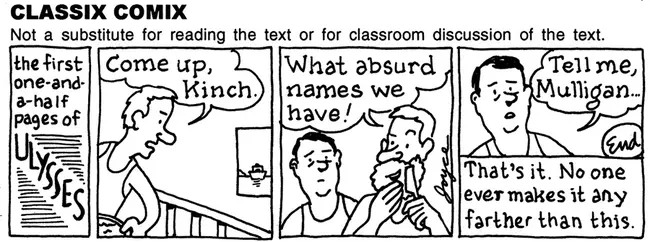
The monster at the start of this Humpday is Ulysses, and Ruben Bolling provides a chance for me to link to my classic examination of books everybody references and nobody has read.

Twain wrote that a classic is “something that everybody wants to have read and nobody wants to read,” which I would modify to say “something that everybody wants you to think they’ve read,” for which proof click the link.

For my part, I like big books and I cannot lie. It may be related to the reason, when I was a kid and we’d visit the city, I’d order things like frog legs and escargot, because I wondered why anyone would. It’s similar to why I was eager to visit Yellowstone: I wanted to see what all the excitement was about, and in that case it was well-deserved and I’ve been back.

I’ve also read Ulysses twice and War and Peace more than half a dozen times, but I’m not ashamed of having bailed out on the Brothers Karamazov and Moby Dick. This not the Clean Plate Club, and, as my mother would say when someone rejected an exotic food, “More for the rest of us!”

I’m in the downsizing phase of life and have donated several boxes of books — some of which I’ve read, some of which I haven’t, none of which I planned to pick up again — to a local nonprofit used-book store. Recirculation is an advantage of print over Kindle.
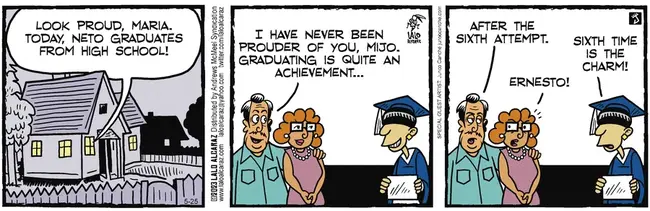
Before I step off my soap box, I’m grateful to Lalo Alcaraz for his series on graduation, which continues at GoComics, because it gives me a chance to comment without specific rudeness on something I keep seeing on social media: people congratulating kids for finishing random levels of elementary school, with formal ceremonies and hoopla far beyond its significance. It seems like handing out participation trophies.

Granted, there are still families where a kid can be the first to graduate from high school, and that absolutely merits a party. Graduation’s also often the point when the little bird leaves the nest.

But eighth grade graduation is a remnant of the days when that was where education ended for most people, and unless you take a long time getting there, truancy laws in most states today require you to show up for ninth grade the next September.
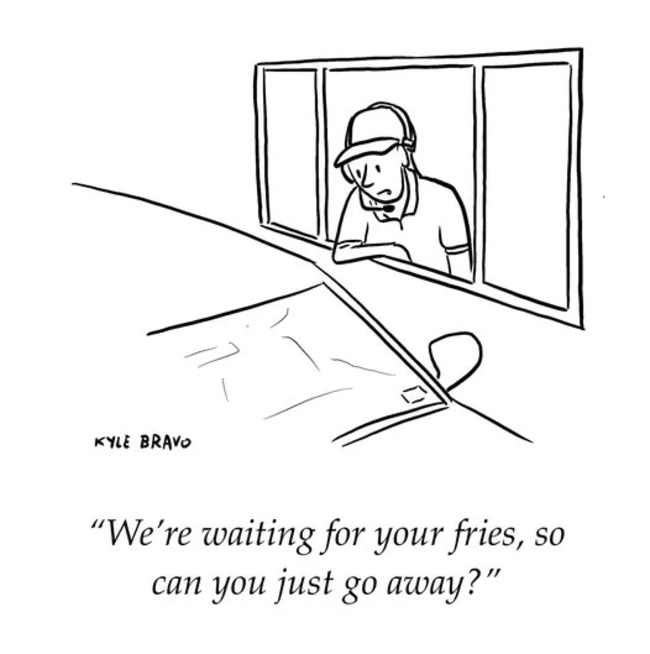
Seems like Bravo got sent to the park-and-wait section once too many times. Fast food used to be take-it-or-leave it, but then Wendy’s and Burger King got into “have it your way” and even drive-thru food was no longer fast.

Where I’d fault Bravo’s cartoon is that they’re never waiting for the fries and I wish they were. Instead, they’re waiting for the burger, and “efficiency” means putting fries in the bag in the meantime, so they can be room temperature by the time you get them.

Retirement has solved the problem for me, since I’m no longer driving around trying to grab sustenance between stops. Any not-so-fast food I get now is infrequent and my own damn fault.

Juxtaposition of the Day
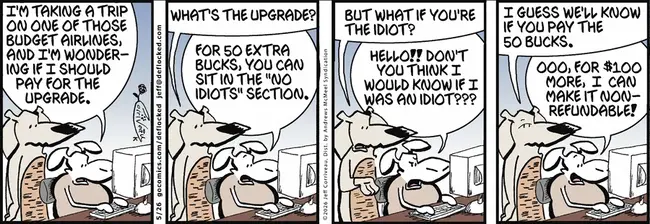
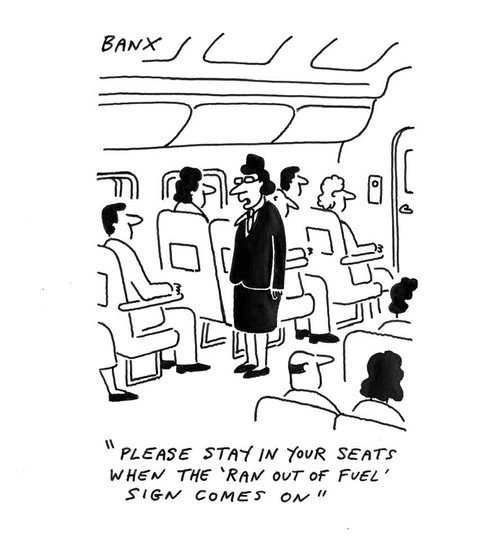
I wonder if we’ll ever see budget airlines again? It’s not as if fuel prices are going to fall very soon or very much, while, in the “I’m so old …” category, I’m so old that I remember pre-monopolistic days, when we had several airlines competing against each other.

When I was moving back East in 1987, I used People Express to pop back and forth between Colorado and Vermont because it was cheap, but also because my new job hadn’t started yet, so it didn’t matter how long I sat in Newark or O’Hare. If your schedule mattered more than the price, however, you flew the big boys.

The no-idiots section is a joke, but it’s not long since I first booked a trip to find that seats were extra. And it’s not as if they gave you the option of strap-hanging in the aisle.

We’re all in the idiots section now.
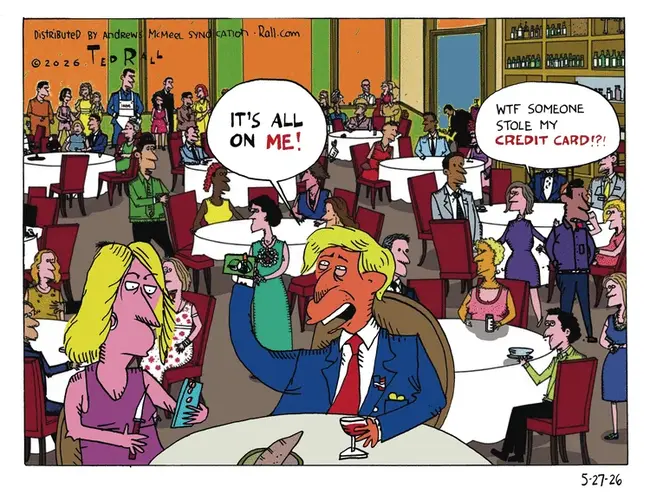
Speaking of olden times, I gather Rall is critiquing Trump’s running up of the deficit, but I’m using it on Humpday as a reminder of the Golden Age of Student Credit. After all, Trump didn’t invent this cavalier attitude towards debt.

Back around 1970 the credit card companies had the brilliant idea of sending unsolicited credit cards to college seniors.

It turned out to be a bad deal for the companies, but great fun for the students, since the bills they ran up were basically uncollectible. Many of the cardholders were still under 21, the legal age then for contracts, and others swapped cards so that the person purchasing pizza or gasoline was not the person whose name was on the card.

And the way a merchant knew a card was bad was by checking in a booklet of tiny little numbers that came out once a month and so was invariably about three months behind.

Who’s in your wallet?

Juxtaposition of the Day #2
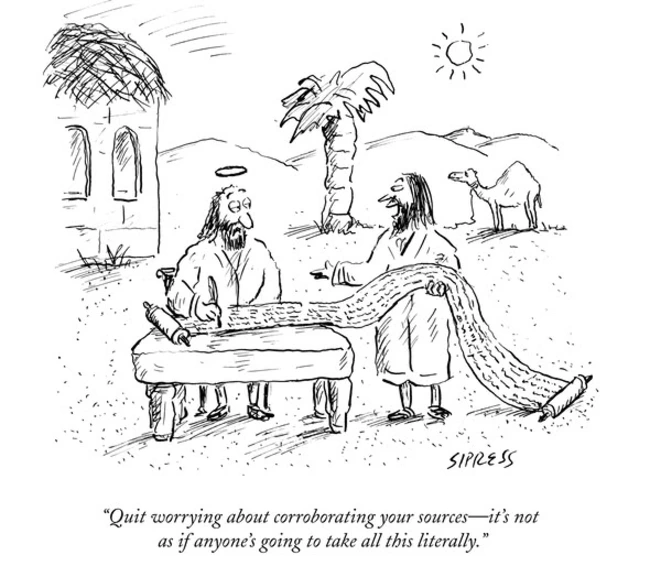
This can sure be an easy job, if you collect the right cartoons so that they answer each other.

Constant Readers will see that Sipress agrees with my take on Scripture — which most scholars would also endorse — that the stories are folkloric and not intended either as history or as science.

I’ve often wondered if anyone in Ancient Greece actually thought there were giant people on Olympus doling out rewards and punishments and thunderbolts, but I’m quite certain that we’re more comfortable dismissing their stories as folklore than we are applying the same logic to our own.

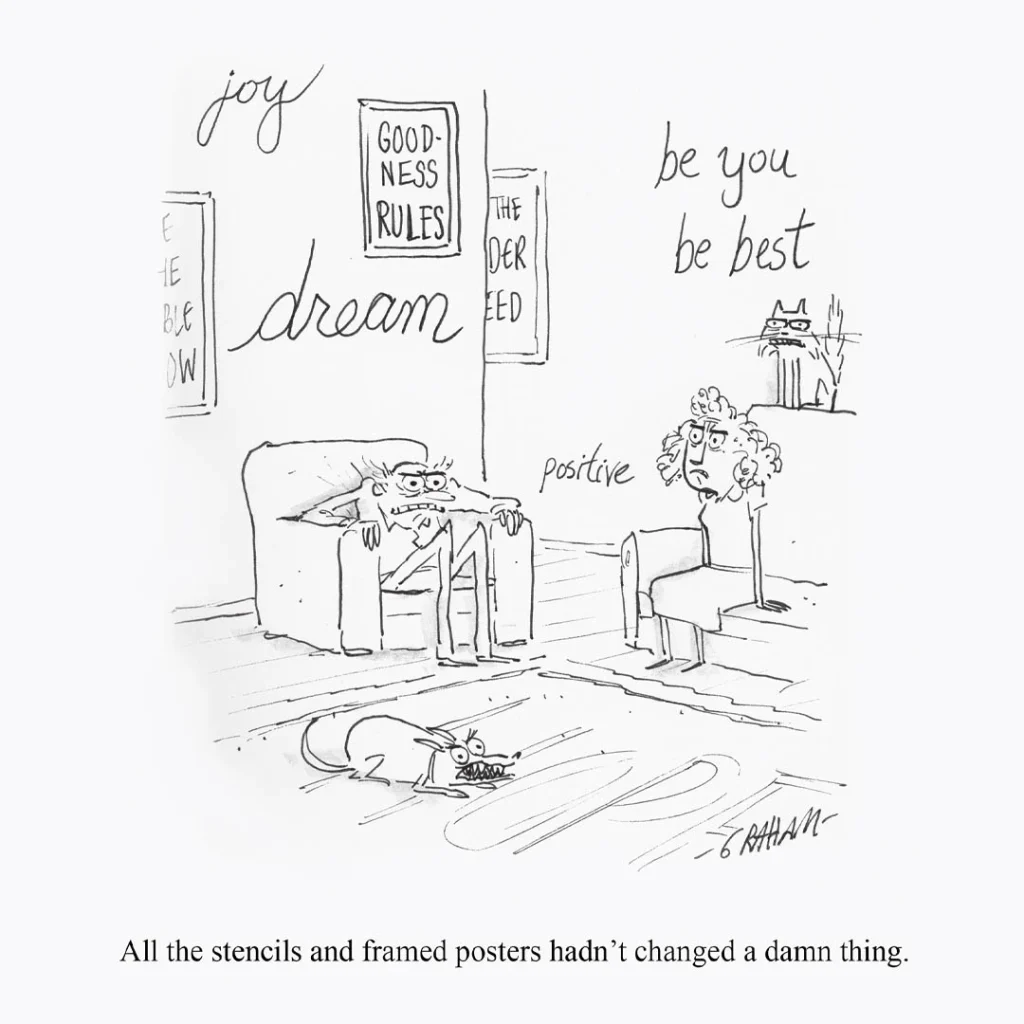
Meanwhile, I believe positive thought is good for the psyche, but that posting affirmations around your house only overcomes attitude so much. The collection of abandoned crutches at shrines like Lourdes is evidence of how much believing can benefit a person inclined towards faith, but it would be cynical and cruel to conduct six-month follow-ups.

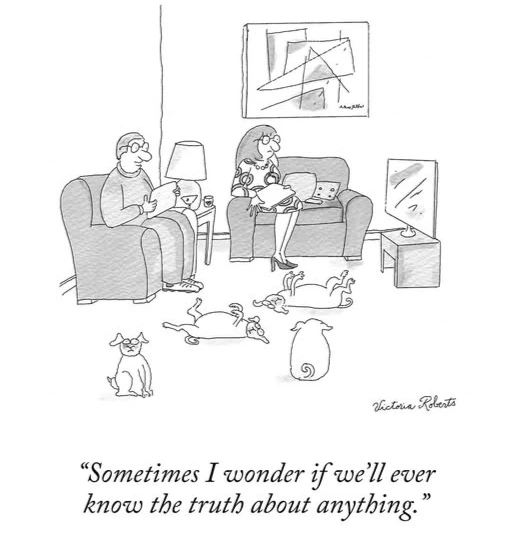
Much better to agree with Roberts that life remains a mystery.
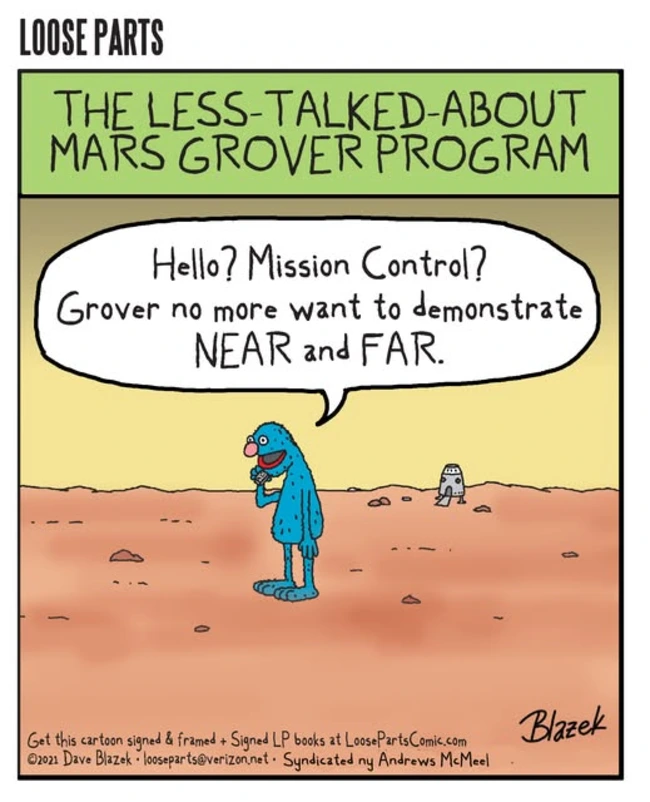
For my part, I’m willing to put our future, and the future of the space program, in the capable hands of little, furry Grover. He’s the most trustworthy celebrity I know of.

Mike Peterson has posted his "Comic Strip of the Day" column every day since 2010. His opinions are his own, but we welcome comments either agreeing or in opposition.
Jack Ohman
Previous Post
Jack Ohman Receives His Herblock Prize Award
Next Post
Cartoonists On Parade

Comments 22

  1. Am I the only one bothered by Loose Parts showing Grover speaking like Cookie Monster? Cute, loveable, furry old Grover can be self-referential but he uses correct grammar.

    1. You’re not the only one. That’s not Grover diction.

    2. Space travel has that effect on puppets.

  2. To be fair, it took me at least 3 attempts over 2 decades to finish Moby Dick — finally succeeding when I realized it was actually several books in one: the jaunty sea adventure everyone thinks it is, a literal encyclopedia of sailing and whaling knowledge Melville included for context, and a supernatural horror story, which was all the rage in the early 19th century.

    At least it was more honest than the illustrated children’s version I remember reading when as a kid that *changed the ending* to show that “revenge was wrong.”

  3. I agree with the idea that “classics” can be overrated. I taught high school English for eleven years, and did not begin teaching until age fifty-six. I tried to find books that the students could relate to and enjoy while also understanding the underlying themes. Some books, like “Of Mice and Men” worked well, and students made connections. Others, like Shakespeare, were more of a slog even though the few who got what was going on enjoyed them.
    One semester I used “Eleanor and Park”, a story about a Korean boy and an overweight girl who find each other. It delved into issues like acceptance, how we define masculinity, and abuse. The students connected with the book on many levels. Some of the language was not school appropriate, but like the “N-word” in “To Kill a Mockingbird”, we skipped over it. When I took the book to the department head to see if I could continue to use it due to a change in admin, she read the first few pages and said it “lacked literary merit” whatever that means. Subsequently, I did not use it again because admin was not very supportive of new ideas.
    Thanks of letting me rant.

    1. I don’t think they’re overrated, just that different people are apt to like different classics, but not if they approach them on bended knee, and I find it a mark against our educational system that people who run from “War and Peace” will settle in on a big, fat bodice-ripper beach book, which is far less interesting or gripping.

      As for current kids’ books, the kid-written publication I edited was swamped with “message books” by publishers, and they got awards from teachers and librarians, but the kids wanted to read Percy Jackson and the Hunger Games trilogy. When younger son was teaching 5th grade, he’d ask the kids to recommend books to him and he both learned a lot about them and got some really interesting reading, too.

  4. When my grandmother was 16, she was hired to teach farm boys to read. She taught me to read. I was a book addict by kindergarten. Some of my greatest reads were on the bottom shelf in the library. Reading taught me how to spelle.

  5. Not sure I get the Victoria Roberts cartoon.

    Are the two dogs on their backs begging for a tummy rub, and the people didn’t get it?

    Are the two dogs on their backs dead, and the people didn’t get it?

    As I said, I don’t get it.

  6. When I first heard that a new “Odyssey” film was coming out, I expected it to be based on “Ulysses“, and I didn’t care whether it would be Homer or Joyce, I have no interest in either one. In high school English I suffered through Faulkner’s “The Sound and the Fury“, hating every page of it, so later, when it was time for “Moby Dick” and then “Crime and Punishment“, I avoided the masochistic self-torture by resorting to CliffsNotes. It’s not that I hate literature, I did read (and enjoyed) “Huckleberry Finn“, “The Great Gatsby“, and “Return of the Native” in that same class. What I dislike is being forced to read monumental tomes, when much shorter books could be equally instructive (for comprehension and analysis purposes).

    P.S. In an earlier English class I was elated with anticipation when the teacher announced that we would be reading one of Tolkien‘s books. Wow! Alas, it turned out to be his annotated translation of “Sir Gawain and the Green Knight“, and was every bit as boring as the first three works mentioned above.

    1. Sounds like the sort of teacher I was torching in that article about people recommending the wrong books for the wrong reasons. The idea of assigning Faulkner to a high school class — even an AP class — is a ridiculous overreach that sounds as if it were intended to make sure they never read books again. I read it as a college senior and felt it was rough sledding.

      But give Homer’s Odyssey another shot. Pretend it’s being illustrated in your mind by Ray Harryhausen.

      1. Although I disliked the novel, the most fascinating part about being forced to read “The Sound and the Fury” was that the teacher had obtained reference notes from a college class that had studied the book a few decades before, including some commentary from Faulkner himself. I remember nothing of the plot (except that the unreliable narrator is a mentally retarded man), but I do remember a number of items from those notes:
        1) Faulkner’s original plan was to print the book in four colors, corresponding to the four time frames between which the narrator’s stream of consciousness randomly jumps. The publisher rejected that because the cost would have been prohibitive (in 1929).
        2) The replacement method was to alternate between Italic and standard (Roman) type fonts; each font change represented a temporal jump, but this did not mean that Italic was always the same time frame, just that there had been a discontinuity at that point.
        3) The notes included a long list of errata. Besides “normal” corrections to the text, this also included many instances where a font change had been forgotten, and others where a font change had been erroneously inserted. No wonder that we couldn’t follow it all!

        P.S. Given the difficult time that our class was having with the book, it was a wonderful relief to discover that college students had just as much trouble with the book, and that there were plenty of reasons for this.

      2. P.P.S. I will probably be forced to give “<a href="https://en.wikipedia.org/wiki/The_Odyssey_(2026_film)&quot;The Odyssey” a fair chance, but not because of Harryhausen. My son (who has virtually no interest in Greek history) wants to see the movie, but that’s because he has seen (and liked) most of Christopher Nolan’s films.

      3. Ah, my mistake. I thought you were expressing disinterest in either of the originals. I won’t go to a theater to watch Hollywood’s take on Homer, though I’d watch it if it ever came to non-pay TV. But only out of curiosity, not out of any real expectations. I like both originals quite a bit, which is certainly a disincentive to see them glamorized.

      4. Alas, I was actually referring to the originals. I wouldn’t want to bother with Homer’s “Odyssey” because I’m not interested enough in the story to wade through the length, and (mostly) because I wouldn’t be reading Homer‘s text, but just some translator’s distillation into English (or German). If it’s going to be distilled anyway, then the three-hour movie may be just as good a solution (for me).
        My problem with Joyce’s “Ulysses” is that Faulkner already proved that I don’t like “stream of consciousness”. If I ever do try to read it, it will be on the recommendation of Harry Rowohlt, a wizard of (German) translation, who distilled (among many other authors) Flann O’Brien, Kurt Vonnegut, and A.A. Milne into flawless German. As Rowohlt put it, Joyce’s “Ulysses” is fundamentally a very funny book.

  7. My mother was intelligent…Phi Beta Kappa, etc. After my father died when I was four, and our TV’s picture tube died soon after (in the 1950s) she didn’t replace it for the next seven years of my (and my three siblings) life. She would read to us at night…Stuart Little; Pooh; all of the Oz books from Baum and Ruth Plumly Thompson. Charlotte’s Web. A friend introduced me to Edgar Rice Burroughs and the Tarzan books.

    When I was in fourth grade and she was checking out my school’s book ordering form she insisted on getting The Hobbit. What an eye opener. I’ve been an avid reader ever since…almost anything. Favorites like The Hotel New Hampshire and Garp; and a plethora of read-throughs of The Wheel of Time. If she were still around I’d thank her again for that legacy.

  8. I’ve been meaning to get back into reading more, in the past couple years I’ve finished The Kite Runner and gotten back into Redwall (my mom got me like, the last 7 books for Christmas. I was so far behind, but now I only have 2 left) and recently found a copy of The Maltese Falcon in one of those Little Free Libraries.

    In school, I distinctly recall that we read Of Mice and Men, Animal Farm (the recent movie was TERRIBLE, easily a contender for worst of 2026), To Kill a Mockingbird, The Outsiders (Stay gold, Ponyboy), and a few others.

    It has to be hard to be an English Lit teacher, choosing books that will challenge students but also engage them. So many kids end up hating the books they’re forced to read, and that’s just tragic. The only books I’ve ever truly hated are crap with crap messages like Atlas Shrugged or those damn Left Behind potboilers that everyone took way too damn seriously.

  9. Too many years ago, my 11th grade English teacher (a young red head that I soon quit lusting after) assigned “Huck Finn” to the entire class during the first semester. Early in the second semester, she was forced to inform us that Huck was no longer on the acceptable list for assigned reading (that N-word thing again), and she asked us to FOR GOD’S SAKE don’t tell anyone what she had done.
    For me, I have no regrets for reading that one, yes, the language bothered me a bit, but I reasoned that Twain was writing in the true voice of a Missouri boy of the time. I’m not sure how many others were able to make that connection, or even gave a damn to try.

    1. I don’t remember the “n-word” ever being a major issue when my AP English class read “Huck Finn”. We knew that the book had been written over 90 years earlier, but this was also just a few years after the release of “Blazing Saddles” had mercilessly satirized the term. I recently saw an interview in one of the DVD extras, in which Burton Gilliam described the difficulty he had using the “n-word” on the other cast members, until Cleavon Little told him it was OK.

  10. “No suicides permitted here, and no smoking in the parlor.” – sign in the sailors’ boarding house in Moby Dick

  11. I manage people. Lots of them. We put robots in space routinely. Give kids the 🤬 participation trophies. They showed up.

  12. There’s no accounting for taste and any book you truly enjoy is a good thing. Even bodice-rippers, pot-boilers and propaganda. Just don’t use them as a guide to life. Some books are more sacred than others.

Comments are closed.

Search

Subscribe to our newsletter

Get a daily recap of the news posted each day.