Comic Strip of the Day Comic Strips Editorial cartooning

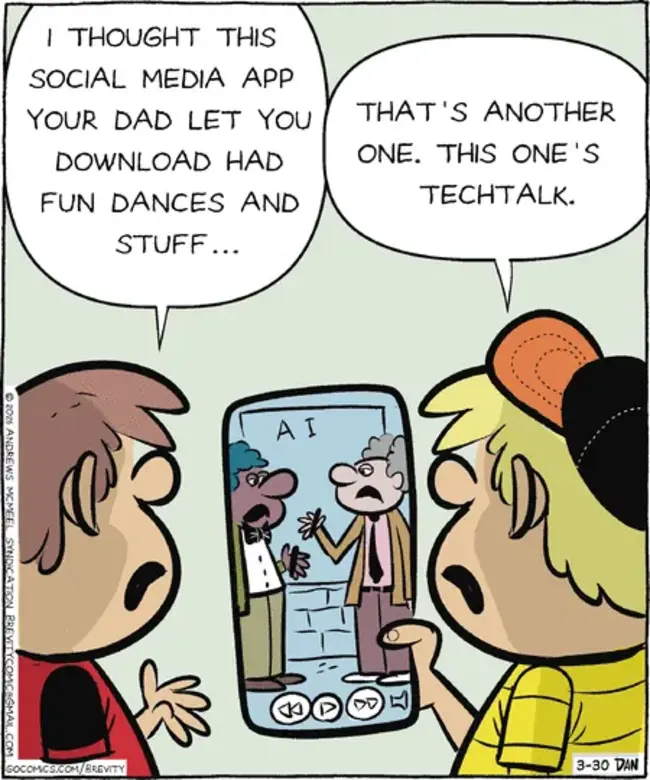
CSotD: TikTok TechTalk

Can’t steal the pun without crediting the punster, and it’s also worth pointing out that Dan Thompson had to have drawn this before the court decision came down and extend him some kudos for that, as well, though the trial took five weeks, so there was plenty of time to jump aboard.
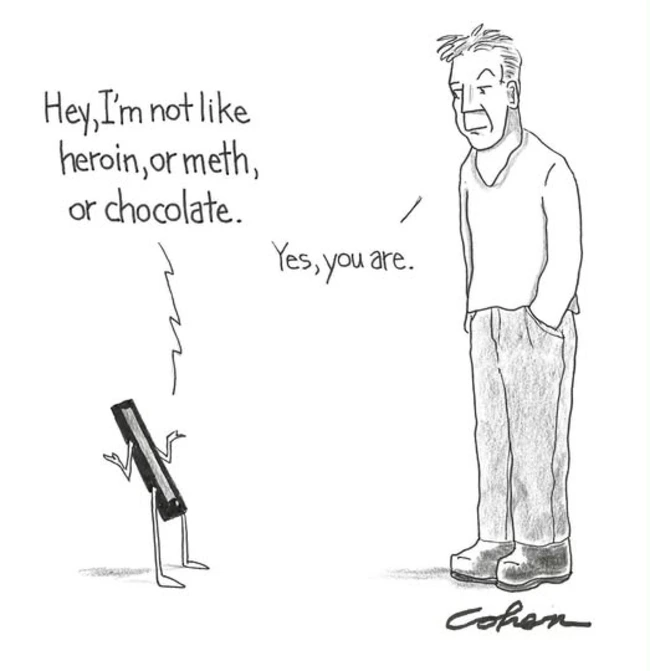
The YouTube lawyer explained that “This case misunderstands YouTube, which is a responsibly built streaming platform, not a social media site,” which is like saying that a Tiparillo is neither a cigarette nor a cigar: A distinction without a difference.
As Cohen suggests, they really need to come up with some more compelling arguments as they head into appeals, because bickering over definitions isn’t gonna cut it.

Bennett pulls out the big guns, comparing allowing a child to play with a Smartphone to letting her play with matches. The sentiment is reminiscent of the famous Daisy commercial of 1964, which only aired once, but got so much publicity that it might as well have run for a full schedule.

Kids of all types and races have been subject to social media, but a tiny barefooted blonde pings all the right receptors to make the cartoon doubly effective.
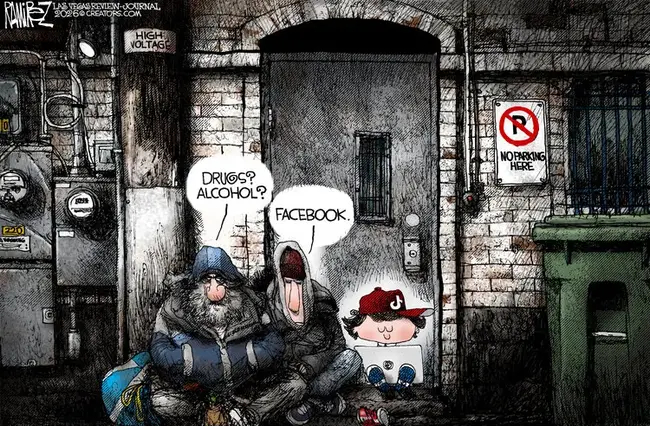
Ramirez goes the opposite direction, and places his addict on Skid Row. One flaw here is that it isn’t simply an issue of the lower class, but this imagery suggests that it’s somebody else’s problem.

The other criticism is that it’s so outlandish that you can’t tell if he’s agreeing with the verdict or mocking it.
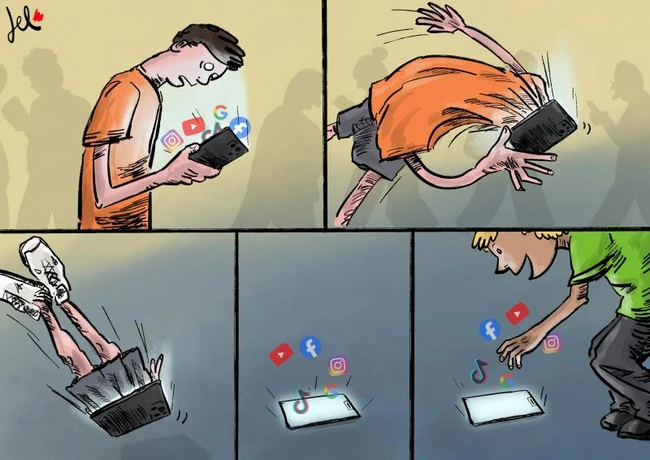
Outlandish is an acceptable strategy, but it needs to be completely outlandish, as in del Rosso’s cartoon, which is drawn in such a Twilight Zone/Outer Limits way that it declares itself absurd but then forces you to confront the reality behind it.
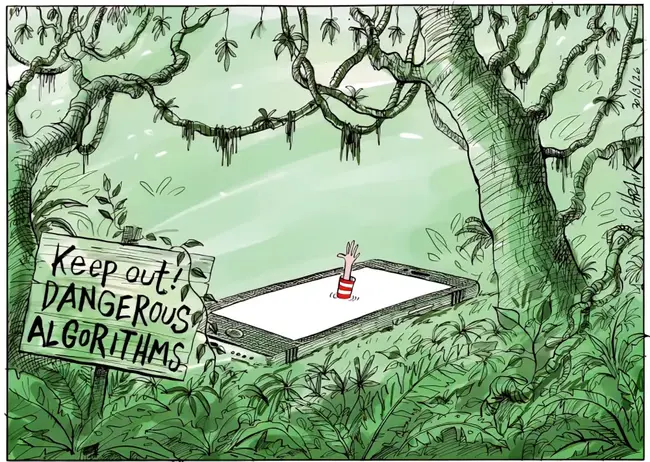
Similarly, Schrank melds quicksand with sandboxes with a phone to create the image of a child sucked in by the “Dangerous Algorithms” that were revealed in the course of the trial.

It’s not just that social media is attractive, but the architects of social media purposefully and consciously programmed in specific elements to make it addictive, at which point we re-open the old arguments about “physical addiction” and “psychological addiction,” which are generally advanced by people who make their money through promoting psychologically addictive substances.
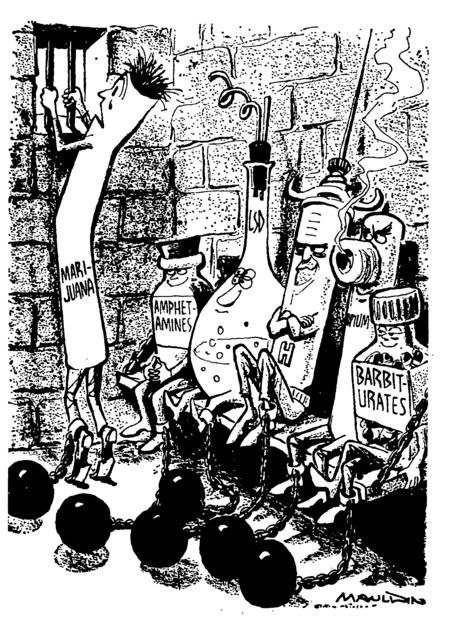
Mauldin defended marijuana half a century ago, since it isn’t physically addictive. However, the argument for legalization often began, “But you drink alcohol …” the answer to which was “If alcohol were discovered today, it wouldn’t be legal either.”
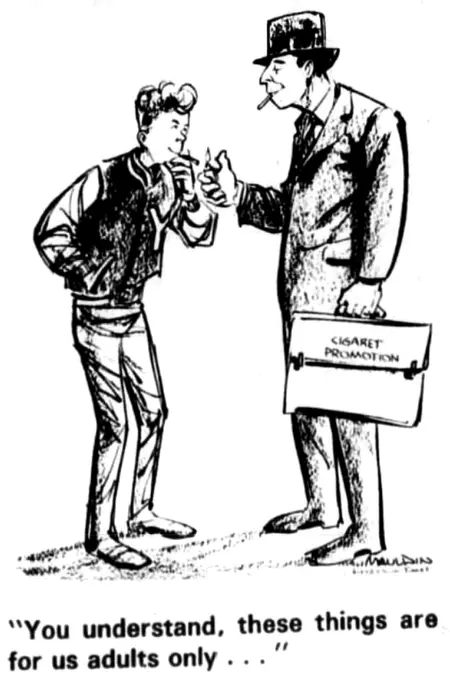
The issue of tobacco dependency could be argued far into the night, but it was generally accepted, even before the explosion of incriminating documents, that promoting tobacco to minors should be — but wasn’t — banned.
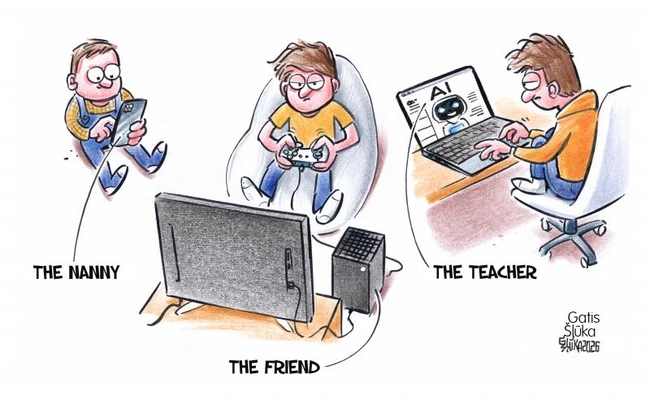
Sluka puts responsibility on the enablers, and cites social media’s frequent role as the “nanny,” knowing that a lot of kids’ parents use technology as a babysitter.

Then he adds “the friend,” which is how technology use advances with the child’s age, but is also applicable to a variety of unwanted influences: What parents control or forbid at home becomes a quick fix at a friend’s house, to which I would add that, even if you could somehow shelter your child from any of it, they’d still be going to school with kids who were steeped in the culture you had hoped to avoid.

Then Sluka turns to technology as educator, which applies both to what kids may learn — for better or worse — surfing around on their own, but also to tech in schools.

When cell phones first became popular, individual teachers and a few schools tried to ban them during class, but it’s only recently that states have enacted no-phone laws. This seems as self-evident as banning alcohol in class, but somehow it wasn’t.

Now some schools are backing off on other technology as well, limiting computers to situations in which they are relevant.
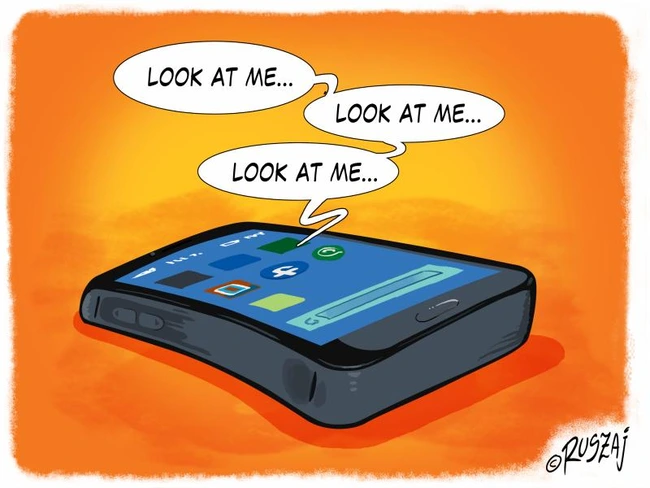
Meanwhile, the phone is waiting, calling out for attention. However much it may be controlled in school, and even if parents confiscate it at bedtime, it’s still there, demanding attention and promising sweet relief from boredom, from pain, from reality.

Just a little taste. I can quit anytime.

Juxtaposition of the Day

An interesting pairing of an identical concept. I like Gouders’ version because the dealer is more sinister, and the shadowy figure beside him offers a suggestion of prowling in search of a fix. On the other hand, Jennings makes it more clear that he’s selling drugs and not stolen merchandise, and if he’s less menacing, the dollar signs in his eye belie the friendly expression.

In any case, I doubt either cartoon will wind up framed and hanging in Zuckerberg’s office.
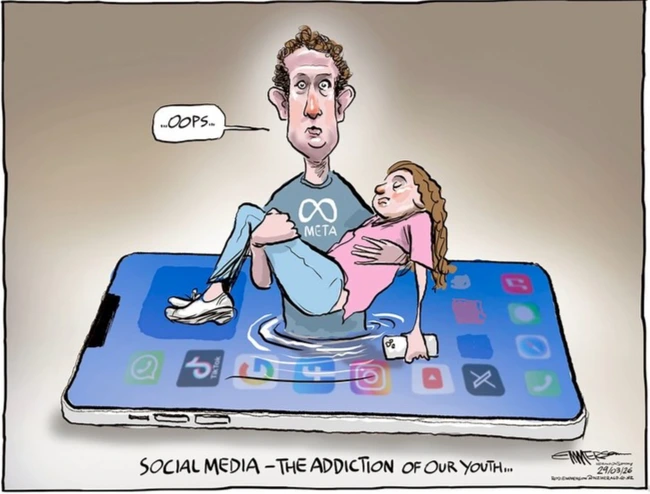
Nor will Emmerson’s cartoon please its subject, though perhaps there will come a point in time where he’ll be happy to hide behind an “Oops,” as if it were all just a mistake, but I wouldn’t hold my breath waiting for that change of heart.

Perhaps there will be an “Oops” over the revelation of documents that made it clear he acted intentionally to draw kids into social media and make it irresistible to them.
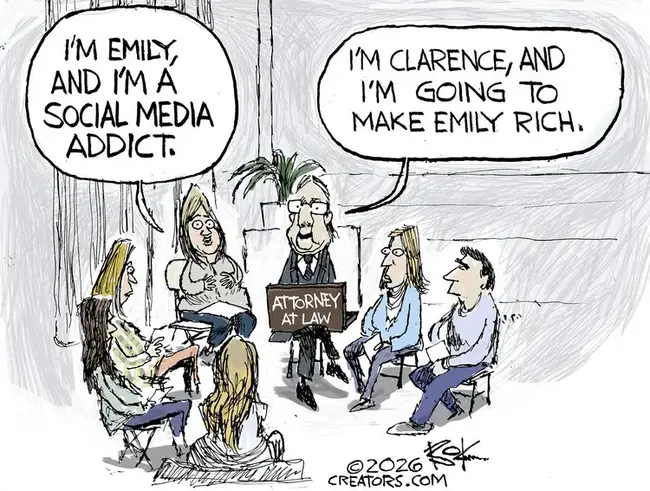
And in the “One in Every Crowd” category, there is, of course, always the observer who finds nothing wrong with harming young people, denies the harm even exists, and dismisses it all as a money grab. My response is, first of all, “Tell me you didn’t sit through the trial without telling me you didn’t sit through the trial.”

Obviously, five weeks of evidence and several days of jury deliberation suggest that there was something to the case. I’ve sat on a jury and seen the way both prosecution and defense are constructed.

However, I think the relevant question here is the same as Joseph Welch asked: “Have you no sense of decency?” This is a level of cynical cold-heartedness I cannot comprehend.
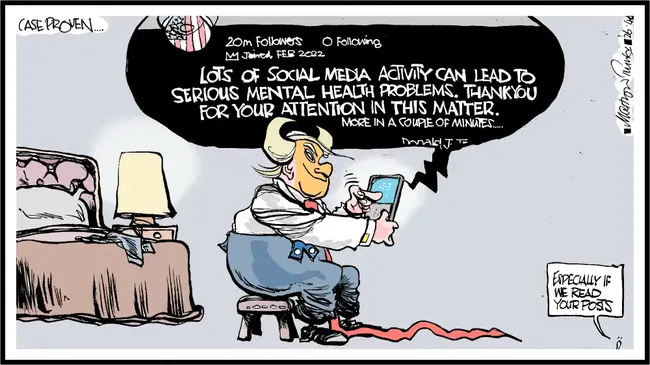
Fortunately, Turner employs good old Irish dark humor to let us finish today with a laugh.

As least, I think it’s intended as humor. Made me laugh, anyway.

Mike Peterson has posted his "Comic Strip of the Day" column every day since 2010. His opinions are his own, but we welcome comments either agreeing or in opposition.

Previous Post
Hey Kids! Comics! March Reprise
Next Post
Glen Baxter – RIP

Comments 14

  1. At least with other addictions you get a bit of space to avoid them.

    The kid needs to get off the iPad, but it’s provided by the school, all his learning material and homework is on there, and they load it up with IXL or whatever so that he can do “educational” things in his downtime.

    I need to get off the phone, but my job only communicates through the secure messaging app on it, my family uses FB and Insta to communicate, I need the mapping app to find my way around town, and I can’t get a car with a CD changer anymore so I need to hook it up to Spotify to listen to any music (since all the radio stations are dying out.)

    It’s like wanting to quit cigarettes but being forced to carry a pack around in your pocket while everyone you interact with shoves one up your nose every few minutes.

  2. I think the most interesting element of Ramirez’s cartoon is the young kid on Skid Row, still fresh and clean looking compared to his (I presume) father, but already incarcerated in a combination laptop/set of stocks. Ramirez’s work is so well done and complex, it’s a shame he’s usually willing to deny the grotesquery of the Trump administration. Such great material, and he rarely takes advantage of it.
    I think that’s Waldo flailing in the quicksand.
    Also great to see Bill Mauldin, who started smoking as a tiny kid, according to my memory of his vastly entertaining autobiography, A Sort of a Saga, a very funny book about his youth, which he was lucky to survive, due to a typical early 20th century unconcern with what children were doing in their spare time. Highly recommended.
    I love this website because I have always read editorial cartoons, along with comic strips and Comix, but the selection here every day really invites a more detailed interpretation than I used to give them. The squabbling the other day about the cartoon with Netanyahu riding the Trump bomb Slim Pickens style was a great example of a deeply complex image not getting the equally complex interpretation it deserved. I am particularly glad that you, Mike, have such a wide knowledge that you can use so many great cartoonists from other countries to illustrate world opinion on our slide into fascism. And because we get to see their fabulous artwork.

    1. Absolutely agree that Schrank’s cartoon has Waldo drowning , therefore to make us ask, “Where’s Waldo?”

  3. Is there really any difference between Zuckerberg and the Sacklers? Or Phillip Morris?

    As the old saying goes: Don’t take it personal, it’s only business.
    “After all, the chief business of the American people is business” (Calvin Coolidge).

  4. I started smoking when I was nine to look like John Wayne and James Dean. I quit at eleven when my chain-smoking aunt started coughing up blood.

    1. Yeah, but when you’re doing your business TO my person, it’s hard to take it any other way. The omelette and breaking eggs cliche doesn’t mention the dead chicken fetuses, either. Just sayin’…

  5. Knowing Ramirez, he’s probably mocking the notion that social media is as addictive/damaging as hard drugs, but then again what conservatives genuinely believe is nearly indistinguishable from absurdity.

    Good old Poe’s Law.

    That said, I have to take issue with the notion that smart phone use is a “relief”
    If anything, avoiding social media and clickbait is what helps keep me sane…

    1. I think Ramirez is showing 3 generations of addictive things: In grandpa’s day, it was drugs and alcohol; in dad’s day, it was Facebook; and in the kid’s day, it is TikTok. That is my take after looking at it in more detail.

  6. While I agree with your take on Bok’s cartoon, I also think he might be as put off as I am by the heavily rotating Davis & Crump TV ads trolling for potential class litigants eager to claim damages from social media’s deep pockets.

  7. You wrote: “Mauldin defended marijuana half a century ago, since it isn’t physically addictive. However, the argument for legalization often began, “But you drink alcohol …” the answer to which was “If alcohol were discovered today, it wouldn’t be legal either.”

    That’s false, since it disregards that alcohol WAS illegal during alcohol prohibition. But the prohibition was ended because it caused more problems than it intended to solve. That’s the way it always is with prohibition. You can’t regulate an illegal subastance.

    Addiction involves withdrawal symptoms that compel continuous use to be avoided. Marijuana doesn’t have them so is not addictive. That’s one of the many things consumers like about it. They can take it or leave it, sometimes for months or years at a time, and there is no discomfort. Added to the fact marijuana has no significant harms and it’s clear it’s prohibition was fraudulently enacted and is fraudulently maintained by powerfully corrupt forces.

    1. If you check the history, you’ll find that alcohol was developed several weeks before January 16, 1919, when the Prohibition Amendment was ratified.

      1. Oh perfect—so instead of engaging my actual point about the flawed comparison between alcohol and marijuana policy, we’re doing a thrilling deep dive into the groundbreaking revelation that alcohol existed before Prohibition in the United States. Truly devastating stuff—next you’ll uncover that water was wet during the Roaring Twenties.

        My argument was about whether alcohol would be legalized if introduced today and how prohibition historically backfires, but sure, let’s sidestep all of that by pointing out a basic historical timeline that no one disputed in the first place—because nothing says “strong rebuttal” like confidently answering a question nobody asked.

        Let’s look at the quote I was responding to again: — “Mauldin defended marijuana half a century ago, since it isn’t physically addictive. However, the argument for legalization often began, “But you drink alcohol …” the answer to which was “If alcohol were discovered today, it wouldn’t be legal either.”

        Did you think marijuana was discovered 89 years ago? BOTH alcohol and cannabis have been consumed by mankind for about 4,000 years. Before cannabis was FRAUDULENTLY prohibited, it was a common ingredient in many U.S. medicines and there were zero reported problems with recreational consumption. – So the “answer” to the alcohol/cannabis comparison is completely void, no matter how you look at it.

        In real time, the people know better. Colorado was the first state to re-legalize cannabis, doing it through a voter initiative. Their simple, winning slogan was: “Marijuana is safer than alcohol.” Nothing can touch that essential truth.

      2. You purposely “misinterpreted” the comment in order to go off on your own rant. Which you have now repeated. Which nobody had questioned or even raised in the first place.

  8. That’s pure deflection—accusing me of “misinterpreting” the comment instead of actually addressing the substance of the argument about prohibition, addiction, and the alcohol comparison. The original point clearly engaged the quoted claim about whether alcohol would be legal if introduced today and used historical evidence like Prohibition in the United States to show how bans can backfire, which is directly relevant—not some random “rant.”

    Saying “nobody raised that” is simply false, since I was explicitly responding to a quoted argument about alcohol versus cannabis. In other words, rather than rebutting the argument, you just try to dismiss it by relabeling it as irrelevant—which is not a counterargument, it’s avoidance.

Comments are closed.

Search

Subscribe to our newsletter

Get a daily recap of the news posted each day.