CSotD: Hiding our heads in search of solutions
Skip to comments
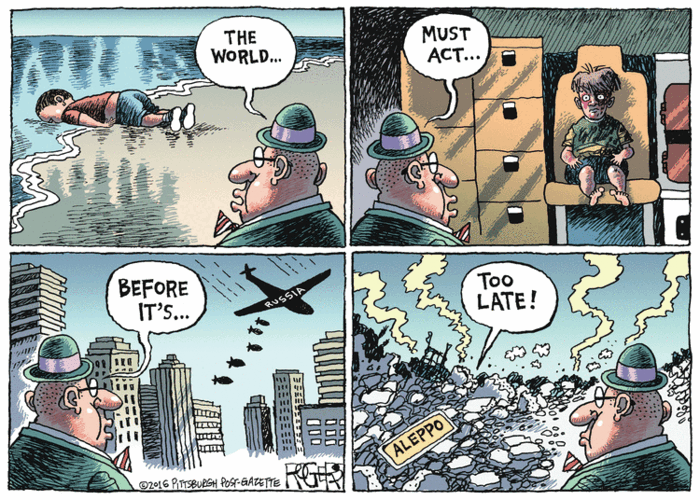
I feel like I pretty much covered this topic yesterday, but Rob Rogers' cartoon is too good to ignore.
Political cartoons that rely on symbols run the risk of being misinterpreted, while cartoons that spell out their intent run the risk of seeming preachy and boring. Rogers combines familiar images with a narrative to avoid either.
I did see a SJW meme this morning on the topic of "Why is everyone ignoring Aleppo?" which might better be phrased "How have I missed so much news?"
Aleppo is all over the place, as Syria has been for the past couple of years. The question is not why is everyone ignoring it but, rather, why do we — progressive or conservative — remain so indifferent in some ways and downright pig ignorant in others?
Let's not speculate on whether the consulate at Benghazi was a spook shop specifically dealing with the Syrian resistance. That would explain the immediate confusion and unconvincing cover stories for why it was attacked, but it's that last part that can't be confirmed: Were the spooks explicitly there to deal with Syria?
And let's not ask voters to connect the dots between Trump's relationship with Putin and the ongoing war crimes engendered by Putin's relationship with Basar.
In exchange, we'll pretend Putin and Obama didn't have a behind-the-scenes meeting at the 2013 G-20 summit whereupon Russia held back the Syrian forces for a time.
 Let's just focus on the racist hatred of Muslims under which we allowed Trump to flatly lie about the number of Syrian refugees entering the United States and the ease with which they are able to get in, as well as how many of them are children and old people.
It is similar to how he is being permitted by his loyalists to claim that his Electoral College squeaker was a landslide: The plain, disproving facts are there for anyone to see.
But we don't care.
And dead children don't matter anyway, once they are born, especially if they weren't born here to American citizens.
And another thing
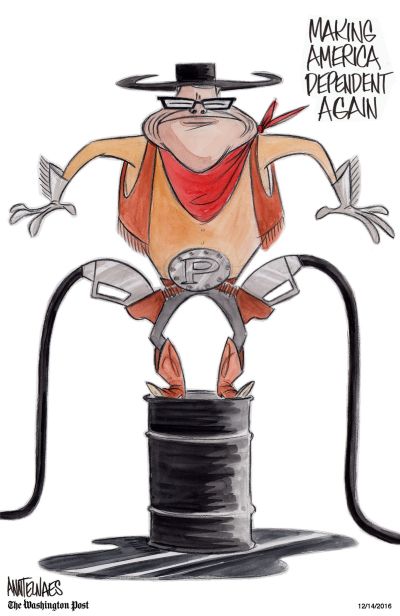
Ann Telnaes raises an issue about the (proposed) appointment of Rick Perry to head the Energy Department, particularly in combination with placing Exxon/Mobil CEO Rex Tillerson in the Secretary of State position.
Aside from Perry's overall lack of qualifications — the governor of Texas being more of a ribbon-cutter than an administrator — and ignoring the "He put on glasses so people think he's smart. People can see through the glasses" crack Trump made about him, and the fact that he's on record as wanting to eliminate the department … okay, hold on a minute …
Right, I remember now … there's also the question of whether he'll even attempt to be responsible on the "Drill, Baby, Drill" approach to energy independence, and how that will jibe with a Secretary of State who has a history of wanting to make petroleum import deals with Russia.
Of course, Tillerson won't be working for Exxon anymore. And I'm sure he won't allow the massive heaps of their stock options in his portfolio to impact his dealings with Trump's BFF, any more than Perry will allow increasing earthquakes in Oklahoma to dim his support for fracking.
To be honest, however, energy policy is the opposite of Syrian refugee policy, because the facts are so complex that even good-hearted people with the best interests of the nation, the future and the environment can become confused.
From the days of converting from coal to oil and forward to the present day, there appears to be no solution that does not bring with it a series of new problems.
It's not just that each solution — biofuels, nuclear, increased natural gas production — provokes arguments with opponents; it should provoke arguments among its own supporters over whether the advances counterbalance the problems.
Anyone who claims to have found a pain-free solution has simply not thought it through.
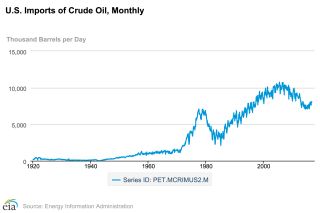 We're not energy independent, but, while I was able to find a graph of our imports, I wasn't able to pull up a graph showing the balance of consumption over time between imported and domestic fuels, which seems more relevant.
On the other hand, given Trump's pledge to make America great again, I wonder if he'd like to dial back consumption to the levels it was when America was great.
That would solve the issue of whether we're going to frack our way to independence or simply let Vladimir get his nose further under the tent flap to help solve the problem.
As I said, there is no simple fix.
For now, the biggest barrier to suckling at the Russian petro-teat are sanctions that have to do with things like invading other nations or helping dictators bomb civilian targets.
The obvious answer being to let our Secretary of State handle the diplomatic issues, and our Secretary of Energy solve the whole energy-independence thing.
That'll work.
On a more ethereal note
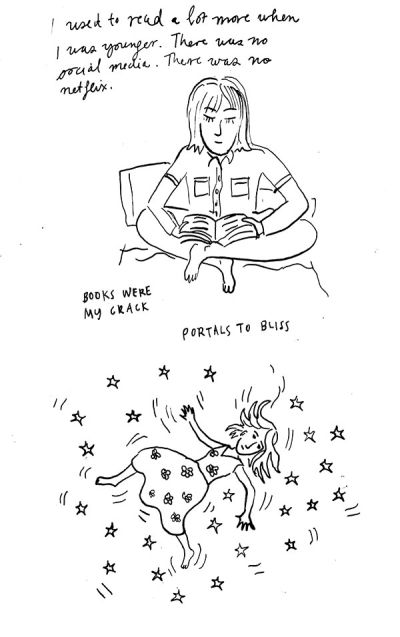
Sarah Laing has posted a new reflection on life and stuff, and it's very much worth going there to read the rest, particularly since it won't take you where you probably thought this snippet was going to lead.
It is, however, of a piece with her Katherine Mansfield graphic memoir, examining artistic influences and responses, and she reflects on the current piece, saying, among other things:
I’ve been thinking about this quite a bit lately – where has my intensity of feeling towards art gone? It’s still there; art makes me think, constantly, mulling over how I experience the world as opposed to how the protagonist in a book, or the artist, experiences it. But I don’t experience it in that ecstatic, almost orgasmic way that I did when I was young.
As in the Mansfield memoir, she engages the reader in a conversation that matters, which is worthwhile in and of itself, but particularly so at a time when so many graphic memoirs are simply bland, self-important adolescent chronicles of unremarkably normal, self-important adolescent lives.
Mike Peterson has posted his "Comic Strip of the Day" column every day since 2010. His opinions are his own, but we welcome comments either agreeing or in opposition.
Comments 3
Comments are closed.