CSotD: Funny stuff and not at all funny stuff
Skip to comments
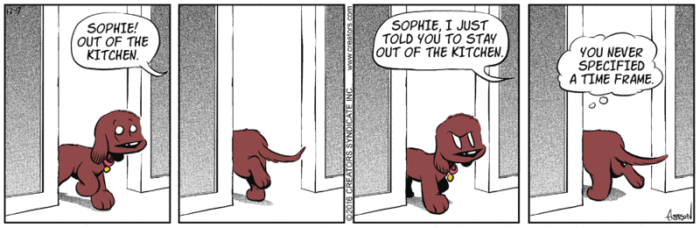
We'll warm up with some cartoons that made me laff because they reminded me of something else, which is to say YMMV, but, on the other hand, much of humor is based on making a specific thing feel universal.
Or something.
Anyway, Dog Eat Doug takes me back to a point when I had an extremely headstrong Ridgeback and was dating a former officer's wife who had grown up as a military brat. Which sounds like a set-up for a sitcom or a comic strip already.
For instance, while my style of food prep included taking the skin off a raw chicken and dropping it to the waiting dog, her style of food prep included removing all quadrupeds from the kitchen.
Their clashes of wills had gotten off to a somewhat rocky start, but they had started to work things out, and, in this case, the compromise was that, when she was cooking, he would lie in the diningroom doorway with his toenails — but not his actual toes – just across the metal strip separating the linoleum from the carpeting.
A statement of "Ha! I'm still in the kitchen!" that didn't risk his being ordered out of the kitchen.
Yes, it's possible that I was simply attracted to the same thing in dogs and women, because I remember them both very warmly.

And today's Loose Parts touches off a very specific memory of a very specific moment and I laughed at the comic on its own merits, which is to say that I know kale is quite nutritious but I do not believe that eating it has the same impact on your body as being bitten by a radioactive spider.
However, the gag also reminds me of a news story I wrote about the local mall in which I listed its new tenants and included "the redundantly named 'Corn Dog On A Stick.'"
I got a call from the publicity director of the mall, who had been told to inform me that this was an inappropriate way to refer to the tenant.
Which she did without cracking up, but then again, she found herself a better job shortly thereafter.
(Kale On A Stick is not only not in the least redundant but makes me wonder how a health-conscious vendor would do it.)
Best accidental timing ever
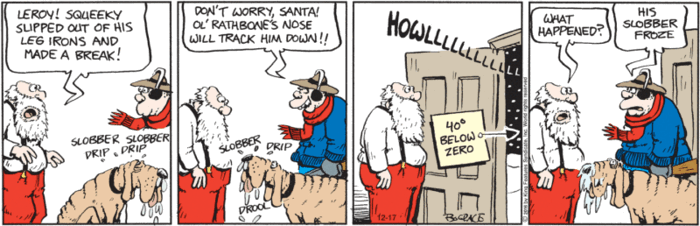
Obviously, Bud Grace didn't need a crystal ball to time this Piranha Club Santa's elves arc to run just before Christmas, but he gets a serendipitous timing award for dropping this particular episode smack in the middle of the current freeze.
Juxtaposition of the Day
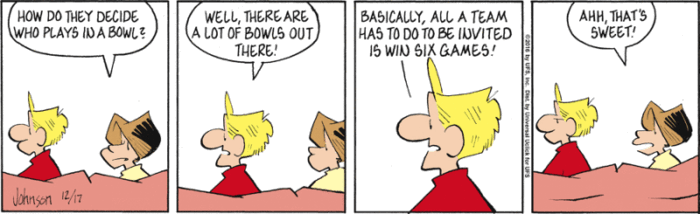

I'm so old I can not only remember when Bowl Games were significant, but when their names reflected the communities that hosted them: The Orange Bowl was in Florida, the Sugar Bowl in Louisiana, the Rose Bowl in Southern California, the Cotton Bowl in Texas.
Now it's the "Capital One Orange Bowl," which I guess could make a good commercial: Samuel Jackson asks, "What's in your wallet?" and then pulls out his own and we see that it is covered in orange rind and embossed in large letters with the title "Sellout MFer."
Bowl Games were once part of their communities; now they're just items on the TV schedule and at the betting parlors.
Meanwhile, consider the Minnesota Golden Gophers, who may be boycotting the National Funding Holiday Bowl in order to make an important point about women who were asking for it or something.
Or about how the university needs to keep its big fat nose out of their locker room.
In any case, if they stick to their guns, the team that would replace them has only five wins and seven losses.
Of course, there's more than one definition for "loser" and a 5-7 record isn't the worst.
(Update: Praise the Lord, order has been restored to the universe.)
Speaking of education and things that aren't funny
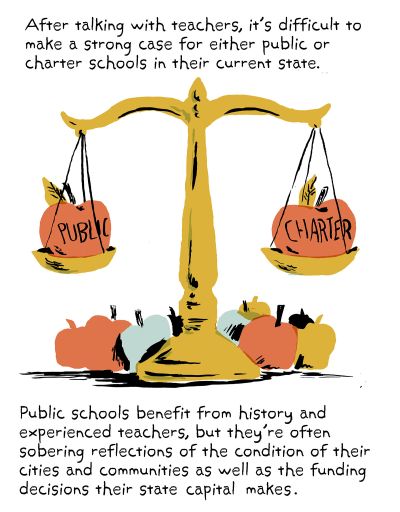
Steve Teare has an extended rumination on charter schools at the Nib, which is not only an important topic to begin with but, given the nominee for Secretary of Education, rapidly approaching critical.
It's an unusual perspective, because it's largely based on whether teaching at a charter is more rewarding than teaching in a public school, and it's not so much that it ignores the benefits to students — it doesn't — but the focus is not what we normally see in these things.
Having devoted substantial professional time to education, I find it hard to view the charter movement as more than a convenient cop-out for those who don't want to spend the money to reform our public schools.
I've often said before that the chief benefit of charters is that they draw active parents out of the public system, reducing the hell-raising at school board meetings so that failing public schools can continue to be ignored.
As Teare notes – and in contradiction to the blue-sky promises of charter advocates who never taught a class – none of the innovative concepts in charter schools seem to do the kids a whole lot of good, though getting them out of under-financed hell-holes is not a bad thing.
One would think, given the number of years we've played around with this alternative to adequate funding, that someone would have stumbled across a method that could be expanded to serve a more diverse (which is not just about color) group of students.
So far, however, the only innovations that work seem based on small class sizes and well-coordinated missions. The others either don't work or can't be replicated because they're based on charismatic individuals.
Meanwhile, the trend in public schools is "consolidation," which is the opposite of small class sizes and well-coordinated missions.
His observations are worth reading, since we seem headed for a more honest time when people in charge will actually ask, "How can we improve education for the kids we give a damn about without spending additional funds?"
And others will likely be promoting the for-profit prison system.
Mike Peterson has posted his "Comic Strip of the Day" column every day since 2010. His opinions are his own, but we welcome comments either agreeing or in opposition.
Comments 1
Comments are closed.