CSotD: Happy Canada Day
Skip to comments
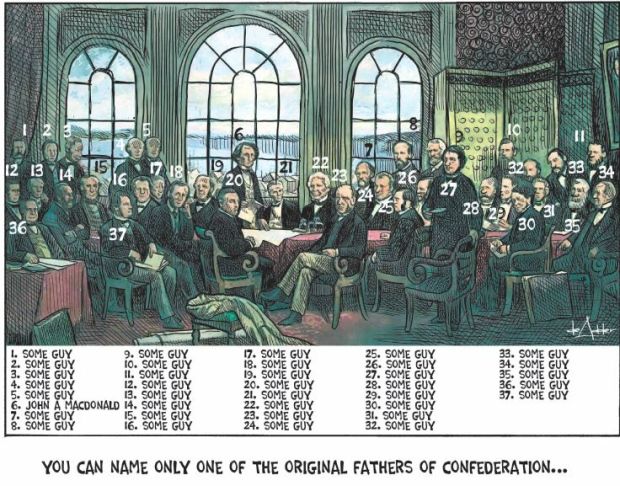
Today is Canada Day, and so we'll salute our neighbors to the North on the occasion of the 150th Anniversary of Confederation or perhaps not, as Michael de Adder suggests, given that only parts of Canada confederated on that date.
However, that's when they mark their start as a nation and, on the 100th anniversary, they held Expo in Montreal and ran a train across the country with various exhibits and redesigned the flag and it was quite the shindig.
150 seems more restrained, at least from this distance.
 In any case, as de Adder notes in his new book, nobody can name any of the founders except John A. MacDonald, whom they recognize because not only had he been featured on the ten-dollar bill but …
… well, because he was on the ten-dollar bill.
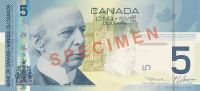
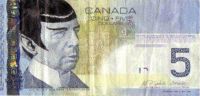 Wilfred Laurier was featured on the five-dollar bill, which you would think would make him even more recognizable, except that he's not a Father of Confederation, since he hadn't yet been born at the time, but, more to the point, people kept turning him into Spock.
Whom they do recognize.
The Canadians also have a one dollar coin they call a loony because it has a picture of a loon on one side.
On the other is a picture of a duck, which is as good an intro as any to the topic of the Fenian Invasions That Sort Of Made Canada a Nation.
This article covers the entirety of the events, since it was actually a disjointed series of attempted invasions over several years, in which Irish nationalists, mostly Civil War veterans, attempted to seize unconfederated Canada in order to exchange it for Ireland.
There's a Kate Beaton cartoon on the topic linked in that article, which you can also see on her site, here.
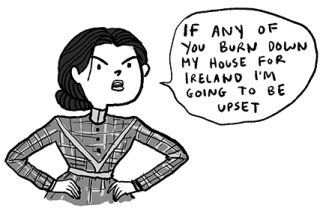 I'm excerpting this particular panel because it typifies the Average Canadian's reaction to the plan at the time, which only even sort of kind of worked around Buffalo very briefly and elsewhere was not simply quixotic but Quixotic, the distinction being that it was not just overly optimistic but actually kind of insane, albeit in an endearing comic opera sort of way, a vast conspiracy carried out in a half-vast manner.
That previous link will tell you about the parts that involved real battles, but I wrote about a pair of Fenian invasions further upriver that, while not entirely bloodless, were less Lee and Grant than Gilbert and Sullivan.
The oddest part was that it seemed that General Meade sat back and watched it all unfold until he realized they might actually get beyond the planning stage, at which point he stepped in and said, "Wait, wait, wait, no" and sealed the border with them half on one side and half on the other.
When I was researching the second of these, I drove from Frelighsburg, Quebec, site of the Canadian lines, over to Franklin, Vermont, where the Fenians had staged their invasion.
This was back in the days when you could simply go from here to there without hassles, and, when I told the border guard what I was up to, he said, "Oh, did you go to Richard's farm and see the bullet hole in the door?" which I hadn't.
So I drove into town and they pointed me at the farm and, by golly, 125 years later, it was still owned by the same family (though spelled "Rykert" in this telling) , and the fellow told me how some Fenian wanted to set up an observation post on the second floor of the farmhouse, but his great-great-great grandfather told the guy to get out and slammed the door, which is how it got a bullet hole in it.
He also told me that one of the few fatalities in the conflict was some curious person from town who had climbed up on a pile of lumber to get a better view of things and fell off, breaking his neck.
In any case, all this back and forth of armed partisans goaded the Canadians into moving ahead on Confederation, and so, while it was still some years before the Irish managed to found a nation in their own homeland, they did manage to start one somewhere and it's now 150 years old.
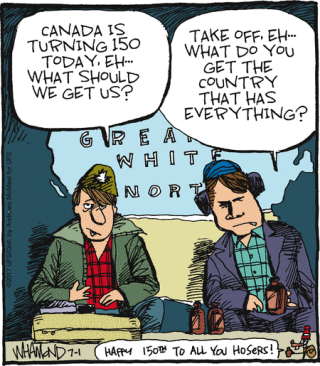 And if the impact of the Fenian Invasions on Confederation is somewhat of a myth, today's Reality Check offers a look at something even moreso, though, again, the phenomenon has been accepted in much the same spirit as the Spock five-dollar bills by a country that doesn't take itself half so seriously as One To The South Which Shall Remain Nameless but which takes itself very, very seriously.
As far as I can tell, the McKenzie Brothers are, as a type, somewhat regional, while the term "hoser" was, in my experience, almost entirely a phenomenon of the St. Lawrence River Valley in the mid-60s.
I was absolutely stunned to hear them use the term on television a decade later, since it's pretty obvious what it means and that certainly was how we used it on our side of the border and definitely not in polite company or even in mixed impolite company.
Point being that it was not a more genteel substitution for its F-derived equivalents but simply a synonym.
The censors sure got hosed on that one.
Those hose-heads.
Anyway, de Adder has a new book out called "You Might Be From Canada If …" which the cartoon we opened with today is from, and, if you're not from Canada, you won't have the slightest idea what the hell he's talking about, but, yes, they buy milk in plastic bags.
I don't think you can blame that on the Fenians.
Now here's your moment of cross-border zen
Mike Peterson has posted his "Comic Strip of the Day" column every day since 2010. His opinions are his own, but we welcome comments either agreeing or in opposition.
Comments 3
Comments are closed.