CSotD: The Politics of Division
Skip to comments
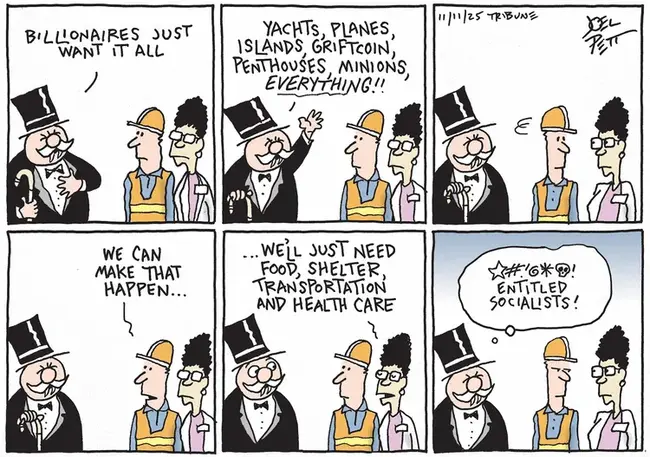
Pett lays it out: It’s not so much that people resent the wealthy. It’s that they resent the wealthy standing on their throats. They resent living paycheck-to-paycheck in a world in which CEOs make 285 times what they pay their workers.
And, assuming there is no compromise by year’s end, they’ll resent watching the uber-wealthy get tax cuts while workers’ health care insurance premiums double, or worse.

They resent voting for people who pledge to level things out a bit, only to see them attacked by the allies of the wealthy under the assumption that sharing is a bad thing. We don’t do a good enough job of teaching civics and economics or more people would realize that “socialism” is how you wind up with streets and street lights and libraries and public schools.
It’s not just niceties. It’s necessities. In The Battle with the Slum (1902), Jacob Riis reported on a meeting former NYC Mayor Abram Hewitt and police chiefs held with an advisory committee to discuss putting more parks and playgrounds in the city.
They displayed a map with green pins showing districts with parks and red pins showing districts without parks, and he asked the chiefs about crime in their areas. Those in green districts said things were under control. Those in red districts had higher levels of crime and disturbances.
“Many complaints are received daily of boys annoying pedestrians, storekeepers, and tenants by their continually playing base-ball in some parts of almost every street. The damage is not slight. Arrests are frequent, much more frequent than when they had open lots to play in.” This last was the report of an up-town captain. He remembered the days when there were open lots there. “But those lots are now built upon,” he said, “and for every new house there are more boys and less chance for them to play.”
IOW, socialism fights crime. You don’t have to be kind, generous or “woke” to want peace and quiet, and both parks and schools were created in part to get young people off the streets and make them better citizens.
Even the most greedy, selfish jackass on Wall Street should be able to see the benefits of “socialism.”

Of course, this assumes he wants to see and is willing to roll down the windows of his limousine and listen to the people.
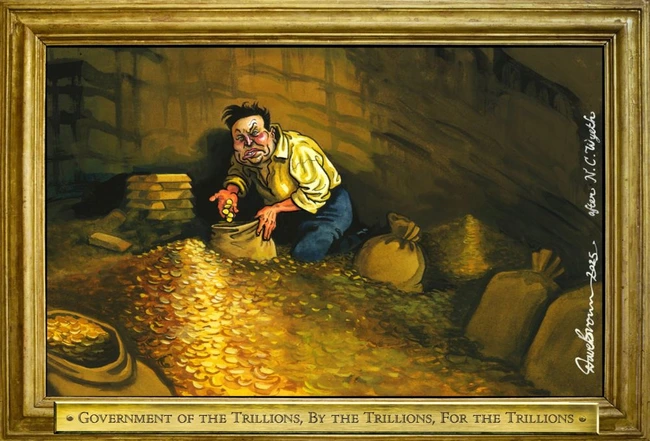
And assuming he is not consumed with some irresistible Scrooge McDuck fantasy that blinds him to all other people and all other values.

He may, indeed, be more to be pitied than censured, but Herbert also levels criticism at the system that lets him indulge those pitiable/toxic compulsions.
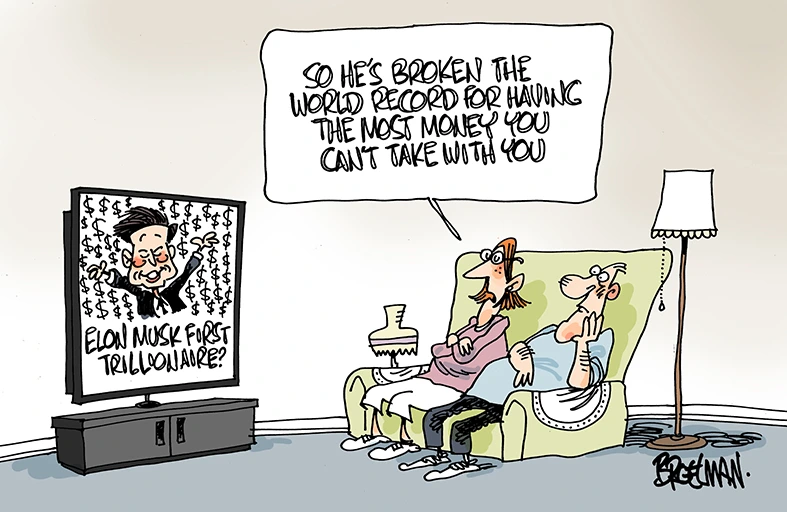
It’s not so much that you can’t take it with you, but — for the religious amongst us — where you’re going that you won’t be able to take it. Carnegie, Rockefeller and Ford at least redeemed their dubious career values by returning some of their pelf to the community in the form of libraries, museums and support of the arts and of uplifting non-profits.
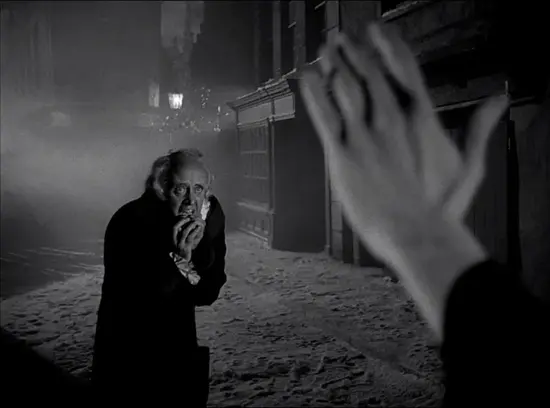
Greed, one of the Seven Deadly Sins, puts you not only in danger of the fires of Hell, but, even if you don’t believe in such things, it’s a sign of a sociopathic malignancy that puts you in danger of dying unloved and surrounded only by lackeys and lickspittles.
And speaking of lackeys and lickspittles:

Looks like we’ll get a headcount on the lackeys and lickspittles Tuesday, when release of the Epstein files comes up for a vote in the House, and a second count when and if it comes to the Senate floor. As that linked story points out, it would not only have to pass both houses, but then be signed by the defendant president.
Unless, that is, it passes by veto-proof majorities, and the thing to watch is that certainly neither house will allow an anonymous voice-vote. Someone will most surely call for a roll call vote, and then, whether or not it even passes, narrowly or by a veto-proof majority, we’ll see who’s for young girls and who’s for pedophiles.

I don’t know who started the flood of Sherlock Holmes references, (Editor’s Note: It was Epstein, describing Trump as knowing but keeping silent.) but a whole lot of both cartoonists and columnists have suddenly become Baker Street Irregulars.
For those who aren’t up on their Holmes, the reference is to a dog that would have barked at a burglar but did not bark at a familiar figure. Of all the “dog that didn’t bark” cartoons, I like Danziger’s best because he depicts more than one dog.
In return, Dear Leader has launched what amounts to a kamikaze attack by ordering his Justice Department henchmen to investigate a laundry list of (other?) people he apparently believes were involved with Epstein.
It is irrational to believe that this threat would cause everyone to stop caring about the scandal, and it’s either naivete or desperation to believe people who call for prosecuting pedophiles and rapists only care when the villains are their political rivals.
Or it’s another example of Dear Leader standing immobile and blank while everyone else tends to the unfolding emergency.
However, he may find out that he has not been saved by surrounding himself with people who are willing to believe that the dog that didn’t bark also ate his homework and to accept he was a casual Epstein acquaintance.
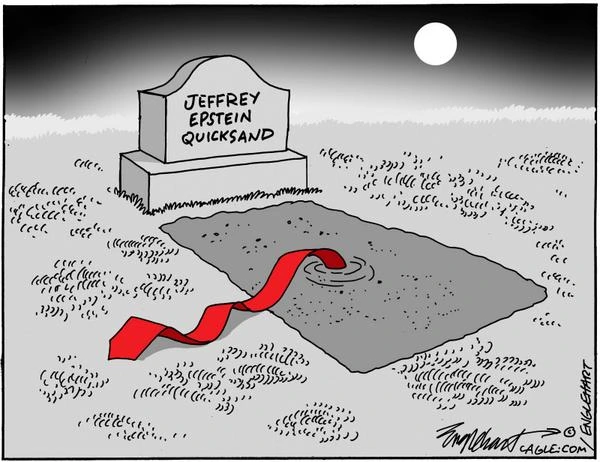
There are a kabillion red-tie cartoons on the topic, but Englehart’s made me smile because Epstein may indeed be the corpse that won’t stayed buried, but, whether or not that’s true, Trump is assuredly the pal eternally attached to him.
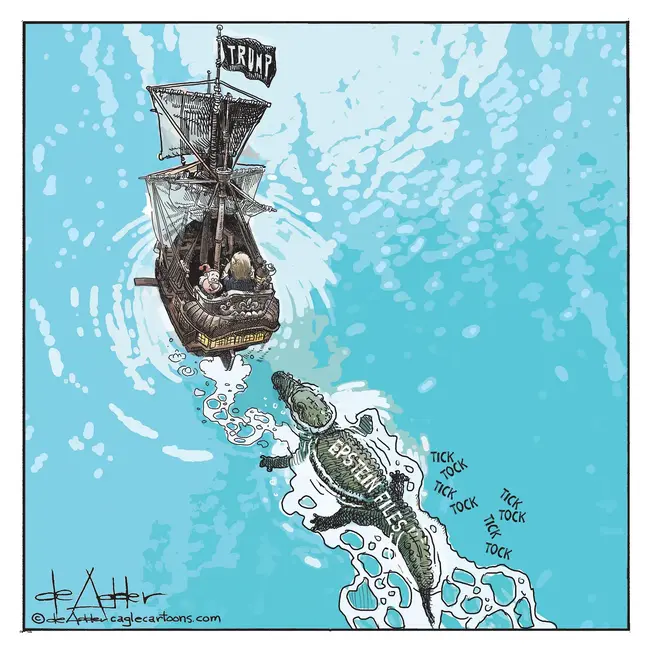
And I’ll forgive de Adder for planting a wretched earworm, because the Croc and Captain Hook are such a farcical pair, and certainly “tick tock” is an appropriate sound effect for what clearly is happening.
It’s also an apt literary reference, since James Barrie’s “Lost Boys” had disappeared from neglected baby carriages, while, in the plays, Hook is for some unexplained reason traditionally played by the same actor who plays Wendy, John and Michael’s father.
Barrie’s “Lost Boys” and our “Lost Girls” have a potayto/potahto interchangeability: Robbed of their right to a normal childhood and to grow up happily.
Mike Peterson has posted his "Comic Strip of the Day" column every day since 2010. His opinions are his own, but we welcome comments either agreeing or in opposition.


Comments 17
Comments are closed.