Secret Origins of a Dancing Bug
Skip to comments

In 2004 The Chicago Tribune set the record straight:
First off, there is no Tom the Dancing Bug.
Nowhere in Ruben Bolling’s 700-odd “Tom the Dancing Bug” comic strips does an insect, named Tom or otherwise, shake its groove thang.
Second, there is no Ruben Bolling.
No, “Tom the Dancing Bug” — an esoteric, form-bending comic strip of fiery satire and surreal goofiness — is the creation of New York City’s Ken Fisher, 41, a Harvard Law School grad who works at a financial service company. Fisher writes “Tom” two nights a week, after finishing his day job and roughhousing with his three kids.
In 2018 R. C. Harvey let us in on another secret:
[Ken Fisher] said he’s the only alternative cartoonist he can think of who has never put himself in his comic strip. “You have to have a really good reason for autobiographical work,” he said. “I don’t think that the fact that you just smelled your own armpit is a good reason for doing an autobiographical comic.”
After working backward on “The Complete Tom the Dancing Bug” the series has reached volume one and two.
As R.C Harvey told us:
The strip first appeared in a commercial newspaper in June 1990, in the New York Perspectives. Then Bolling began self-syndicating. By the time Perspectives went under in 1994 or 1995, Tom the Dancing Bug was in 30-40 newspapers around the country. It was picked up by the San Jose Mercury News, Washington Post and the St. Louis Post Dispatch. He was in about 60 papers. Then syndicates took notice. He started with Universal in 1997.
Today’s recent Inner Hive, the Tom the Dancing Bug/Ruben Bolling Substack, shows that first June 8, 1990 comic, an early preview of tomorrow’s Tom the Dancing Bug Classic which appears every Thursday at GoComics.

With the Kickstarter comes an short but excellent interview with “Ruben” by Alex Zalbin at Comic Book Club.
Comic Book Club: I used to read Tom the Dancing Bug religiously in the Village Voice… What did we lose when these readily available alt-weeklies started going under? Or has the wider availability of online comics supplanted that?
Ruben Bolling: What a great question. I’m going to take my time to answer it.
I guess the shift in newspaper comics is the shift in journalism and media in microcosm. It’s great that there are now almost infinite outlets on the web to get comics, and there is a more meritocratic, democratic path to cartooning success than convincing a handful of editors to buy your comic. But there was something good about the limited means of distribution, because such a broad range of readers would see the comics.
When my comic was, say, in The Village Voice, one of the hundreds of newspapers that used to carry Tom the Dancing Bug, it could be read by an 18-year-old who picked up the paper to find out about music shows that night, or a 47-year-old nurse who wanted something to read on the subway home, or 62-year-old banker who liked the arts reviews.
By many measures, Tom the Dancing Bug is more successful now on the web than it was when it was in newspapers. Including, I’m fairly sure, more eyeballs on it. And I’m delighted with that. But those eyeballs are more spread out in the country and the world, so it doesn’t have as big an impact in the certain cities (like my own New York) in which it was published. More importantly, I think the comic is now only read by people who seek it out, and who may be more homogeneous. It’s a large but relatively narrow band of like-minded people.
And while that’s not ideal for my comic strip, I can certainly live with that. But this shift in the larger media and news landscape is a disaster, because everyone is in their own media silos being told what they want to hear, and we end up with balkanized views of the world.
That first question and answer is followed up by more great Qs & As about the comic strip and alt newspapers.
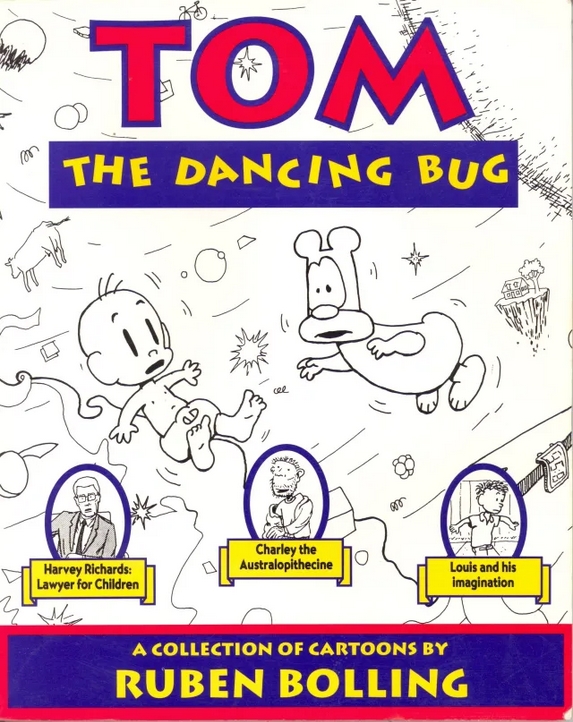
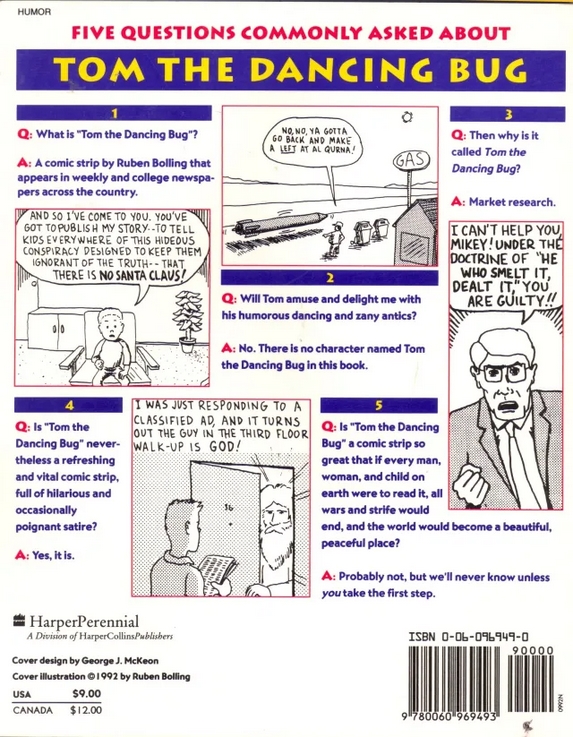
More secret origins.
That 2004 Chicago Tribune article:
He tried cartooning in high school and college “with very bad results,” he says. Only while attending Harvard Law School, when Fisher answered an ad for a cartoonist in the Harvard Law School Record, a student-run newspaper, did he find his voice, “inventing a whole new format that fit my sense of humor,” he says. To his knowledge, he’s the only cartoonist with a Harvard Law degree.
Law school provided him flexibility in post-grad opportunities, Fisher says, but he never thought cartooning would be one of them.
“I had as good a chance of becoming a shortstop for the Mets as becoming a cartoonist,” Fisher says. “I wasn’t thinking about cartooning as I entered law school.”
But he enjoyed cartooning for the Record, and after he graduated in 1987, Fisher says he kept his hand in, drawing a couple of conventional strips before self-syndicating “Tom the Dancing Bug” to weekly publications in 1990. Marriage — to a lawyer — came in 1991. Six years and two books later, Fisher was picked up by Universal Press Syndicate (which also, coincidentally, distributes “Doonesbury.”)
And returning to R. C. Harvey:
His second year at Harvard Law, he answered a Harvard Law Review ad for a cartoonist and submitted the strip that became Tom the Dancing Bug. But when he submitted it, it had no name—deliberately.
“I didn’t want it to have a name at all. I just wanted to be as clever and funny as possible but with total flexibility, with nothing, not even a title, tying it down. I wanted to do my own Mad with different characters, different themes, different art styles each time. I would be the Don Martin and the Mort Drucker and everybody— the whole staff.
“When I approached the Law Review with the strip, they said they wanted to run it. But they hated the idea of the strip having no title, and they said they wouldn’t ruin it unless it had a name. So, on the spot I came up with the dumbest name I could think of.”
He said he loved the name almost immediately. “I thought it up out of spite,” but later, walking home, he thought: “That’s perfect.”
He adopted the pseudonym as self-defense. He didn’t want anyone to know who did the strip, the wisdom of which was confirmed almost at once when he attacked a dean who later came around to the Law Review offices wanting to know who Ruben Bolling was.
“The editor refused to reveal my identity, and I kept it a real secret thereafter.”
He now thinks of the pen name as a metaphor for the sort of double life he leads with “Ken Fisher having a job and a family, and Ruben Bolling drawing the comic strip.”
So were the Harvard Law Record strips part of what was distributed to the alternate newspapers in 1990? Are they included in the Secret Origins book? Or will there be a Volume Zero forthcoming?


Comments 2
Comments are closed.