CSotD: On Beyond the Cornell 7
Skip to comments

Looks like the Cornell 7 story is going to stick around awhile. That’s a good thing, because it’s a national conversation we need to have.
And it’s a bad thing if it simply leaves the impression that Cornell is some vicious hell-hole.
I like Davies’ cartoon, because there’s an implication that the usual set of college rankings don’t tell the full story, which has always been true. I was married to the public information director at a well-respected private college that, during her tenure, made the decision to drop out of the ranking surveys, because participating required a choice between submitting puffery or being ranked below the schools that did.
In later years, when the boys were in jr. high and high school, I got one of the spin-off versions of The Underground Guide to the College of Your Choice — a 1971 classic that inspired a variety of similar books in the decade or so to follow — and plunked it down in the bathroom as reading material. It gave you the strengths of several hundred schools, just as the commercial guides do, but it also spoke of the actual atmosphere of each place, based on reports from students who went there.
You can’t go by the ads and the viewbooks, which have been known to adjust reality.
Davies’ cartoon suggests ranking schools by response to sexual assault, and there is a federal law requiring disclosure of that and other crimes for each school.
When I first wrote about this, I suggested that the rankings could be skewed by the social make-up of the student body and the degree to which a school encourages reporting by students.
The most apparently crime-ridden school was reported to be the University of Utah, and I suggested that its large number of Mormons might mean students were more readily outraged by assaults that less socially conservative students. That wasn’t the factor.
The Salt Lake Tribune reports that the high ranking was a glitch in which two years saw a large number of assaults reported by two couples, one set of reports for each year. Meanwhile, I poked into reports from my own alma mater, Notre Dame, where I spent four years among a socially conservative Catholic student body, and its Clery report shows very few reports of sexual assault.
It isn’t as simple as who goes there, or the extent to which the school encourages reporting.
Plus this: The Clery reports are raw numbers, not proportional figures, so you should expect more incidents at Texas A&M (81,354 students) than at Deep Springs, with an average enrollment of 13.
If you want to rank schools, then, get out your calculator, but remember that the numbers are only based on who reports what anyway.
Juxtaposition of the Day


Goris offers two closely related pieces on the topic, both of which are easy to misinterpret but equally easy to agree with.
His first risks a response of “Not all men,” and, yes, not all boys bring guns to school, nor do all young college men assault women.
This is obvious, but, then again, blanket accusations bring obvious retorts. Goris, though, is probably right to limit the K-12 threat to “boys with guns,” who are a small but deadly number, and to cast a wider net in college where there is a larger pool of men who may prove dangerous.
His second cartoon also has a hazard, because talking about self-defense and other safety choices runs a great risk of blaming the victim. Still, reflecting on the fear women may have is reasonable, and while smart measures can’t make you invulnerable, they can reduce risk.
That’s not just true for women, but, as Dave Chappelle has noted, while we all run risks, it’s more constant for women than it is for men. Strong language warning.
Juxapostion of the Day #2

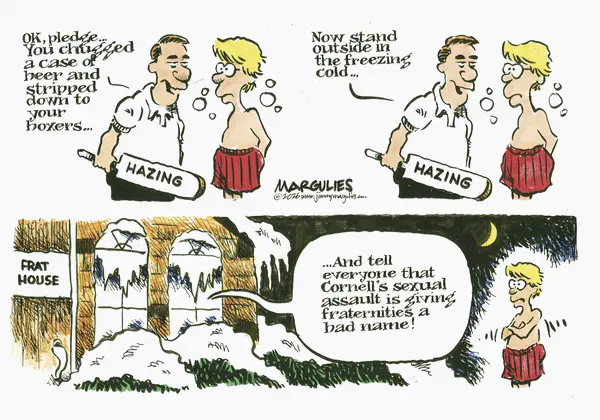
I’ll admit I don’t understand fraternities. I’ve run into them and I know they vary in tone. My father was in a frat at MIT because the dorms were too noisy and his frat brothers imposed study hours. But the term “animal house” wasn’t coined for the movie, and there have been major issues at some frats on some campuses.
I’m not sure what a college can do about frats, since kicking them off campus seems to leave the school with even less control, and you’ll note that Jane Doe is suing the college as well as the seven alleged perps and their fraternity.
Cornell is also the focus of the state AG’s investigation, and so has brought in Sally Yates to conduct their own investigation, and if you remember her testimony during the investigation into Russian election interference, you’ll know they’re serious about getting things straightened out.

Cornell is at grave danger of being forever used as an example of things that also happen other places, and having Yates, who was fired by Trump for going against his policies, may help separate their lack of guidance and enforcement in this case from the influence that Pett accuses Trump of creating throughout the country.

Pett is hardly alone in this, and Anderson draws a more pointed connection between the issue and the Oval Office, while Robert Reich delivered a blistering attack in which he listed the ways that misogyny has not just surfaced but been encouraged and celebrated in the current administration.
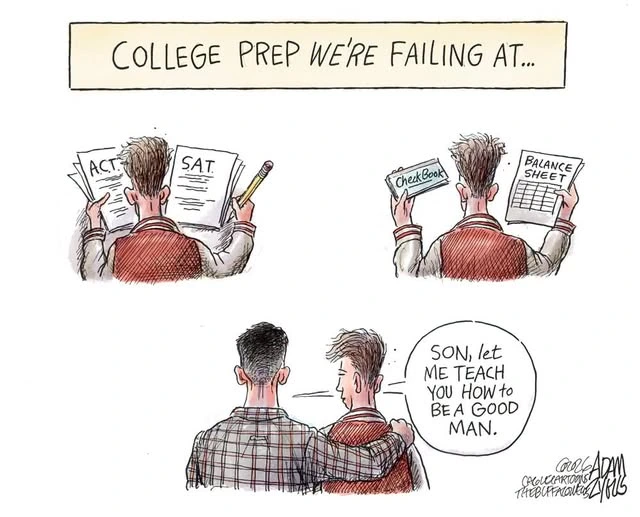
Zyglis is right that this is not entirely about Trump and the rise of the manosphere, because, if young men were taught to be conscious and responsible, there would be no manosphere and nobody would have ever voted for the kind of fellow who laughs and boasts about grabbing women’s genitals.
But it isn’t something you sit down and talk to your teenage son about. It’s something he learns by osmosis. It’s something he learns from the very first day of his life, from the people he is surrounded by, how they treat each other and how they respond to media, to the news and to him.
In lieu of a video today, I’ll leave you with a column I wrote nearly 37 years ago, and a wish that we could someday stop having to teach its lesson.
Mike Peterson has posted his "Comic Strip of the Day" column every day since 2010. His opinions are his own, but we welcome comments either agreeing or in opposition.

Comments