Art Spiegelman Profiled (and TDC Adjusts a Pulitzer Attribution)
Skip to comments
He is 78 years old, slight and scruffy-looking, with a grizzled goatee and wispy grey hair, and he can still talk faster than most people can think.
Sophie McBain

Sophie McBain for The Guardian visited cartoonist Art Spiegelman.
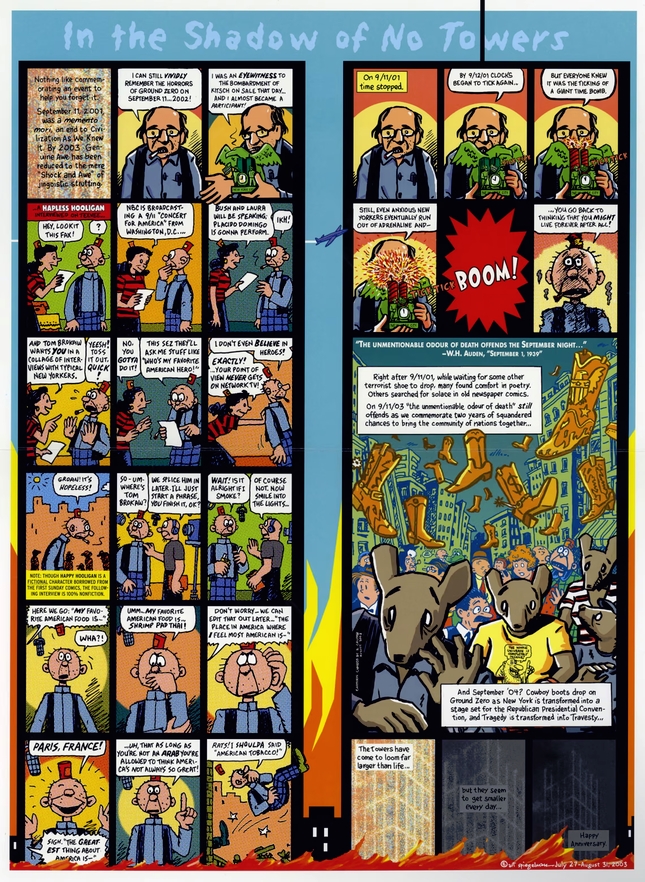
He produced a series about 9/11 for the German magazine Die Zeit, which was later run by other European magazines and American Jewish weekly the Forward. On one page he describes himself as “equally terrorised by al-Qaida and by my own government”. He felt that other American publications were too quiescent in the aftermath of the attacks, and not yet receptive to his fear that the US government was using 9/11 as cover for a massive crackdown on civil liberties and to launch xenophobic wars. “Sigh! It’s hard to be an artist who is consistently Seconds Ahead of His Time,” he writes in the foreword to In the Shadow of No Towers, a book that compiled these comics and is being reissued to mark the 25th anniversary of 9/11 (link added). (Although, he says, it may come out late – a shipment has been held up in the strait of Hormuz.)
But there is a problem with the profile: McBain writes; “Spiegelman, who in 1992 became the first cartoonist to win a Pulitzer prize for Maus.”
Technically that is a true statement – Spiegelman was indeed “the first cartoonist to win a Pulitzer prize [specifically] for Maus.” But…
As we all know the Pulitzers had been handing out Prizes to cartoonists for 70 years before Spiegelman got his. Some quantify Spiegelman’s Pulitzer by explaining that he was the cartoonist to get a Pulitzer outside that Editorial Cartooning category as his Pulitzer was a Special Citation. But even that must be further narrowed down to the first cartoonist to receive a Pulitzer prize for a specific graphic novel since Dr. Seuss had earlier been awarded a Special Pulitzer for his body of work.
So: Maus by Art Spiegelman was the first graphic novel to win a Pulitzer Prize. No longer “the only” as last year Maus was joined by Feeding Ghosts: A Graphic Memoir as the second Pulitzer Prize-winning graphic novel.

Comments 1
Comments are closed.