No Laughing Matter? – Introduction
Skip to comments
In “No Laughing Matter?” parts One and Two we see governments repressing cartoons that humiliate their particular political idealism and institutions crumbling under pressure to not publish satire of political, ideological, or religious stripes. (Most extreme is the Charlie Hebdo massacre.)
The practice of suppressing cartoons goes back hundreds of years – I was about to say “back to more unenlightened times,” but…
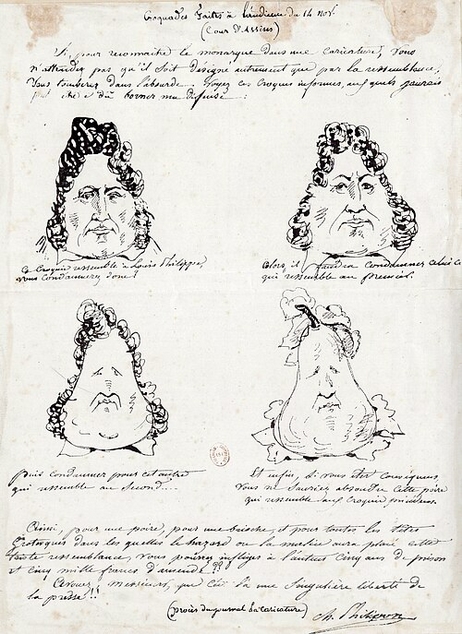
The most famous early case is Charles Philipon being jailed for caricaturing France’s King Louis-Phillip in 1831. From Jill Jeffers Goodell at Studio Muses:
Philipon’s journals were not particularly lengthy but from the start were generally political. By 1831, Philipon found himself in court for libel because of, among other things, drawing the Citizen King Louis-Phillip’s head in the form of a pear. Poire (pear) means not only the fruit in French but also slang for being dim-witted. By drawing the king’s head in the form of a pear, he was doing more than placing big ears, as political cartoonists have done with Obama.
Philipon said in his defense, “Is it my fault, gentlemen of the jury, if his Majesty’s face looks like a pear?” Unfortunately, it just didn’t fly. He was jailed and fined 2,000 francs—lots in those days.
Jumping ahead 80 years and to the United States.
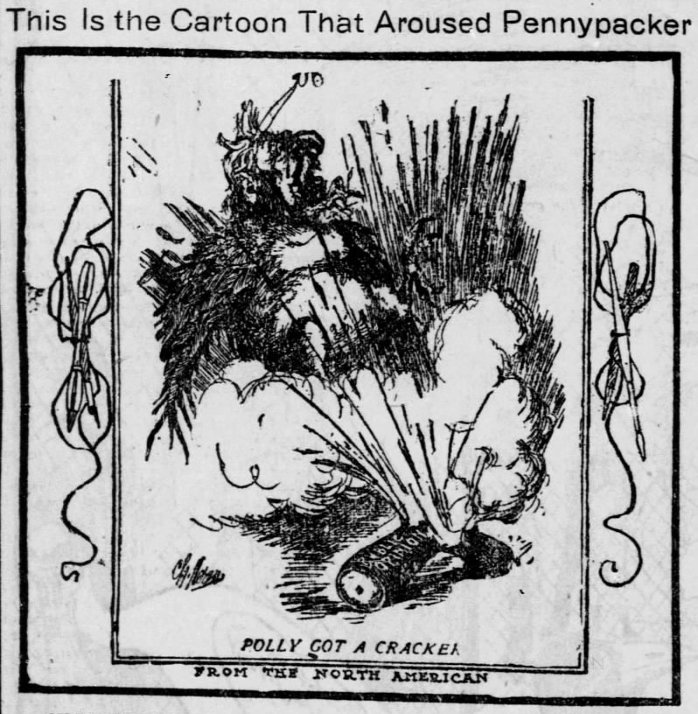
After years of state legislators from New York to California (successfully) trying to intimidate cartoonists with anti-cartoon laws in 1903 state cohorts of newly elected Pennsylvania governor Sam Pennypacker got a law passed in that state easing the restrictions on libel laws making it easier for politicians to sue newspapers and cartoonists.
From Wikipedia, the free encyclopedia:
The Salus-Grady libel law, also known as the Pennsylvania anti-cartoon law, was enacted by the Commonwealth of Pennsylvania in 1903 to discourage political criticism from the press. Governor Samuel W. Pennypacker championed the controversial law in response to an ongoing set of cartoons that mocked his successful 1902 gubernatorial campaign and his tenure as governor. Upset by being caricatured as a parrot, Pennypacker denounced what he deemed “the sensational devices and the disregard of truth” employed by the press. The law broadened the circumstances under which a newspaper could be sued for libel, and made editors liable in their personal capacity to such lawsuits. Rather than having the chilling effect Pennypacker desired, the law backfired spectacularly. Charles Nelan and other artists drew cartoons more contemptuous than the previous ones, and nationally circulating newspapers joined the Pennsylvanian newspapers in protesting against the law. The law languished aong with Pennypacker when he stepped down from office in 1907, as his successor quickly repealed the controversial measure.
Isn’t there a justifiable worry that in today’s climate with compliant Congress, a kowtowing Department of Justice, and a Supreme Court willing to overturn established precedent that such a law could happen on a national scale?
Comments 5
Comments are closed.