Wayback Whensday: Popeye by Sims, Penny by Haenigsen
Skip to comments
After Segar there was Tom Sims writing Popeye. Harry Haenigsen drew the Penny and the teen scene.
Tom Sims, Popeye Writer
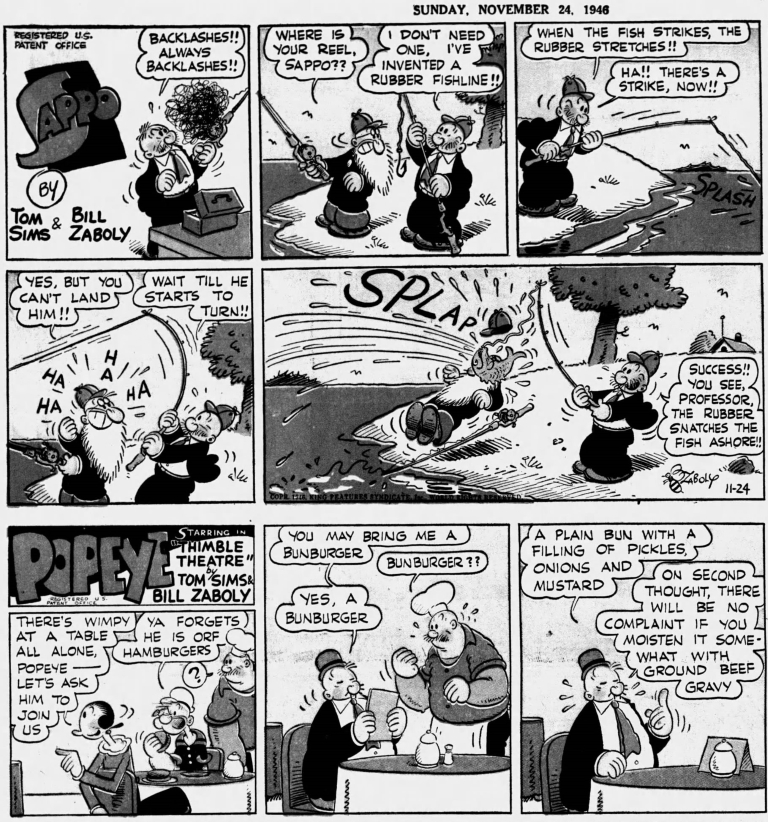
Kelly Kazek for AL.com profiles the local writer who took over the Popeye comic strip after E. C. Segar died (or here).
If not for a new folklife marker in Gadsden, Alabamians may have forgotten our state’s connection to the Popeye comic strip. Not only was Popeye written by Alabamian Tom Sims (1896-1972) for two decades, but he based the hero’s antics during that time on sailing on the Coosa River.
Sims wrote the Popeye strip, which began as part of the Thimble Theater comic, from 1938-1959, according to the Popeye Fandom Wiki.
The article has a couple grainy photgraphs of Tom Sims from The Birmingham News of Sims time on Popeye. Sims also wrote the Sunflower Street panel for Tom Little, about which the less said the better.
Harry Haenigsen, Middle-Aged Cartoonist and His Teen Penny
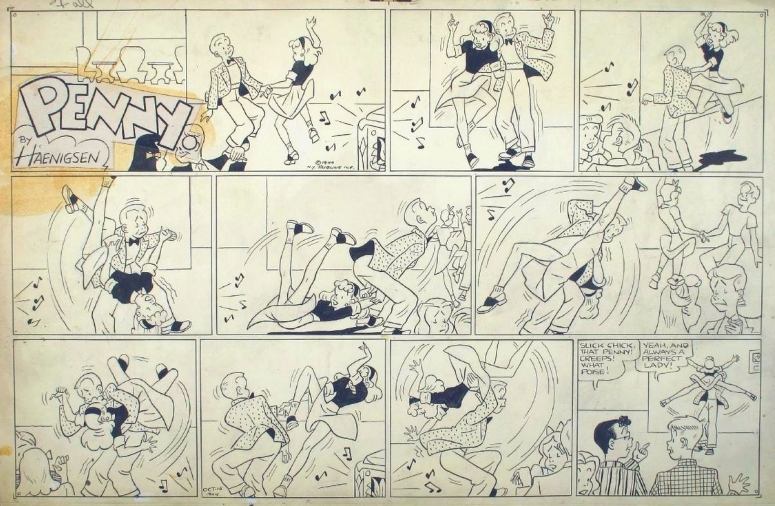
Steve Smith at Panels & Prose looks back at Harry Haenigsen‘s teenage Penny.
Harry Haenigsen’s Penny launched in 1943 directly out of the intersection of two new social realities – gal power and the “invention of the teenager.” It is not surprising, then, that Haenigsen took an almost sociological approach to portraying two things he certainly was not – young nor a girl. Like any good cartoon anthropologist, he decided to go native. The Oct. 6 1946 Philadelphia Inquirer reports how the New Hope artist researched Penny by eavesdropping on soda shop conversations and even hosting cookouts for the local high schoolers.
With the help of writer Howard Boughner the childless Haenigsen was able to depict 40’s and 50’s teen life.
To be sure, teen stylings, slang and the generation gap had been comic strip commonplaces for decades. Carl Ed’s Harold Teen (1919) is familiar to cartoon historians as a proto-Archie. And in Polly and Her Pals, Bringing Up Father, The Bungles, et. al., adolescents were necessary generational foils to hapless sitcom dads. But Haenigsen’s Penny represented a much more assertive teen figure, more assured of her power both in the family and in the market. Haenigsen recycles a number of familiar generational tropes – about teen slang, musical heroes, irrational outbursts – but there is an unusual parity among the Pringle family.

Comments 4