Wayback Whensday with Winsor and Watterson
Skip to comments
The 20th Century newspaper comics were bookended by two masters of the art. Winsor McCay’s full page Little Nemo was a near-perfect example of the early comic strip (you’d think someone who began their career as a poster artist would be better at lettering). At the other end of the century was Bill Watterson whose Calvin and Hobbes, once he rid himself of the enforced Sunday format restrictions, was a cartooning tour-de-force of humor and visuals – not that the comic was second rate before that.
Winsor McCay in the Land of Wonderful Dreams
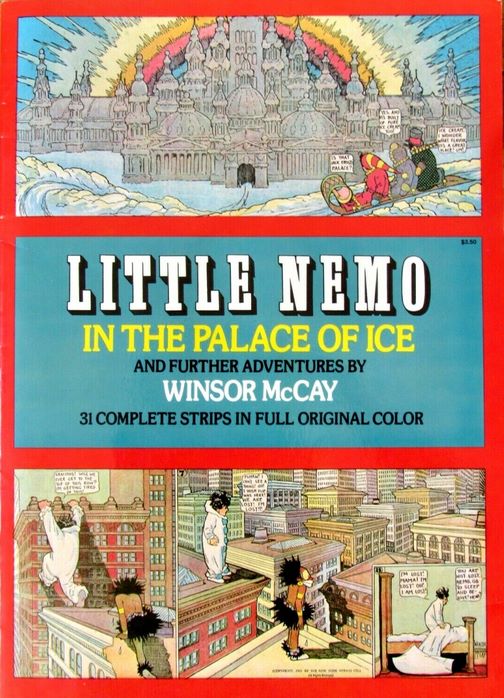
Little Nemo In Slumberland/In the Land of Wonderful Dreams was brought to mind when I recently stumbled across Zachary J.A. Rondinelli’s Welcome to Slumberland blog where he reproduces all of Winsor McCay’s Little Nemo pages and discusses the art, innovations, plots, and action of each Sunday page.
Rondinelli does give a hat tip to Zachary Chavez and The Comic Strip Library for the first nine years of images.
Little Nemo in Slumberland October 15, 1905 – July 23, 1911 (New York Herald)
In the Land of Wonderful Dreams September 1911 – July 26, 1914 (New York American)
Little Nemo in Slumberland August 3, 1924 – January 9, 1927 (New York Herald-Tribune)
Of course the only way to fully appreciate Winsor McCay’s Little Nemo is to see the entire page as a whole rather than seeing only part of the comic and moving the image around on your computer screen.
[If anybody can tell me of a way to flip the order of the blog posts from oldest to newest I would be grateful.]
Bill Watterson’s Wonderful World of Calvin and Hobbes
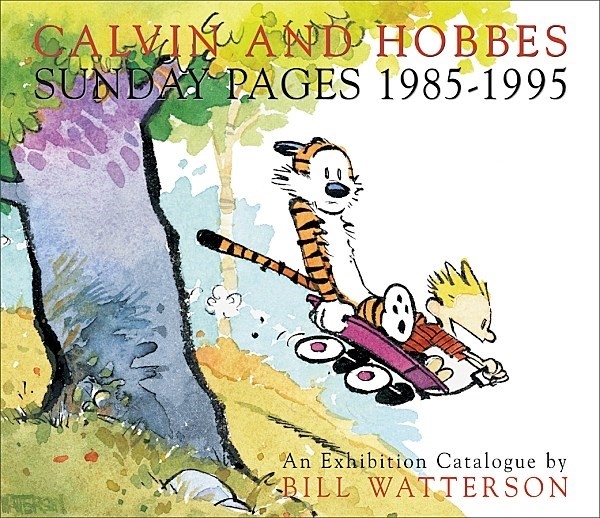
It is “Everyone should read Calvin and Hobbes,” Emily Augustine’s essay on Calvin and Hobbes for University of Kansas’ Her Campus, that brings us to Calvin and Hobbes, a comic strip masterpiece. And Emily feels that same sense of significance toward Bill Watterson’s magnum opus.
One of the most compelling components of Calvin and Hobbes is its unique, but limited cast. There are only eight recurring characters, each one vital to the story as they bring out unique sides of Calvin, our protagonist…
The most meaningful moments of the strip are the times that Calvin and Hobbes are on their own expeditions or having their own philosophical discussions away from the noise of parents, babysitters, teachers, or school bullies. The pair produces just enough chaos on their own for these standalone moments to be the most entertaining…
The plot of the comic strip surprisingly covers a wide range of material. Overall, the strip is obviously meant to be comedic, but there are times when it explores difficult, deep subjects such as human existence, the necessity of love, and even death…
Lastly, through all the unique storytelling devices that Watterson uses in Calvin and Hobbes, my favorite is Calvin’s wagon. The wagon almost exclusively appears in scenes of long-winded philosophical discussion between Calvin and Hobbes, so as I’ve gotten older I find that I gravitate to these strips in any collection…
Calvin and Hobbes can be read at GoComics or, as Emily recommends, by diving into the books.



Comments 3
Comments are closed.