CSotD: On Beyond SOTU
Skip to comments
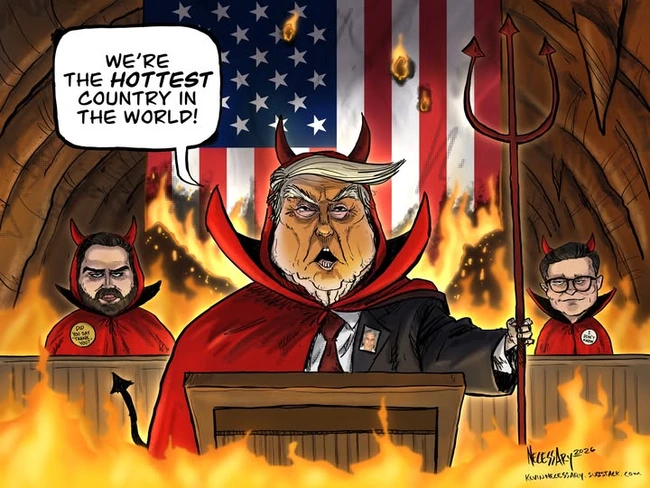
A response to the braggadocio in Dear Leader’s speech. It’s not unusual for the SOTU to include some blue sky self-praise to go along with the more serious policy discussions, but this claim was not only meaningless but flies in the face of the criticism we’ve been hearing both from other governments and from citizens of other countries.
Maybe we’re so hot that other nations are turning to China instead, for fear of getting burned.
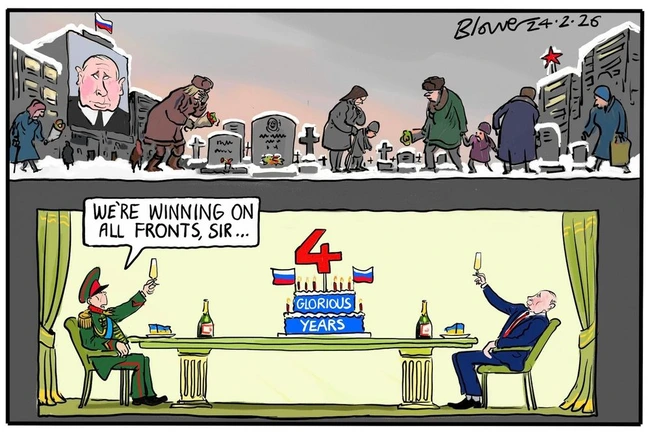
We’re not the only country where cheery optimism ignores obvious realities. Note that, in the upper image of mourners, the Red Star and portrait of Putin indicate that Blower is pointing out the sacrifices of the Russian people, not the Ukrainians, and contrasting it with the lack of sacrifice from those who live immune inside a rich cocoon.
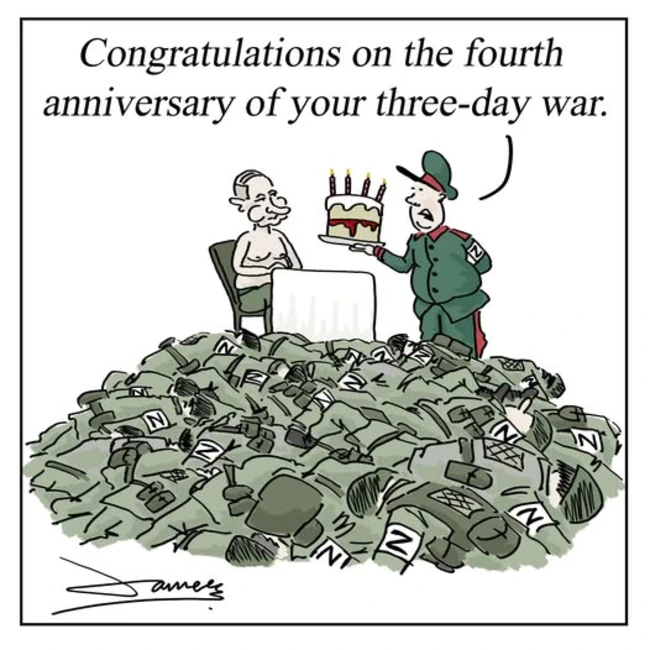
Mellor makes much the same point, but is more direct in confronting the gap between the initial, boastful predictions and the ongoing, bloody struggle. Between Mellor and Blower, we see a strong accusation that perhaps Putin has bought himself another Afghanistan.
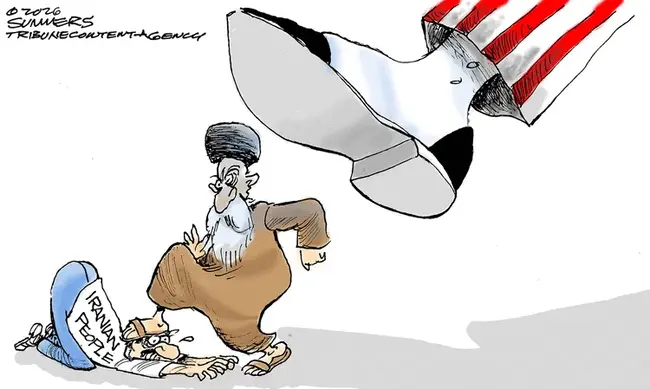
Summers is similarly projecting a swift, painless victory when Uncle Sam goes after the mullahs, assuming that the grateful, liberated people will greet us with flowers and we’ll just replace their tyrannical government with one that promises peace, justice and democracy.
Unless the war takes place on this planet, in which case it will likely be more like our invasions of Iraq and Afghanistan.
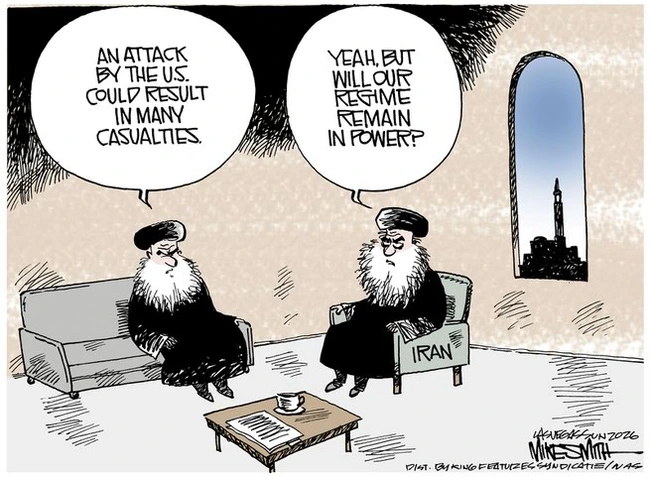
Smith is correct that the current government there would rather make some kind of deal and get to keep their power, and since we had a deal before Dear Leader tore it up, we can hope for that to be the outcome.
They’ve already repeatedly said they want nuclear power for their domestic use and have no intention of building a bomb, and the earlier deal allowed for monitoring of the promise.
We should go into the discussion remembering how removing Saddam Hussein from power and attempting de baathification yielded a bloodbath of Iraqis, Kurds, Americans and American allies.
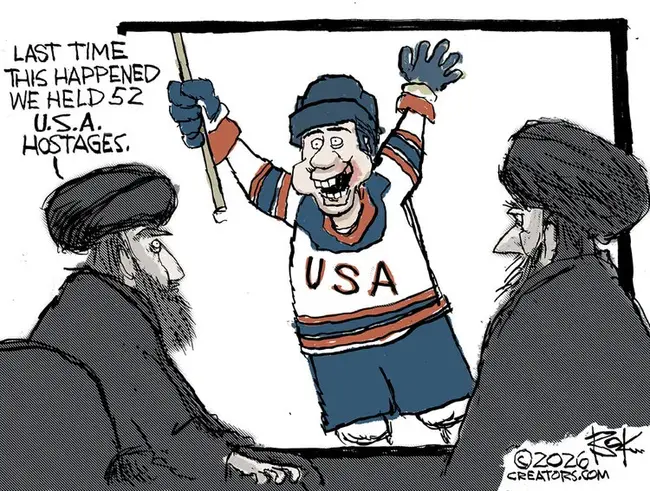
I have no idea what this one means. The hostage crisis was going on in 1980 when the Miracle on Ice occurred, but I can’t see any logical connection. Perhaps he’s claiming they’re nostalgic for a time when wiser heads negotiated solutions rather than responding like chest-beating warmongers. If so, I agree.
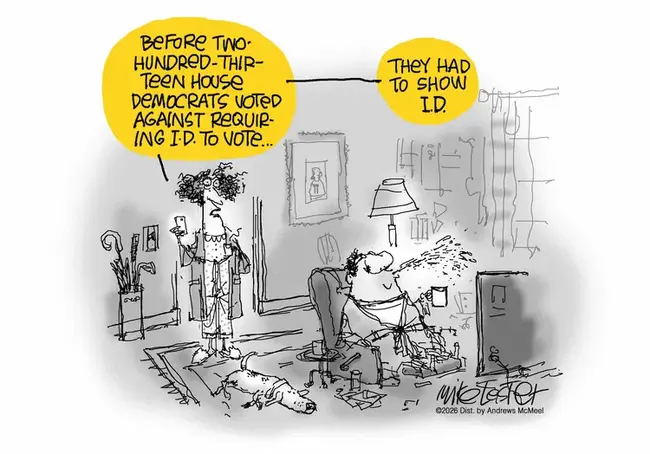
And speaking of head-scratchers, I don’t know enough about Congressional votes to say for sure that they never have to show ID, but I know there are reports of legislators leaving the chamber and having colleagues insert their cards and register votes for them, and I’ve watched enough voice votes to know they aren’t pausing to show ID first in those.
What I know for sure is that there is substantial evidence that the large majorities of people who support showing ID mean showing a drivers license or something at the polls, which is not the same as jumping through all the hoops in the SAVE legislation in order to register.
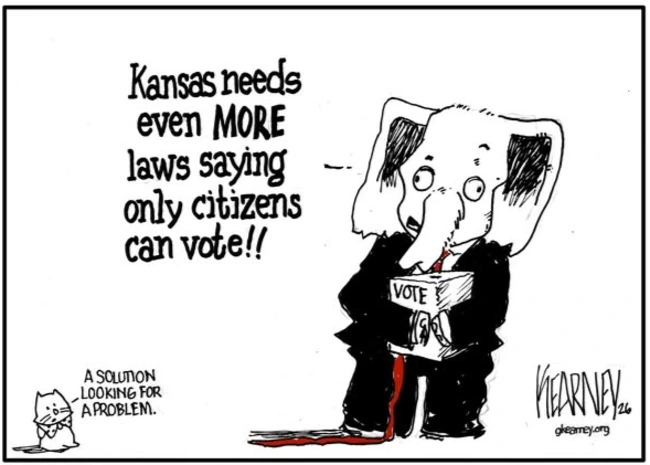
And I know that the MAGA partisans wasted millions of dollars looking for illegal votes in the 2020 elections and that the Heritage Foundation did a nationwide examination of records and only found 77 cases of non-citizens voting between 1999 and 2023, each of which was flagged and examined.
But Kearney notes that Kansas legislators find banning non-citizen voting an appealing solution despite there being no problem for it to solve.
Juxtaposition of the Day
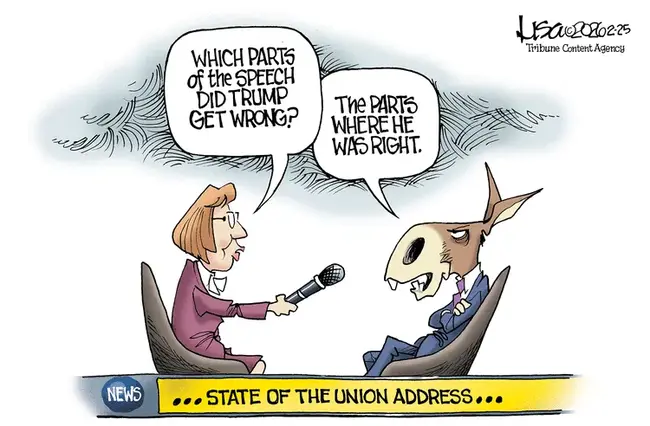
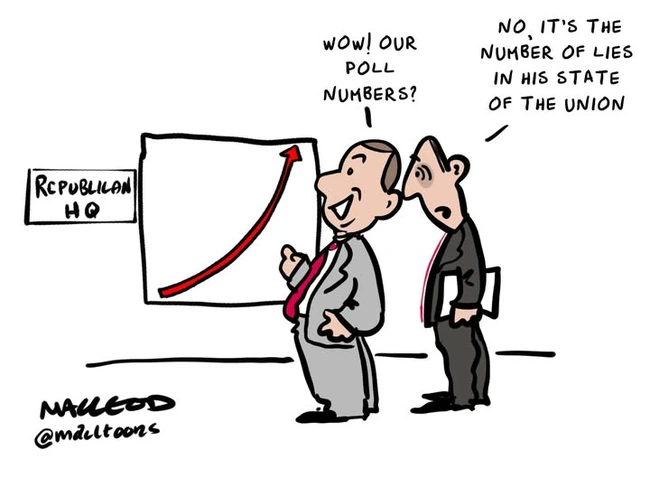
If you want to ponder the honesty issue, make another pot of coffee and settle back with this lengthy debunking of lies and exaggerations in what was reportedly the longest State of the Union speech in history.
Or if you’re reading this at the end of a long day, just pour yourself a stiff drink and read this less detailed, more entertaining collection of Democratic and Republican responses to the talk.
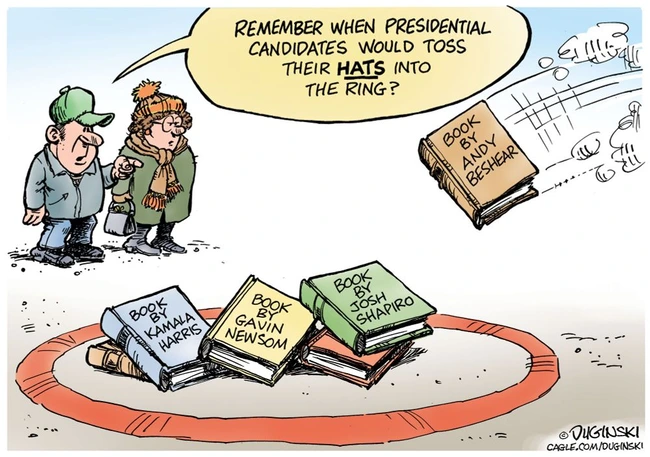
An interesting point by Paul Duginski. There’s nothing new about presidential aspirants releasing books, but perhaps there are now more than in the past.
Barry Goldwater had The Conscience of a Conservative in 1960, prior to his 1964 run for the White House, for instance, and John F. Kennedy won a Pulitzer for Profiles in Courage, a 1956 best seller that presaged his 1960 run, while my favorite was Write Me In, Dick Gregory’s detailed platform for his 1968 campaign.
Kennedy made you read between the lines to see what an admirable fellow he was, based on who he praised, while Goldwater’s was more specific in setting out his beliefs, but I prefer Gregory’s because he laid out exactly what he thought we ought to do.
Gregory had a snowball’s chance in Hell of winning the race, but times have changed, and Zohran Mamdani didn’t have a chance either, because his ideas were as utopian as Gregory’s.
In any case, if candidates want to put specific promises in writing, I’ll admire their candor, even if I don’t admire their plans.
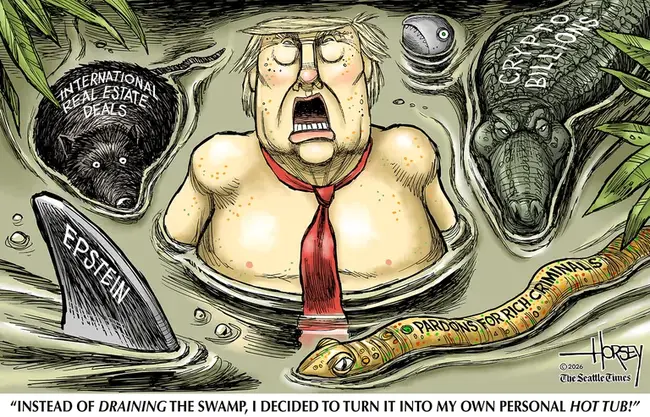
Not that I necessarily believe promises. Nixon claimed he had a plan to end the war in Vietnam, but half the names on the Wall are of men who died during his presidency, while, as Horsey points out, whatever “drain the swamp” promises Trump made as a candidate have certainly not achieved that happy result, even with both houses of Congress in his grip.
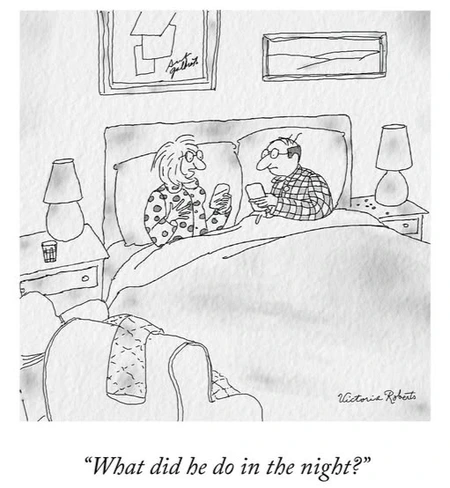
While Horsey specifies the worst aspects of the current swamp, Roberts depicts the general mood that has led to No Kings demonstrations, resistance among the citizens of Minnesota and a resurgence of red Norwegian-style toques.
There’s been a rebirth lately of an old Soviet joke about the fellow who comes to the newsstand each morning, scans the papers and walks away. Finally, the newsie asks him if there was something he was looking for. “An obituary,” he says. The newsie explains, “But obituaries don’t run on the front page,” to which the man replies, “This one will.”
I’ll admit that, when I switch on my computer each morning, if I’m not quite like that optimistic Russian, I’m certainly like the apprehensive woman in Roberts’ cartoon.
Keep the faith.
Comments 7