Cartoonists Talking Cartooning
Skip to comments
Mike Lynch, Jim Keefe, Patrick McDonnell, Steve Brodner, and David G. Brown talk the about the art.
Mike Lynch Interview
EERIE: In my burlesque acts I rely on a formula of setup & reveal. So far, I’ve been comparing this to the formula of a multi-panel cartoon strip.
Do you think this also applies to single panel cartoons?MIKE: Yes. A successful single panel gag cartoon has to work in 3-5 seconds. And there has to be a story, even in that one panel. I mean, here’s a for instance: when there’s a salesman-looking guy at the door asking the homeowner, “Have you heard what may or may not be the word?” — that’s the set up. The reveal is then in the second thing you read, in the legend below, “Door-to-door Agnostics.”

A couple other responses:
MIKE: I think things have changed a lot. For me, old markets are gone, but people still love cartoons. That won’t change. Last month, I sold some cartoons to Reader’s Digest, sold some more to another magazine, sold some cartoons at Cartoonstock.com, taught some classes and gave a couple of lectures to the National Education Administration about comics. This was all part of my income stream…
and
EERIE: What advice would you give to someone who wants to start cartooning?
MIKE: My advice is to talk yourself out of it. I don’t mean to be mean, but it’s not for everyone. I know my parents were generally supportive, as were my friends, but no one had any clue how this all worked; how you draw something on your board and then how the thing gets published and you get money. If, however, you feel that this is a calling and you will be a horrible, miserable human being if you don’t do it (which is what happened to me), then, by God, you are stuck!
Jim Keefe Advice
Here’s a few life lessons I’ve learned over the years in regards to being a cartoonist (updated from a previous post). They pretty much can be applied to any career in the arts…
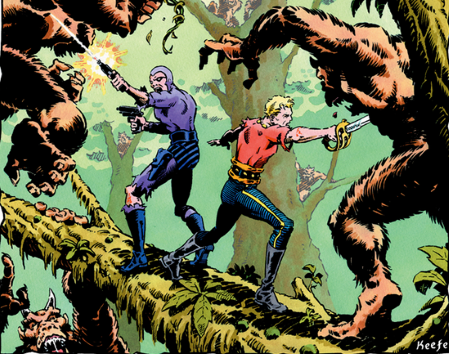
A couple examples from the schooling:
• Devote your time to sharpening your art skills AND your business skills. Trends, networking, contracts, etcetera all. Best advice Joe Kubert gave at the Kubert School in regards to the business side of the field was simple – know what you’re signing.
• Don’t pigeonhole yourself to one small aspect of the art form.
At the Kubert School my goal was limited to just being a comic book artist. Since then I’ve done coloring, lettering for manga, teaching/lecturing, comic strips, and the occasional comic book work. There’s a whole world of other job opportunities out there, don’t limit yourself by saying no to work that isn’t your end goal…
Patrick McDonnell Talks Peanuts, Mutts, and More
At the Unpacking Peanuts podcast Jimmy Gownley, Michael Cohen, Harold Buchholz, and Liz Sumner conduct an hour and a half conversation with Mutts cartoonist Patrick McDonnell (transcript here).

…Can you take us back to the beginning of turning MUTTS into a comic strip? Like, how… What was your learning curve? Like? Could you just tell us about that?
Patrick: Sure, sure. Well, the first thing I’ll tell you, and it’s a. When I think about it, it’s really kind of funny, you know, as we all talk. So we all wanted to be cartoonists since we were five years old. and mainly for me, because of Peanuts. And when I finally got to do MUTTS, you know, all those years, and I didn’t do MUTTS until much later. I was in my 30s when I started MUTTS. But that whole time, I never once thought about the reality of the job. I mean, I kind of knew you had to do a comic strip every day, but then when you actually have to do a comic strip every day, my God, if I always wonder if I would have kept that dream alive if I really thought about what it was, the insaneness of, you know, it really is a crazy job. I, mean, it truly is to do.
The Not-So-Quiet Steve Brodner
From The Daily Heller comes The Greater Quiet as Steven Heller interviews Steve Brodner.
Steve Brodner, the 2024 recipient of the Herb Block Prize for editorial cartooning, is one of the most prolific and regularly published graphic storytellers and commentators today. He has long been at the nexus of a tradition of print parody—and to communicate his messages loud and clear, he uses as many platforms as possible. From 1979–1982 he published his own journal, The New York Illustrated News. In 1981 he became a regular contributor to Harper’s magazine with his monthly feature, “Ars Politica.” He’s also contributed to National Lampoon, Sports Illustrated, Playboy, Spy and Esquire (as an unofficial house artist) and currently has a weekly spot at The Nation. This all served to convince him that illustration is an important part of the mix of any journalistic enterprise.

You can’t rely on fixed solutions for a variety of new problems. In this long career, I have been criticized and, perhaps, admonished for experimentation of different kinds. I look back on a lot of those old pieces and I feel that they are evidence of an artist in one kind of box or another struggling to get out. If we are permitted to match the medium to a message, then some images are going to be calling out for paint or crayon or pencil or marker. Some images are asking for a detailed treatment and others for a simpler finish. The world of illustration has long accommodated artists seeking a variety of solutions—from R. O. Blechman to Gary Panter to Anita Kunz to Yuko Shimizu to Ed Koren. If we viewed each solution used by them and all the artists who have ever lived as doorways to be able to address things differently, why not walk through those doors?
David G. Brown on The Art of Racial Dissent
For Capital & Main Erin Aubry Kaplan discusses being a Black cartoonist with David G. Brown.
How does a Black artist satirize a racial reality that has gone way beyond satire under President Donald Trump? It’s something David G. Brown asks himself every week.
The longtime political cartoonist for the Los Angeles Sentinel, the city’s oldest Black newspaper, says coming up with effective responses to the almost daily outrages emanating from the White House is a challenge that often leaves him at a loss for words, and for images.

“I always had side hustles,” Brown said, laughing. Becoming a cartoonist in 2003 was just one of those hustles. But it had historical continuity: He took over for Clint Johnson, the veteran Sentinel cartoonist who’d spent 45 years in the chair.
Brown has been at it only half that long, though given all that’s happened on the racial front the last two decades, it often feels to him like it’s been longer. He walked away from his day job years ago, he said, because he didn’t have the time for it anymore. But the real reason was that he’d found his calling — his true career.
feature image by Patrick McDonnell

Comments 2
Comments are closed.