CSotD: Doing Unto Others
Skip to comments

As Christmas season fades, Ramirez asks if there are no prisons, and if the workhouses are still in operation. Scrooge at least conceded that his taxes — however reluctantly — supported those institutions.
Ramirez, by contrast, insists that any but minimal support is a form of theft.
As noted yesterday, I’ve been reading Barbara Tuchman’s history of the 14th Century, and she writes of a Europe in which the lives of the nobility and of the common folk were as separate and disparate as we’ve always seen in Robin Hood and other stories.
Yet there were guilds and associations among the artisans and other skilled workers in which membership fees went to public support in a functioning society.
As it happens, some years ago I was in the Harrowing of Hell, one of the York cycle of Mystery Plays, this one sponsored by the Saddlemakers’ Guild. On the feast of Corpus Christi, themes from the Bible would be re-enacted in short plays staged on wagons that circulated through the city so that a person standing in one place could experience the entire sequence.
The nobility benefited from the work of these crafters but didn’t greatly interfere with their daily lives, though I’m not very far into the book and Barbara may yet break my heart.
Still, it’s nice to think of a society in which people recognized the justice and propriety of caring for each other and in which, for all its shortcomings, misery and mud, an effort was made.
Tuchman also writes of a pessimistic view of eternity, in which it was assumed that only a small percentage of people were bound for Heaven and the majority full expected to wind up in Hell, but I suppose those watching the Mystery Plays trundle by each year resolved to be among the elect, at least until the last wagon had passed, and I suppose many of them determined to do it more through prayer than through charitable actions.
Still, the workers paid their dues and the people benefited from their unbegrudged charity.

Speaking of skilled workers, Harry Burton offers this illustration to go along with an article in the Independent of Ireland, commenting on Time Magazine’s cover story naming “The Architects of AI” its Person(s) of the Year.
The story is behind a paywall, but shows enough of its lead to reveal that the writer, Declan Lynch, notes that the original photograph parodied by Time “features 11 ironworkers — all immigrants, two of them Irish — sitting on a steel beam high above Manhattan, eating their lunches during the construction of the Rockefeller Centre.”
While the Saddlemakers’ Guild had little to do with it, the artisans of medieval Europe did build the castles and cathedrals that were the equivalent of skyscrapers in that world, and while I don’t imagine the nobles gave them a lot of thought, they at least didn’t seem to interfere with the process very much.

Well, times change, and, as Alcaraz notes, Home Depot is driving immigrant labor from its parking lots, and standing by when ICE attacks them. You might argue that efforts to drive them off is an attempt to avoid those confrontations, but that seems like turning your head rather than addressing the issue.
Whatever they’re thinking, I saw a TV commercial for Home Depot yesterday that, besides showing average people buying things for their home repairs, showed workers building homes and shingling roofs, and it sure seemed like Home Depot was taking credit for construction projects as if everyone doing that work was fully accredited and legally up-to-date.
Which reminded me of driving by a house under construction in Denver some years ago when we saw a fellow fall from the roof into the excavated foundation below. We stopped and, as he lay on his back moaning, offered to call for help, but his fellow workers said not to, because the project wasn’t carrying any insurance.
According to Tuchman, the guild would have taken care of him in the 1300s.
If a man was condemned to be executed, fellow members accompanied him to the scaffold. If he drowned accidentally as in a case at Bordeaux, they searched the Garonne for three days for his body. If he died insolvent, the association furnished his shroud and the costs of the funeral and helped to support the widow and children. The furriers of Paris paid sick members three sous a week during incapacity for work and three sous for a week of convalescence. — Barbara Tuchman, A Distant Mirror
Granted, unions support labor on major projects these days, while there were likely small jobs back then on which peasants worked on their own, but the same Scrooges and oligarchs that complain about welfare today complain just as loudly about unions.
And perhaps things haven’t really changed all that much:
‘Ye nobles are like ravening wolves,’ wrote Jacques de Vitry, a 13th century author of sermons and moral tales. ‘Therefore shall ye howl in hell … who despoil your subjects and live on the blood and sweat of the poor.’ Whatever the peasant amasses in a year, ‘the knight, the noble devours in an hour.’ — Ibid
Juxtaposition of the Day
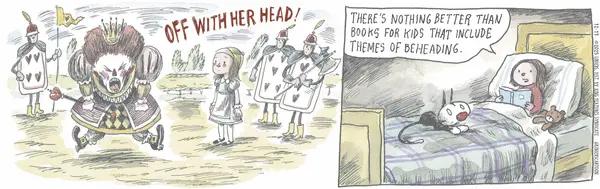
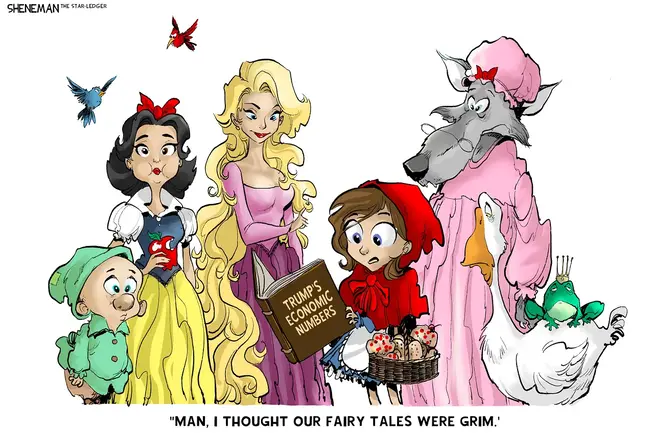
Liniers features a story written in the 19th, not 14th, century, but it’s only in recent years that we’ve turned away from harsh lessons in children’s literature, and it should also be noted that the folktales collected by the Grimm brothers were not intended solely for children but captured themes that applied to the entire community.
As, for that matter, did Alice, though Carroll did write for kids.
Life was real in those days, when illness could carry someone away in a day or two and poverty was not always assuaged either by guilds or by the church. Stories regularly featured death and disfigurement because “happily ever after” was not guaranteed and often seemed unlikely.
Today we soften the lessons, even if, as Sheneman suggests, it requires lying to people in order to make them feel everything is for the best in this best of all possible worlds.
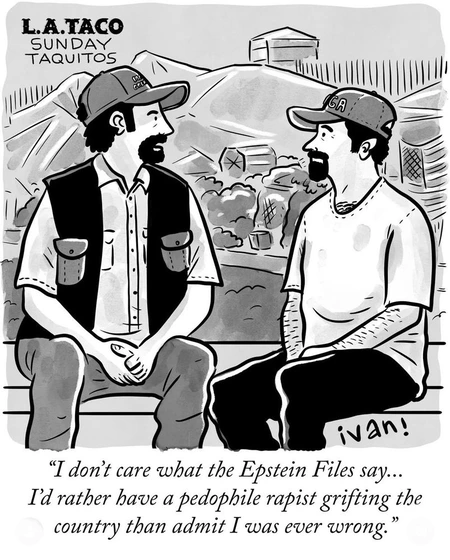
Voltaire considered such optimism absurd in the face of real life, but, as Ehlers points out, that doesn’t mean some people aren’t eager, against all evidence, to embrace it.
Comments 11