CSotD: A Sunset in the East
Skip to comments
In case you missed it, the world has shifted, and, as Eliot predicted, not with a bang, but a whimper.
A bang you would have noticed, and perhaps resisted. A whimper sneaks up, and yet, once it is in place, you wonder how you could have missed it before. Or perhaps you don’t, which is why a whimper is not resisted.
After all, this phrase has been floating around for most of the past decade:
If you’ve ever wondered what you would have done in Germany in the 1930s, you’re doing it now.
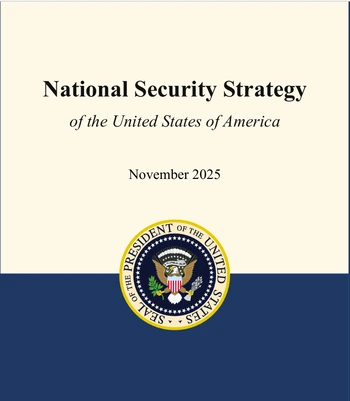
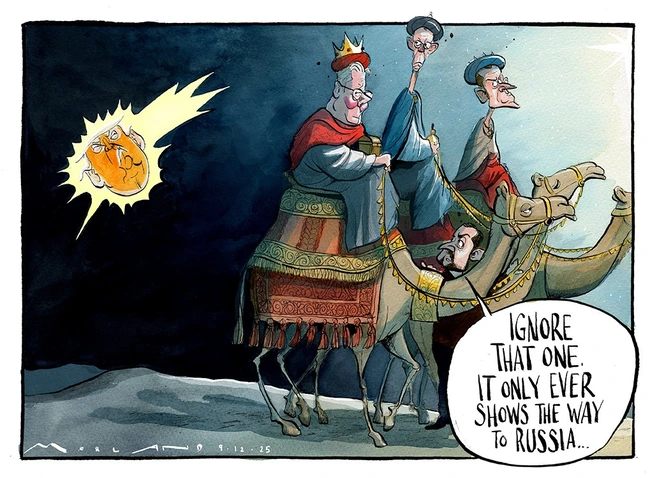
For a quick explanation of Morland’s cartoon, Charlie Sykes offers a rundown under the headline Trump Just Put The Quiet Part in Writing, matching our new National Security Strategy with the warning signs we should have seen and how they have now burst upon the stage.
In Morland’s cartoon, the Wise Men of Europe are giving up following the American star, because, as Zelensky warns them, it leads only to Moscow.
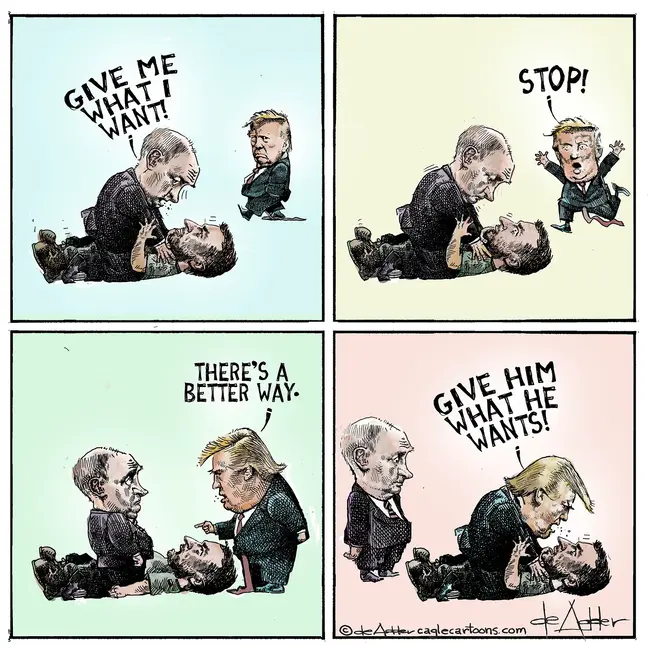
De Adder reflects the shift in policy under which Trump has adopted Putin’s point of view in ending the war in Ukraine, which seems to involve Zelensky giving up the territory Russia has seized. Perhaps this should have been obvious in the White House bullying of Zelensky, but enough people passed that off as a momentary lapse of good manners that they can still be shocked to see Trump proposing a surrender.
But in retrospect — and the point is, much of American foreign policy must suddenly be seen in retrospect — the demand that NATO members increase their funding was the first rumble of a move to desert the post-WWII established concept that America and Europe would stand together.
Under the new system, Europe stands alone, and is warned that allowing non-Europeans to dwell there endangers destroying its culture, just as the United States is working to eliminate voices from its own shores that don’t reflect its approved culture. It’s not just political isolationism but a clearly-stated intention to establish ethnic purity.
As Noah Berlatsky writes on his Public Notice Substack, you don’t need a weatherman to know which way the wind blows. You only have to see the blatant, open racism of Trump’s attacks on Somalis, highlighted by his illogical connecting of a lone Afghan shooter with a major, totally unrelated immigrant group in a completely different part of the country.
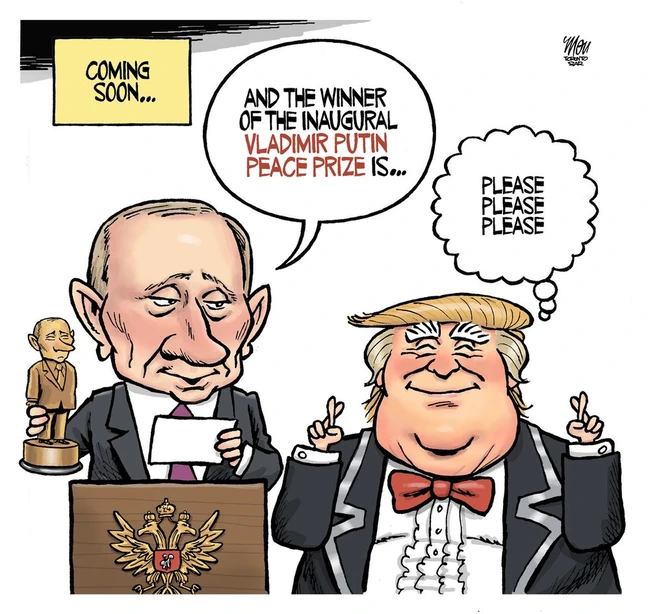
The Russians are thrilled.
Sykes quotes Putin’s press secretary, Dmitri Peskov, on the new approach, “The adjustments that we see correspond in many ways to our vision,” which is extremely out-front from a country that tends to play its cards close to the vest.
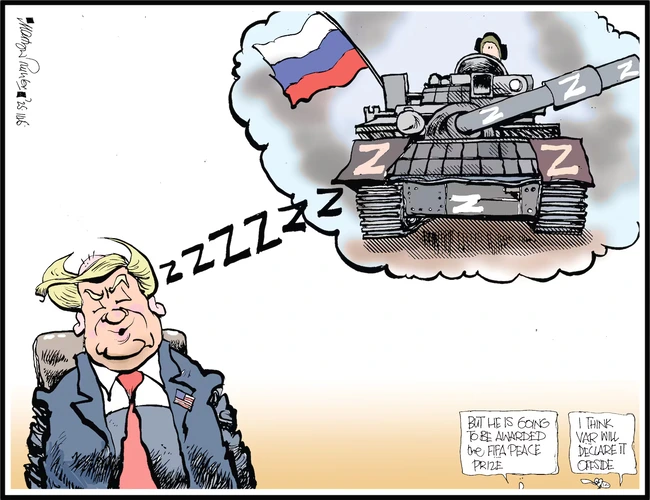
And while Moudakis mocks Trump’s eagerness for awards and his appetite for flattery, Turner focuses on his obvious envy and embrace of dictators he sees as strong and decisive.
Turner centers on Putin, who is certainly at the top of that list, but it’s important to recall Trump’s admiration, for instance, for Victor Orban, his championing of convicted Brazilian leader Jair Bolsonaro and his pardoning of Honduran president and cocaine dealer Juan Orlando Hernández, the latter case being an odd conflict with his previous praise for the way China and the Philippines execute drug dealers without trials.
However, the extent to which the new system depends on Trump’s personal foibles may be a passing factor.

With or without Donald Trump, the abandonment of the post-Cold War stance in which the US championed a face-off between Western Europe and the remains of the Soviet Union is good news for the Russians, while the idea of going back to a system based on “spheres of influence” seems yet another example of fanciful 19th Century Gilded Age thinking in which tariffs substitute for income taxes, and gunboat diplomacy substitutes for the diplomatic approach of a nuclear world.
Sykes and Berkatsky offer bite-sized summaries of this New World, but the Brookings Institute provides a series of more diverse and in-depth examinations of the shift, including a potentially intimidating look at what is being called “A ‘Trump Corollary’ to the Monroe Doctrine” that won’t help you sleep at night:
Although the NSS decries forever wars, its insistence that the United States can deploy the U.S. military for conducting strikes against “cartels” (not just criminal groups designated as foreign terrorist organizations) anywhere in the hemisphere (and eventually perhaps beyond it), unleashes a potentially true forever war. The assertion that the U.S. military can strike other countries also contradicts the strategy’s embrace of the sovereignty of nations.
Clearly, parts of this new approach are already falling into place, though another essay in the Brookings wrap-up suggests that there is many a slip twixt cup and lip:
Having helped craft several such documents in the past, I am acutely aware that they offer little operational guidance to foreign policy practitioners. They are less strategies than barometers of countervailing pressures within a particular administration. They are often cut-and-paste jobs; when different agencies fight to preserve their favored words, coherence goes out the window. They are also typically unmoored from any budgetary realities.
Which seems to only promise delay while the details either fall into place or are cast aside, leaving us to face the familiar notion that clowns with flamethrowers may be clowns, but they still have flamethrowers.
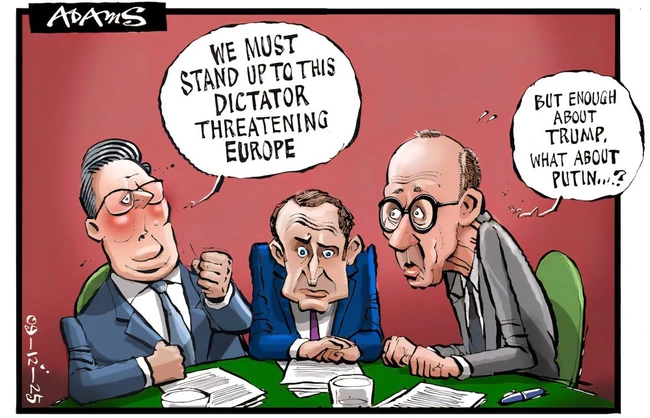
American cartoonists haven’t begun to respond to the major announcement, focusing instead on the specific attacks in the Caribbean, but Adams is among several European-based voices suggesting that Western nations deal with this new reality before this new reality deals with them.
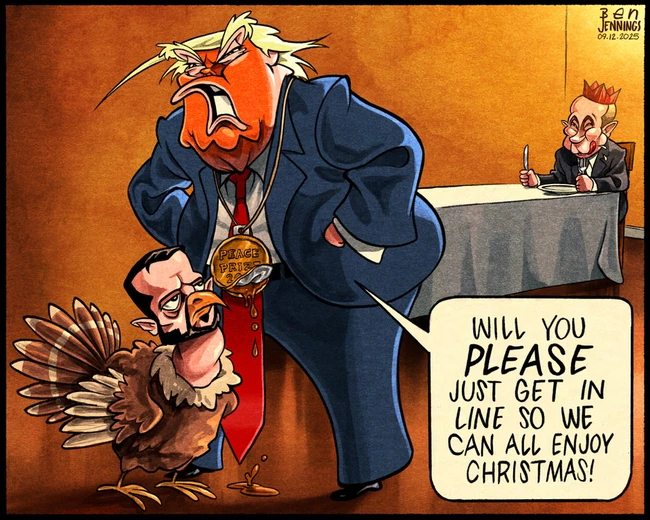
That new reality is already dealing with Ukraine, and Zelensky is having to face the fact that Trump is on Putin’s side. Zelensky is meeting with European leaders, who may not be in a position to offer the same level of backing as the US did, but could unfreeze enough seized Russian assets to support Ukraine for two years, if they can agree that something must be done.
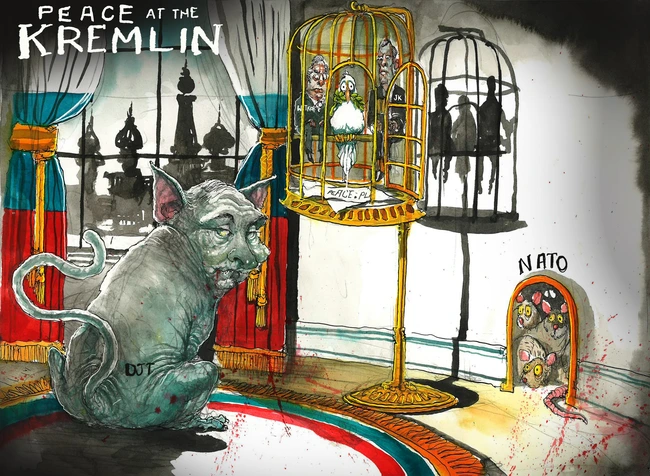
While they squabble to come up with a plan, the cat is willing to wait.
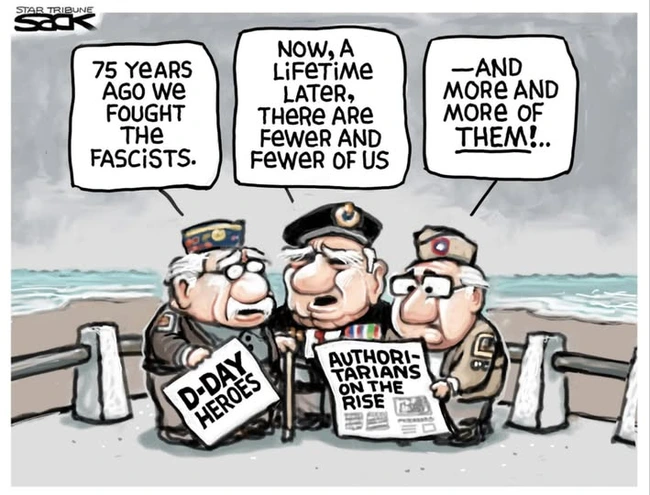
Steve Sack has stepped out of retirement to run some of his favorite classics on a Substack.
But younger voices must keep their leaders firmly under control.

Comments 1
Comments are closed.