“The Marvellous Alison Bechdel”
Skip to comments
Dykes to Watch Out For, a widely syndicated strip cartoon series, ran from 1987 to 2008, ending only after [Alison] Bechdel achieved success with her first graphic memoir, Fun Home: A Family Tragic Comedy, later made into a Broadway play. Fun Home was followed by Are You My Mother? A Comic Drama (2013), then The Secret to Superhuman Strength (2021) and now Spent: A Comic Novel (2025). All these, leavened by a dry, mocking wit guaranteed to detonate outbursts of laughter throughout, retained the loyalty of her early readership while aiming to bring in a more broadly based following.
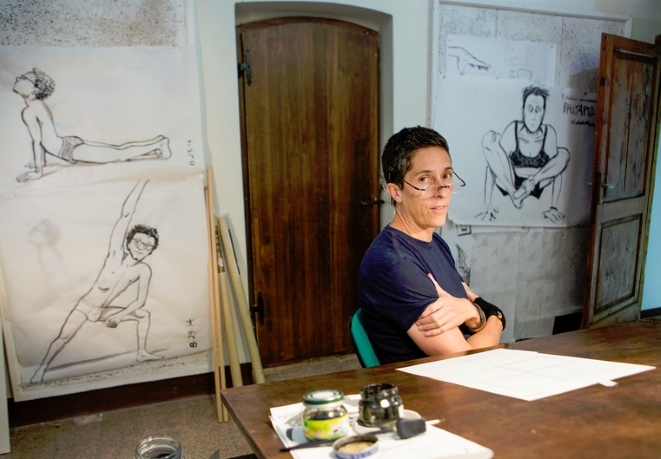
Iain Topliss at Inside Story pages through the graphic novels of Alison Bechdel and allows us to follow him as “the attempt of a straight male reader to bring himself up to speed.”
Fun Home, about childhood and coming of age, refers throughout to James Joyce’s Ulysses. The book’s central character, a sort-of Leopold Bloom to Bechdel’s sort-of Stephen Daedalus, is her talented, practical, polymathic, domineering father, a compulsive preceptor and DIY expert, who along with much else runs the family funeral home, the “fun home” of the title, part-time.
Are You My Mother?, although subtitled “a comic drama,” is in fact a sombre work about Bechdel’s fraught relations with her mother.
Both these books are printed in black and white. By contrast, The Secret to Superhuman Strength (2022) is in full colour, and correspondingly more cheerful. It introduces Bechdel’s partner, Holly Rae Taylor, and extends the choice of literary pre-texts: Wordsworth, Coleridge, Emerson, Margaret Fuller, Buckminster Fuller, Gary Snyder and Jack Kerouac all make an appearance, with vignettes of episodes in their lives shuffled into a decade-by-decade account of Bechdel’s quest for physical self-improvement.
Spent, Bechdel’s latest work, is a very different book, more expansive, more enterprising, more forgiving about human quirks than its predecessors. It is a tightly woven semi-autobiographical comedy depicting small upsets and ructions in a rural bohemian idyll.
The review lingers longest on Spent.

Leaving gender issues aside for the moment, Bechdel’s success depends on her breathtaking skill as an artist. She gets maximum effect from the extraordinary flexibility of the graphic narrative form.
Alison Bechdel is published through Harper Collins/Mariner.



Comments
Comments are closed.