Around the Comic Strip Scene
Skip to comments
Returns
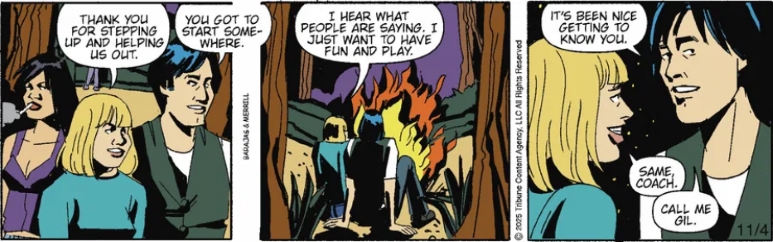
Note that regular Gil Thorp artist Rachel Merrill has returned to the strip this week, not to universal acclaim.
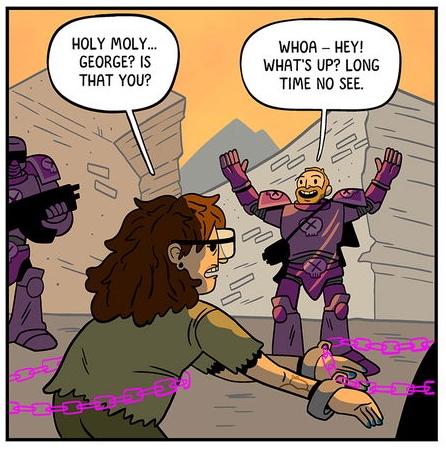
The GoComics Newsletter informs us that a half dozen cartoonists and their comic strips have returned.
After brief hiatuses, these creators have returned to GoComics and are actively updating their comics at least once a week. Let’s give a warm welcome back to:
“Worry Lines” [by Worry Lines]
“Bad Machinery: Solver” (the sequel to “Bad Machinery“) [by John Allison]
“Please Listen to Me” [by Mattie Lubchansky]
“Sweet and Sour Pork” [by Bob Holt]
“The Worried Well” [by Dana Maier]
“Cat’s Cafe” [by Gwen Tarpley]
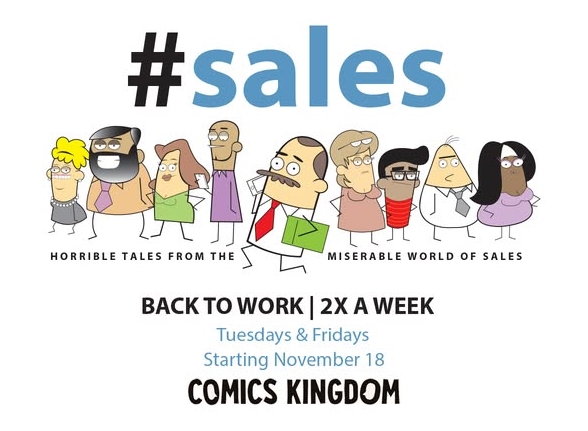
And over at the Comics Kingdom #Sales by Bill Bettwy is returning to new comics this month after some time in rerun status.
Four Equal Panels
Comic strip, and Peanuts in particular, historian Nat Gertler discusses the framing of Schulz’s strip:
For more than the first three decades of Peanuts, the daily strip was always four panels… well, no, that’s not quite 100% true, as I think of the August 31, 1954 daily strip of Patty jumping rope, but even that had panel breaks at the quarter, half, and three-quarter marks of the width of the strip. This was necessary to fulfill the original promise made to newspapers that Peanuts would be a strip that could be run as a square or as a vertical stack. (Alas, I cannot quickly find a vertical stacking of that jump rope strip, whether it’s four tiers of two panels or just one huge tower of eight.)
Update: With the help of a reader Nat did find the vertical strip.

When Schulz decided he could move the strip away from being reformatted, he didn’t give up on rhythm. His first move away from the old format was on Leap Day, 1988, and the strip was three panels of equal size…
Deep Dark Fears by Fran Krause also comes in four equal panels.
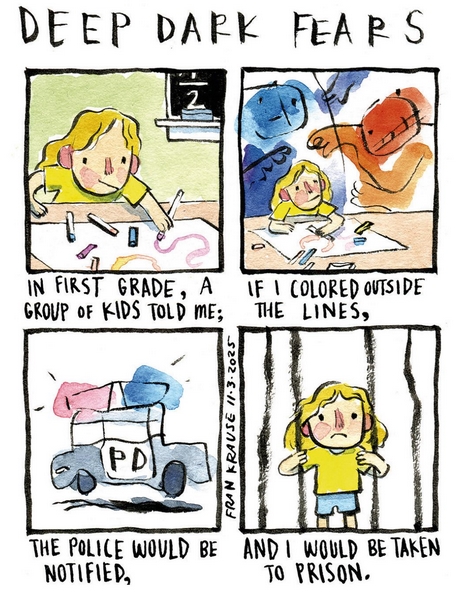
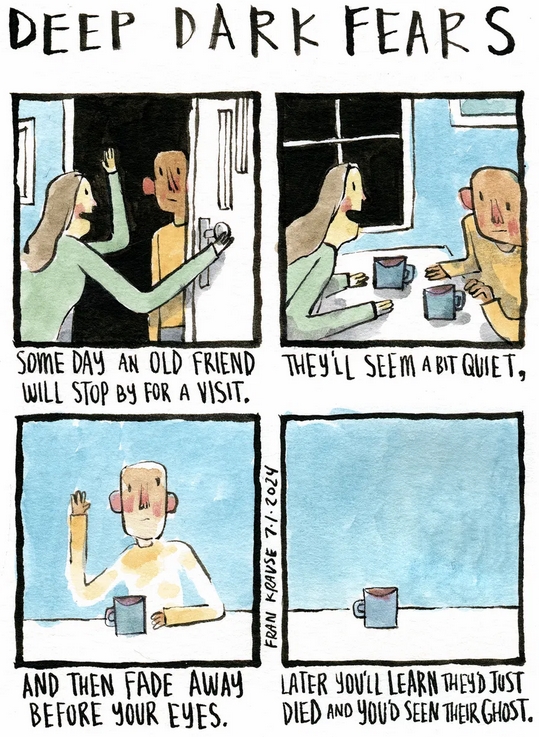
Comics has the wonderful ability to seamlessly flow between the imagined or metaphorical and the real. When reading a comic we take it for granted that a nauseous character may not actually be green even though we’re looking at a green-faced sailor. If you read a lot of comics, this might not seem remarkable, but the ability to see something drawn on a page one way and understand that in ‘reality’ it might be another, is really special. This cartoon alchemy lets us portray people’s internal experiences in ways no other medium can.
Tate McFadden for The Beat reviews Deep Dark Fears by Fran Krause.
The quaint but macabre swipe comic Deep Dark Fears by Fran Krause is an excellent example of this singular power. The series follows a simple four panel comic strip format: Panels One through Three are the setup and Panel Four is the punchline. But rather than gags, the setup describes the anxious foundations upon which an irrational fear, revealed in Panel Four, is built…
The Name Game
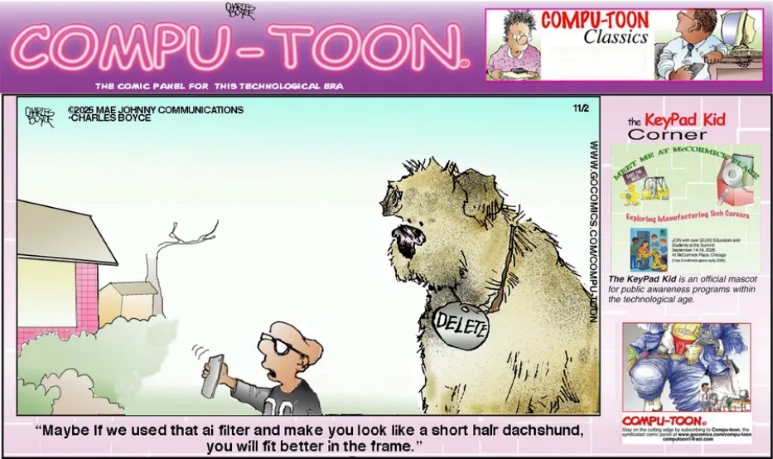
We all know that the name of the dog in Compu-toon is Delete, after all it is on his dog tag. But Joseph Nebus, who pays much closer attention to Charles Boyce‘s panel than I, recently learned of the boy’s name.
Anyway because I talk about Compu-Toon more than anyone else on the planet I want to have this where I might someday find it again. This Halloween’s comic reveals that the kid who hangs out with Delete the Comically But Not Too Preposterously Large Dog ‘Delete’, and the cockatoo ‘Broadband’? is…
Joseph promises to keep us apprised of any other characters’ names as they are revealed.


Comments 4
Comments are closed.