Singapore, Like the Rest of the World, Has Cartooning Problems
Skip to comments
Their take on life is different – sharper, more biting.
Through artful strokes, cartoonists illuminate, entertain and provoke, often leaving a lasting impression after the ink dries or the screen fades.
Their licence to wield humour like a knife for social or political commentary has earned them fans and critics.
Senior executive artist Lee Chee Chew, 58, knows this well. His long-running strip, Chew On It!, which began as Life’s Like This! in 1991, has chronicled everyday idiosyncrasies for three decades.
“I’m partial to doodling about things that I find exasperating, for example, littering and people who cycle on pedestrian walkways,” he says.

Shefali Rekhi considers the problems facing cartoonists in Singapore and includes a brief history of cartooning and their colonial roots as seen in The Straits Times.
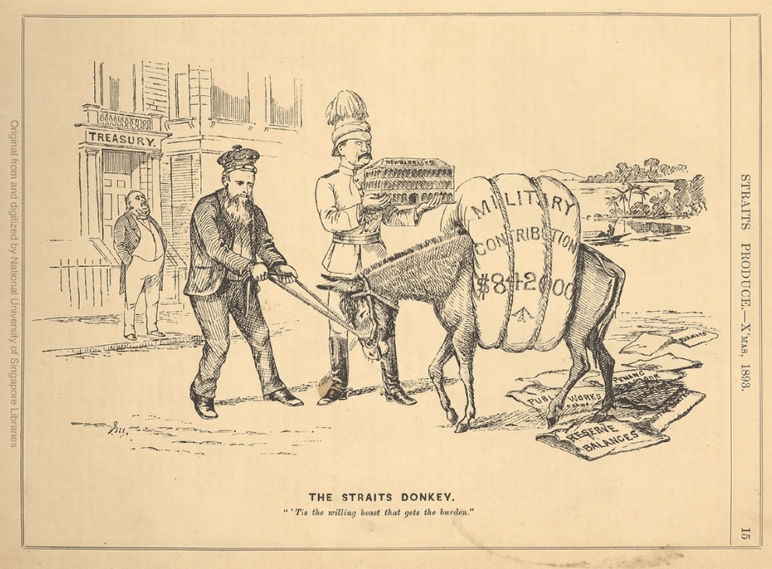
One of the earliest known satirical publications, The Straits Produce [link added], was published in 1868 and modelled on Britain’s Punch magazine. Printed by the Straits Times Press, it skewered colonial society and politics, but ceased publication in the 1930s.
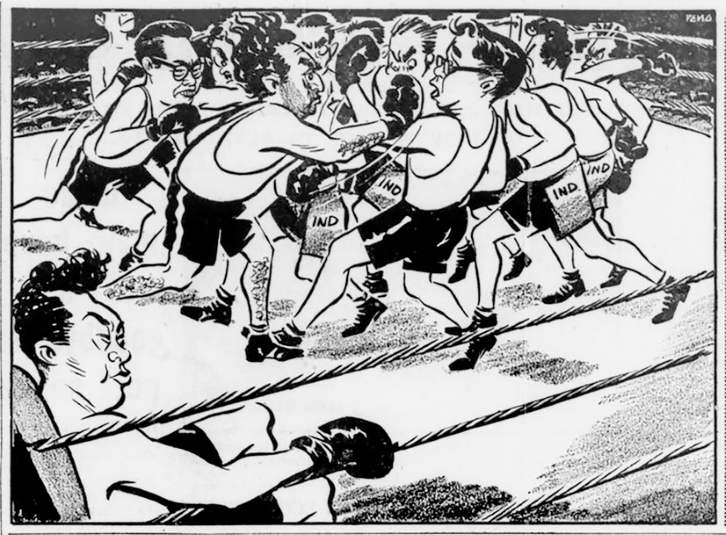
The Straits Times itself started featuring cartoons and caricatures in the 1930s, when the paper was under editor George William Seabridge. During his editorship from 1928 to 1942, Seabridge also increased the number of pages and introduced photographs, creating a visually more appealing product.
And the international syndication of American comic strips are also a part of the discussion:
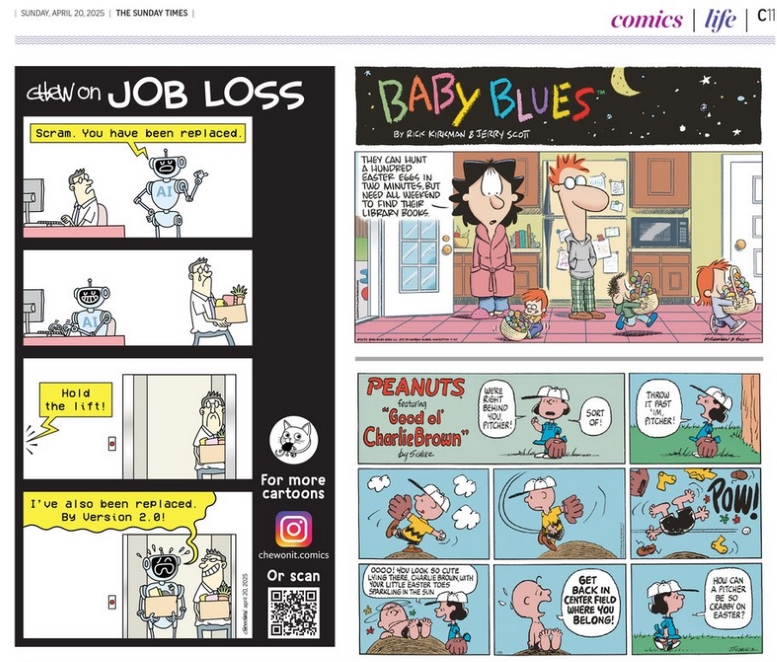
From around 1953, special pages in the Sunday edition of The Straits Times were devoted to syndicated comics. These early strips included The Cisco Kid, “your Wild West favourite”, the adventures of Tarzan, the misadventures of Blondie and her husband Dagwood, and Peanuts featuring Snoopy and Charlie Brown.
Over time, these comics adapted to the changing world. Blondie, for instance, evolved from a carefree flapper girl to a middle-class housewife who started a catering business. In the 1990s and early 2000s, syndicated strips like Calvin And Hobbes, Garfield, and Baby Blues struck a chord with readers.
Also brought to attention is the worldwide problem of digital media vis-a-vis editorial cartooning:
The rise of digital media has led to declining newspaper revenues globally, resulting in fewer opportunities for editorial cartoonists and the disappearance of many syndicated comic strips from print.
According to a 2012 study by The Herb Block Foundation, the number of full-time editorial cartoonists in American newspapers dropped from about 2,000 at the start of the 20th century to over 250 by 2000, and to fewer than 20 in locally owned outlets by 2023.
American cartoonist Rob Tornoe, writing in Editor & Publisher magazine, noted that in 2022, Australia’s two major media companies – News Corp Australia and Nine Entertainment – axed all comic strips from their publications.
McClatchy, a US media group, dropped editorial cartoons in 2021, citing changing reader preferences.
Cartoonist Lee says cartoons lose some of their impact on a smartphone screen compared with the large canvas of a printed newspaper page. He adds that the proliferation of digital content – from webtoons to manga – creates fierce competition for attention.
As for AI:
Artificial intelligence (AI) has entered the creative space with its ability to generate images. But artists remain sceptical of its ability to match human insights or wit.
Straits Times art editor Lee Hup Kheng, 62, says AI can imitate visual styles and churn out cartoon-like images and animations, but falls short of crafting original, personal cartoons that capture an artist’s voice, humour and life experiences.
“In editorial cartooning, the real magic comes from raw feelings like anger, frustration, happiness – real human emotions that machines just don’t have,” he says.
“A fellow cartoonist once told me, ‘AI lacks soul’. That’s the case. For now.”
And maybe a warning for American as the writer mentions the freedom and lack of same as authoritarian politicians put their thumbs on the freedom of the press then pressure was relaxed as more democratic regimes took power.
An aside:
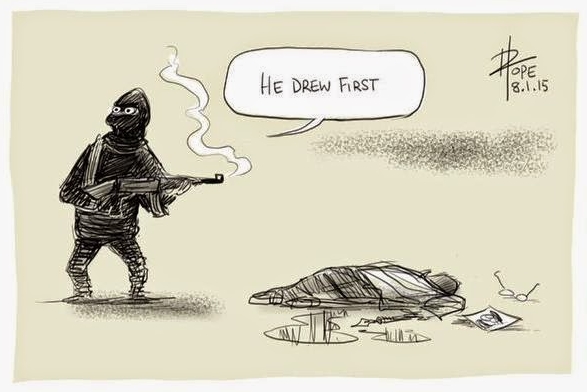
Shefali Rekhi quotes American newspaper editor Tom Plate from an opinion piece following the Charlie Hebdo shooting:
In an opinion piece in 2015 for The Straits Times, American journalist Tom Plate spoke about the editorial cartoonist’s “crazy mind that could twist a lance into your brain to make a point that you knew in your heart was true”.
As he explained in the article headlined “Cartoonists – the ‘mad men’ of journalism”: “At their lampooning best, which is when they are at their meanest, they hardly ever show any mercy – only respect for the truth… even if it is the truth as they see it.”
That piece can be read in full as published by the Columbia Daily Tribune in 2015.
LOS ANGELES — As the editor in charge of the opinion pages of newspapers in New York and Los Angeles, what was the hardest part of my job? Dealing with annoying, demanding bosses? Calming down angry readers? Smoothing the enormous egos of neurotic writers? No, that was the easy part.
The hard part was supervising the truly creative artist — the crazy mind that could twist a lance into your brain to make a point that you knew in your heart was true but mere writers somehow found impossible to capture quite so deftly.
Yes, I am talking about newspaper and magazine editorial cartoonists — truly the “mad men” of journalism.
In various positions at different U.S. newspapers, my job was to “supervise” them, an almost impossible task.
Make no mistake about it: At their lampooning best, which is when they are at their meanest, they hardly ever show any mercy — only respect for the truth … even if it is the truth as they see it. They don’t care how you see it. There are no soft edges to their work. And they know how to hurt. Sorry to say, but most of them enjoy it, at least the good ones with whom I worked…
However, in recent years, at US newspapers at least, the edgiest of them have retired, or been quietly retired.
The new crop seems, to me at least, tamer, even worryingly polite – more like genteel illustrators than the noisy but brilliant drunk at the family dinner table. The passion somehow seems to have diminished.
But not in Paris…


Comments
Comments are closed.